It’s disarming to talk to one of your favorite actors, who happens to be thoughtful, kind, humorous, and all the things you fantasize them being, but they are also, at that moment, playing the TV character you hate most on TV. Your inclination is to be angry at them. But, like, you love them.
A testament to Tony Goldwyn’s talent is how good he is on Hacks, playing the vengeful and petty TV executive Bob Lipka, who makes it his life’s mission to ruin Deborah Vance’s (Jean Smart) career.
“I keep playing these heinous characters,” Goldwyn told me, laughing. Given his big break was someone equally easy to despise, in the 1990 romantic blockbuster Ghost, this seems to be a calling for the actor, who, otherwise, at least during our conversation, is as devastatingly handsome as he is giggly and goofy.
“I don’t know if it’s my alter ego or something,” he said. “But it’s pretty fun to do.”
Goldwyn is the guest on the latest episode of Obsessed: The Podcast. It’s one of my favorite conversations, owed to how much ground we cover.
We dig into everything from the steamy sex scenes with Kerry Washington from Scandal continuing to go viral, his experience as what might be considered the ultimate Hollywood nepo baby, and one of his first-ever screen performances, the one that I revisit most often, playing a young man dying of AIDS on Designing Women. (The episode means so much to me that I nearly start crying when I start bringing it up to Goldwyn.)

He also has one of my favorite one-liners from all of the Obsessed: The Podcast interviews I’ve done. When I asked, because of Scandal, what it’s like to routinely be called “Mr. President,” he said: “Can I admit, Kevin? I’ve gotten used to it.”
Here are some highlights.
It’s been eight years since Scandal ended, yet my social media timeline features as many tributes now to Goldwyn’s President Fitz and Washington’s Olivia Pope and their libido-spiking scenes as ever. When the show started, Goldwyn had no idea that their, well, hotness would become this lasting cultural phenomenon. Here’s his take:
We had no idea. I mean, when we made the pilot, we all of us felt like, oh, this is good. Like, this works. And Kerry and I felt as actors that we had chemistry together. We just loved working together. And Shonda [Rhimes] wrote some pretty hot scenes. So we had a sense of humor about it, but I was completely shocked at what happened with it, that it became this huge thing. I swear to God, just like you say, every day people are talking to me as if [the show has] just come out. Now it’s like two generations of people are watching it as if it were a brand new show. Kerry and I laugh about it a lot.
Shonda Rhimes, who created Scandal, recently presented Goldwyn with a lifetime achievement award for his work at the charity Americares. So it was a good occasion to ask what he thinks the secret sauce, the “Shonda Rhimes of it all” is that makes her series command such passionate audiences. Here’s his best guess:
Shonda Rhimes is, first of all, one of the great writers right now. She creates these worlds that are absolutely fantastical and high octane. And yet she inhabits them with absolute emotional reality and human situations that every person, however lonely or in whatever circumstance, can completely relate to in their own life. Whether you’re talking about in the White House or in an emergency room of Grey’s Anatomy or whether it’s Bridgerton-land in 18th-century England, you just get sucked into these characters. And she makes them totally emotionally honest and real, and often with pretty hard-hitting social commentary. So you think you’re just eating popcorn, and you’re like, what did they just say? She’s really so unique in that regard.
Goldwyn is the grandson of Samuel Goldwyn, the film industry pioneer who essentially began the Hollywood studio system and produced the first U.S. motion pictures. That Goldwyn became an actor himself was perhaps an inevitability; essentially, he joined the family business. Now, however, we call that “being a nepo baby,” and Goldwyn may have been the original. But his take on it is so refreshing, to the point that he even has a podcast with his daughter, Far From the Tree, where they essentially interview nepo babies and their parents about it. Here’s why he never shied away from the conversation:
I feel the opposite about it. I had my struggles coming from a famous family. I’m the third generation of Goldwyns in show business. When I was in my twenties, it was really hard to get out from under the pressure of that. But I knew I had to kind of figure it out. What I discovered was that it was an absolutely beautiful thing to share that with my dad and my mother, and to feel that I was part of a legacy. I realized, wow, man, it’s not unusual at all throughout history that people come into the family business. I mean, it’s pretty normal if your dad’s a plumber or your mom’s a lawyer, there’s a good chance you’re going to go to law school—whatever it is that you do…It’s a very special thing. There are some people who say, you know what, I just want to get away from that, which I respect a lot, but, I found and and I find it to be very special.
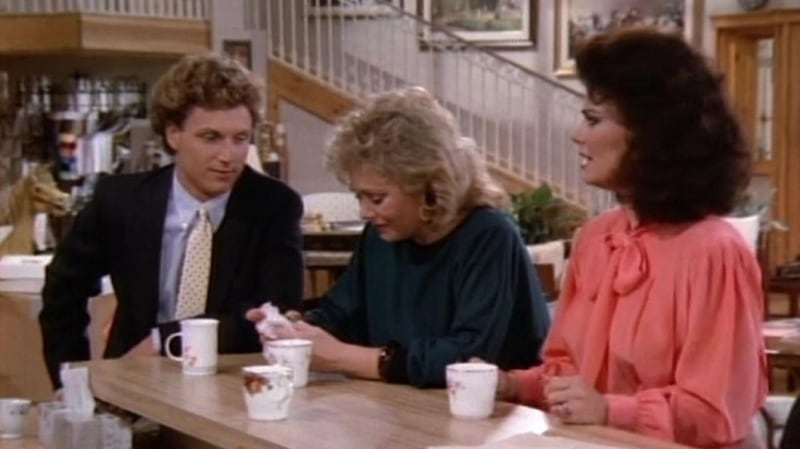
In 1987, the CBS sitcom Designing Women (which starred Jean Smart; full circle!) aired the episode “Killing All the Right People.” In one of his first screen appearances, Goldwyn played a young gay man dying of AIDS, who asks the firm to design his funeral. A bigoted client overhears this and lambasts that, as far as she is concerned, the disease is “killing all the right people,” aka gay men. It was the first time the subject was tackled in primetime. Here’s why Goldwyn wasn’t afraid to sign on:
I will tell you that in the ’80s, when I was considering it, people did say to me, “Are you sure you want to play a gay character? Because people will think you’re gay.” Another time, a few years later, when I was doing a play in New York where I played a gay character, they said, “This could hurt your career.” At that time, Ghost had just come out. Ghost was actually in the theaters, which was my first big break. And people were like, “You can’t play a gay character.” In both instances, [I thought] if this is a consideration, then I should not call myself an actor or an artist of any kind. If I’m not willing to do something that’s potentially controversial… So no, it never made me nervous. It made me angry to think that people think that. I felt lucky, honestly, to be doing it.