Oil executives and Venezuela experts alike are scoffing at President Donald Trump’s $100 billion scheme to ramp up oil production, casting doubt on whether the deal will yield meaningful crude.
The White House rolled out the arrangement this week, securing a 35 percent stake for the federal government in North American Blue Energy Partners, an oil outfit selected to drill in Venezuela.
“F--k all, what is this?” an anonymous high-ranking oil executive told Politico. “This thing is way too big for a company with no capabilities and no credibility.”
It is the latest instance of the Trump administration snatching an equity stake in a private enterprise. The agreement promises the U.S. “preferential access” to 20 percent of the oil harvested, strictly at cost.
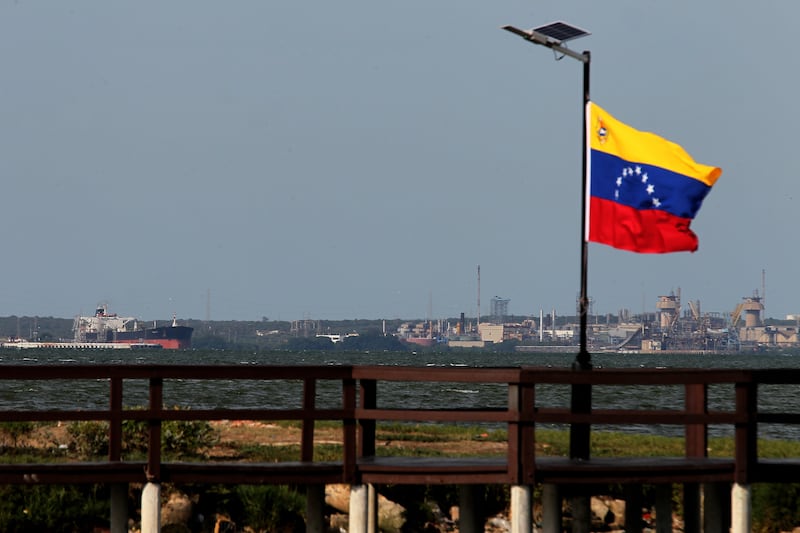
The private firm, known as NABEP, gets a 100-year lease for 17 Venezuelan oil fields containing roughly 65 billion barrels of reserves, according to a White House fact sheet. Beyond its 35 percent corporate stake, the U.S. gets a guaranteed 20 percent slice of production and right of first refusal for the rest.
Trump and congressional allies have hyped Venezuelan crude imports as a quick remedy for sky-high fuel prices hitting American voters after Trump started a war with Iran on Feb. 28.
Industry veterans are not buying the hype, warning that the targeted fields will take years to develop. They also appear to have little faith in the company being handed such a tall task.
“Investing in one company could be a starting point, but I think it needs a bigger approach,” said Alejandro Sucre, a Caracas-based investor pitching an energy and mining fund. “You’re not going to give 65 billion barrels of reserves to one company, right? That doesn’t make any sense.”
NABEP, a Barbados-registered company, has expanded into one of Venezuela’s largest private oil operators. Under the pact, it gets exclusive rights to develop 65 billion barrels across 17 fields, aiming to hit one million barrels a day.
In a statement, NABEP chief executive Alejandro Betancourt praised Secretary of State Marco Rubio and Defense Secretary Pete Hegseth for orchestrating the deal.
A source familiar with talks told Politico that Betancourt, Rubio, and Venezuelan interim President Delcy Rodríguez handled early negotiations before bringing in the Pentagon to bankroll it.
“In the end they needed financing, that’s why they went to the Pentagon,” the source said. “This was sold to the Pentagon on the basis that some of this oil would go to the U.S. SPR, therefore it’s going to be a net benefit to U.S. national security.”
Betancourt’s sudden starring role comes with massive baggage. He has been embroiled in a sprawling international money-laundering probe, with reports indicating Washington stepped in to shield him from a Swiss arrest warrant just to get him to the negotiating table.
The physical sites also appear to be a logistical nightmare. Nearly half the fields sit locked in the remote Orinoco Belt, isolated from coastal ports and lacking pipelines for extra-heavy crude.
An executive familiar with the terrain warned it would demand “a decade at minimum and hundreds of billions of dollars” just to ship the product.
A White House official told the Beast that “this is a company that already produces 250K barrels of oil a day.”
They added: “Because of the off-take rights, as soon as early next year, material production will be coming to the United States. If this company scales as we plan, we could be adding 50M barrels to the SPR every year. By the end of November, there will be at-cost oil flowing to the market to help bring down gas prices for the American people. It will rapidly scale over the next year.”
On the criticism the deal has faced, they added: “This is a deal with a private company–not the Venezuelan interim government.”