President Donald Trump is bragging—in graphic detail—about how his military just shattered his own ceasefire, while simultaneously claiming that the ceasefire is still in place.
Trump, 79, shared his confused thoughts in a Truth Social post Thursday shortly after the U.S. and Iran engaged in battle near the Strait of Hormuz.
“Three World Class American Destroyers just transited, very successfully, out of the Strait of Hormuz, under fire,” Trump began his 208-word social media screed. “There was no damage done to the three Destroyers, but great damage done to the Iranian attackers.”
Trump said that Iranian small boats were “completely destroyed” and “went to the bottom of the sea, quickly and efficiently,” before claiming that Iranian missiles were “easily” intercepted.
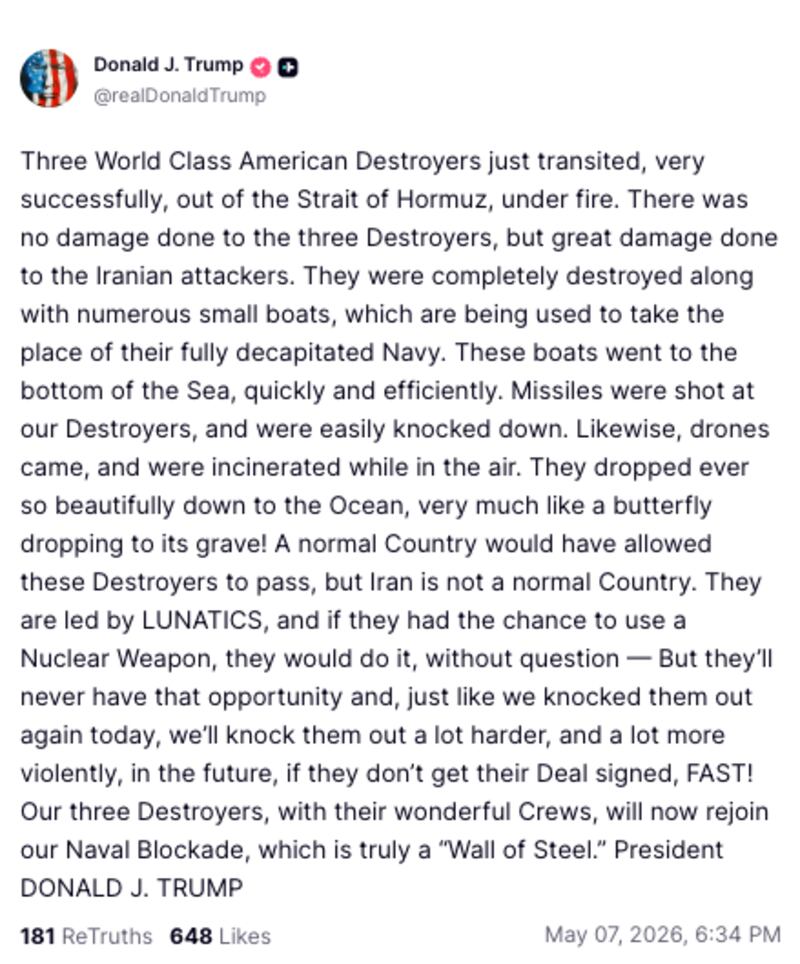
“Likewise, drones came, and were incinerated while in the air,” Trump continued. “They dropped ever so beautifully down to the Ocean, very much like a butterfly dropping to its grave!”
The president then said Iran was “led by LUNATICS” and threatened to “knock them out a lot harder, and a lot more violently, in the future, if they don’t get their Deal signed, FAST!”
“Our three Destroyers, with their wonderful Crews, will now rejoin our Naval Blockade, which is truly a ”Wall of Steel.“
The president told ABC News’s Rachel Scott in a phone call that the strikes, which U.S. Central Command said were retaliatory, were “just a love tap.”
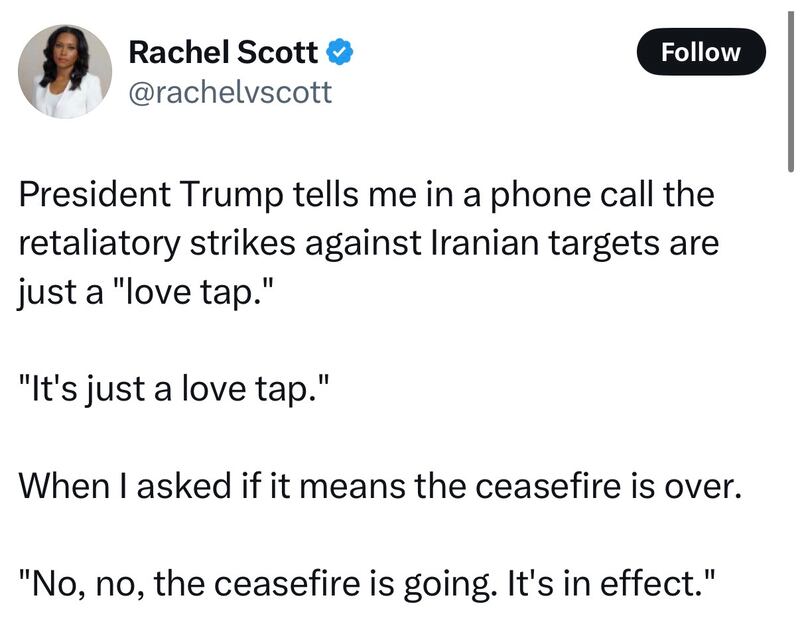
Asked whether the ceasefire was over in lieu of the strikes, Trump said: “No, no, the ceasefire is going. It’s in effect.”
A senior U.S. official told Axios that this was not a restarting of the war, but that both countries exchanged fire.
Reached for comment, the Pentagon and the White House referred the Daily Beast to a social media statement from U.S. Central Command.
The defense force said that “U.S. forces intercepted unprovoked Iranian attacks and responded with self-defense strikes,” and that no U.S. assets were struck.
Three U.S. destroyers, USS Truxtun, USS Rafael Peralta, and USS Mason, were targeted by Iranian missiles, CENTCOM said.
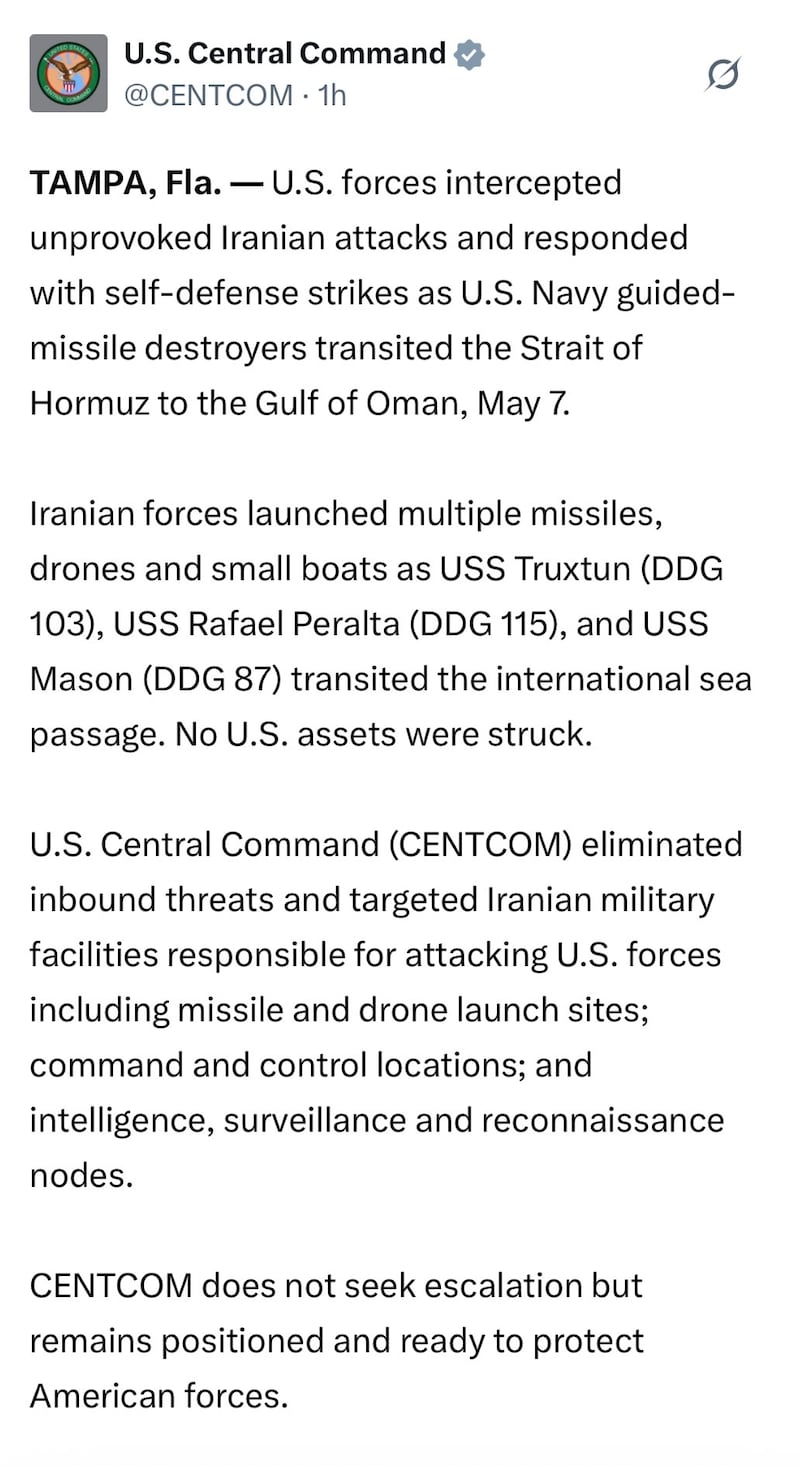
“U.S. Central Command (CENTCOM) eliminated inbound threats and targeted Iranian military facilities responsible for attacking U.S. forces including missile and drone launch sites; command and control locations; and intelligence, surveillance and reconnaissance nodes,” the statement read.
“CENTCOM does not seek escalation but remains positioned and ready to protect American forces.”
The State Department did not immediately return the Daily Beast’s request for comment.
The U.S. military conducted strikes on Iran’s Qeshm Port in the Strait of Hormuz and Bandar Abbas, as well as the Bandar Kargan naval checkpoint in Minabb, according to Fox News.
The terms of the fragile ceasefire agreement, first brokered on April 7 and then extended indefinitely by Trump two weeks later, include a fundamental commitment to non-aggression from the U.S. and controlled passage through the Strait of Hormuz coordinated by Iranian military forces, according to Al Jazeera.
Iran’s military accused the U.S. of violating the ceasefire and threatened retaliation, according to Reuters.
A spokesperson for the country’s Khatam al-Anbiya Central Headquarters said the U.S. targeted “an Iranian oil tanker traveling from Iran’s coastal waters near Jask toward the Strait of Hormuz, as well as another vessel entering the Strait of Hormuz near the Emirati port of Fujairah.”
“At the same time, with the cooperation of some regional countries, they carried out air attacks on civilian areas along the coasts of Bandar Khamir, Sirik, and Qeshm Island.”
The president told reporters later in the evening that “we took our three destroyers and we rammed them through some pretty big stuff today, and we knocked the hell out of them.”
“The destroyers weren’t hurt in any way, the people weren’t hurt, but they were firing at us, and we were firing back at them,” he said.
On Tuesday, Trump, 79, announced that he was putting his “Project Freedom” mission of protecting ships’ passage throughout the strait on hold, at the request of “Pakistan and other countries.”
The president’s initial announcement of “Project Freedom” on social media reportedly angered key regional allies, NBC News reported on Wednesday.
Saudi Arabia and Kuwait also restricted U.S. forces from accessing their bases after the U.S. downplayed Iranian attacks on the Persian Gulf earlier this week. However, the countries lifted their restrictions earlier on Thursday, according to the Wall Street Journal.