Poll Reveals Most Americans Think the Nation’s Divisions Can’t Be Overcome
Voters named polarization and democracy as their most pressing concerns.

Andrew Harnik/Getty Images
Americans are losing faith in the great experiment.
A new poll released Thursday reveals that most Americans believe the country is too far gone to overcome its deep divisions. Just a third of voters think the United States is still capable of solving its political problems, according to the survey from Siena University and The New York Times.
These responses stand in stark contrast to those from September 2020, when 51 percent of voters still believed Americans could unite to address their challenges—even in the midst of the COVID-19 pandemic. Now, in September 2025, that number has dropped to a harrowing 33 percent.
@nytimes/@SienaResearch poll: Views on the nation's direction remain underwater (RT 36, WD 58, NET-22), a stable trend. The partisan divide: 74% of Republicans say 'right track,' while 91% of Democrats say 'wrong track.' Independents also break 2-to-1 'wrong track' (63%) pic.twitter.com/FIwBaPkAsa
— Travis Brodbeck (@_TravisBrodbeck) September 30, 2025
“It is impossible now to have a policy discussion,” Amber Yang, 37, of Boston, told the Times. “There’s no consensus on the facts,” she added. “And when you can’t have a conversation, how do you even move forward?”
More than half of Americans—55 percent—still see the country as a democracy, according to the poll. But a growing portion—41 percent—disagreed.
Get the best of The Beast delivered right to your inbox
By clicking “SUBSCRIBE” you agree to our Terms of Use and Privacy Policy.
These results reflect the country’s deepening polarization, which few voters cited as a top concern until recently. Last October, less than one percent of voters named polarization and division as important issues ahead of the presidential election, surveys show.
Today, the majority of the 1,313 registered voters polled named polarization and the state of democracy as their most pressing concerns outside of the economy, outranking immigration, inflation, crime and more.
The poll was conducted between Sept. 22 and 27, according to the Times, following the high-profile assassination of conservative activist Charlie Kirk at a Utah university.

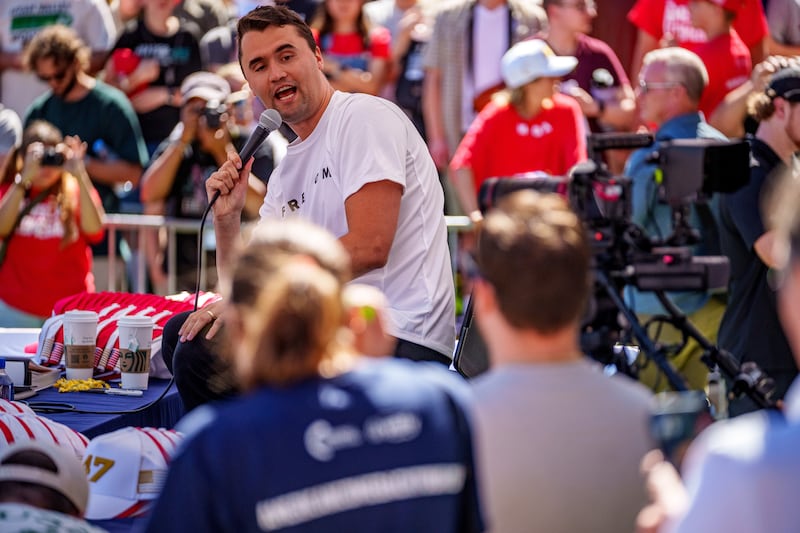
Charlie Kirk was speaking at his "American Comeback Tour" when he was shot in the neck and killed.
The Salt Lake Tribune/Getty Images
His killing was the catalyst for President Donald Trump and his acolytes to declare war on “the left,” turning tragedy into a political weapon.
It also follows a string of political violence and threats this year, including the arson attack on Pennsylvania Gov. Josh Shapiro’s residence, the murder of a Democratic state lawmaker in Virginia, the gunning down of a UnitedHealthcare executive, and more.
Trump himself narrowly survived an assassination attempt in July 2024, when a bullet grazed his ear during a rally in Butler, Pennsylvania.

Trump himself narrowly missed an assassin's bullet that grazed his ear at a rally in Butler, Pa., on July 13, 2024.
Rebecca Droke/AFP via Getty Images
The ripple effects of such events are clear: in April 2024, a PBS NewsHour/NPR/Marist poll showed that a fifth of U.S. adults believed Americans might have to resort to violence to get the country back on track.
A year later, that number had jumped to 30 percent, NPR reported.
Still, most Americans don’t—or at least don’t want to—see each other as enemies. The Times reported that just 10 percent of Democrats polled categorized Republicans as the enemy, a modest decline from 2024.
About 14 percent of Republicans named their political opponents as adversaries.
“Stuff has gotten out of hand,” Al Heymann, a Trump supporter from Louisiana, told the Times.
“It’s just pulling sides apart when we really need to come together to make things happen. But neither side wants to do that.”
See more of our coverage in your search results.

Got a tip? Send it to The Daily Beast here.
Register below to read this article for free or subscribe
to unlock unlimited access to The Daily Beast.
Monthly
$1
First month then $5.99/month
Annual
$35
First year then $59.99/year
Premium
$79
First year then $119.99/year
*Substack access provided by the next business day, using your subscription email. Choosing the Premium plan constitutes your permission to share your subscription email with Substack and your agreement to Substack’s Privacy Policy.
Already have an account? Sign In
Looks like you already have a subscription!
You're all set!
Thanks for subscribing.
Sign in or create an account
Login dialog
Loading comments…