
Vladimir Putin’s approval rating has suffered its sharpest weekly fall since launching his Ukraine war in 2022, as a worsening fuel crisis appears to have struck a nerve with Russians.
A poll conducted by the Kremlin-linked Public Opinion Foundation (FOM) between July 10 and 12 found that 66 percent of respondents approved of Putin’s performance as president, down from 71 percent just a week earlier, independent outlet Meduza reported.
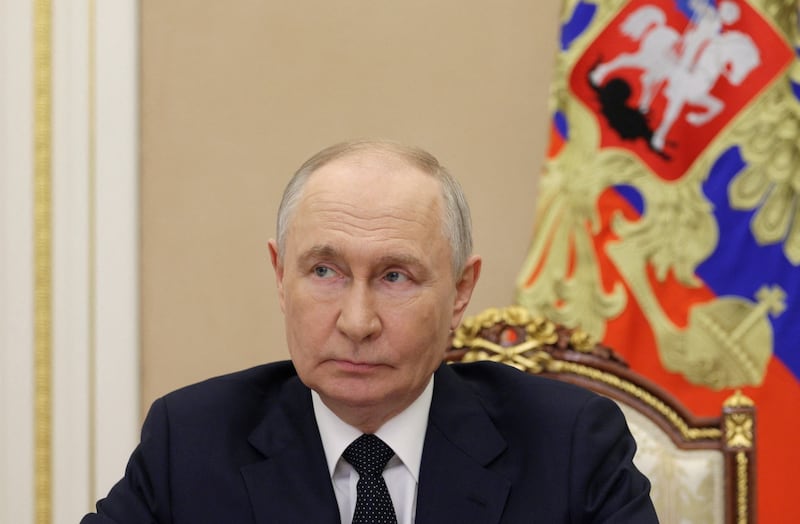
The 5-point drop marks the steepest weekly decline recorded by FOM since the fall of 2022, when Putin announced Russia’s partial military mobilization following battlefield setbacks in Ukraine.
Public trust in the Russian leader has also slipped. According to FOM, 67 percent of respondents said they trusted Putin, down 2 percentage points from the previous week. The figure was the least favorable recorded since the war began.
The slump appears to have been driven by Russia’s deepening fuel crisis. For a second consecutive week, respondents named fuel shortages—not the war—as the country’s biggest problem. Nineteen percent said Russia’s fuel shortage was the nation’s most pressing issue, compared with 18 percent who pointed to the war in Ukraine and 14 percent who cited attacks on Russian territory.
More than four years into Putin’s invasion of Ukraine, Kyiv’s relentless attacks on Russian oil refineries are increasingly being felt far beyond the front lines. Despite being the world’s third-largest oil producer, accounting for more than 12 percent of global crude oil production, Russia has struggled to produce enough fuel to meet domestic demand.
Wholesale fuel prices have climbed, rationing has been introduced in several regions, and videos circulating on social media show motorists waiting in long lines to refuel in Moscow.
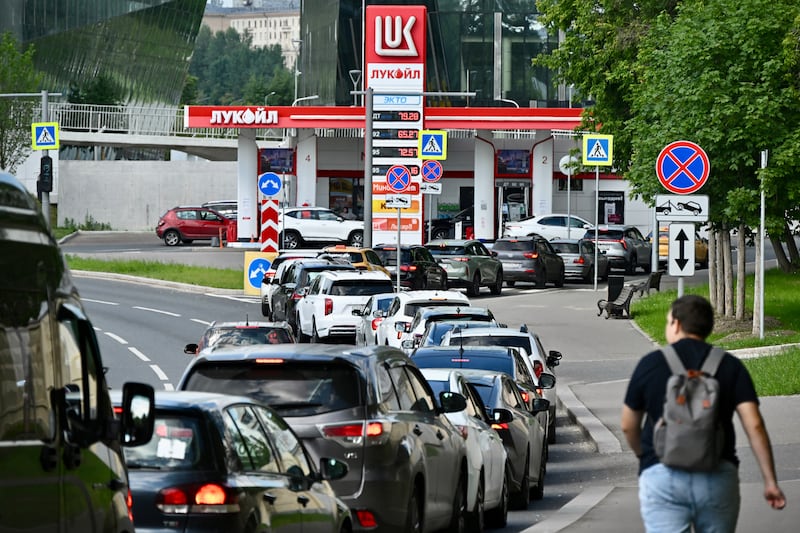
The fuel crunch strikes at the heart of Russia’s wartime economy. Oil exports and the broader energy sector account for roughly 30 percent of Russia’s budget revenues and remain critical to financing the war in Ukraine. At the same time, the industry has faced sustained pressure from Western sanctions imposed following Russia’s full-scale invasion in February 2022.
Putin acknowledged the problem in June in a rare public admission of weakness.
“As for strikes against critical infrastructure in general, and energy infrastructure in particular, of course, these attacks on our infrastructure facilities create problems,” the Russian leader said in an interview published by the Kremlin. “That’s obvious.”
“Right now we’re observing a certain shortage, but it’s not critical,” Putin added.
Behind the scenes, the crisis appears to have sparked a scramble among Russia’s regional leaders.
Independent outlet Verstka, citing regional and federal officials, reported that governors have not been allowed to source fuel independently and instead must rely on allocations approved by Moscow.
Authorities “are left alone with an enraged population” amid the fuel crisis, and now “are forced to act independently,” an official told the outlet.

One Siberian vice governor told the publication that regional authorities’ job had effectively become “mitigating social unrest,” while officials competed for extra fuel supplies by calling in favors with their connections in Moscow.
Some regions have resorted to unusual rationing schemes. In the Oryol region, drivers with odd-numbered license plates can fill up only on odd-numbered days, while even-numbered vehicles must wait for even dates.
Researchers have long warned that polling in authoritarian states can understate public dissatisfaction because citizens are often afraid to answer questions about the government. In Russia, laws introduced in March 2022 made criticizing the military and the war in Ukraine illegal. Many are believed to answer public opinion polls dishonestly, for fear of retribution.