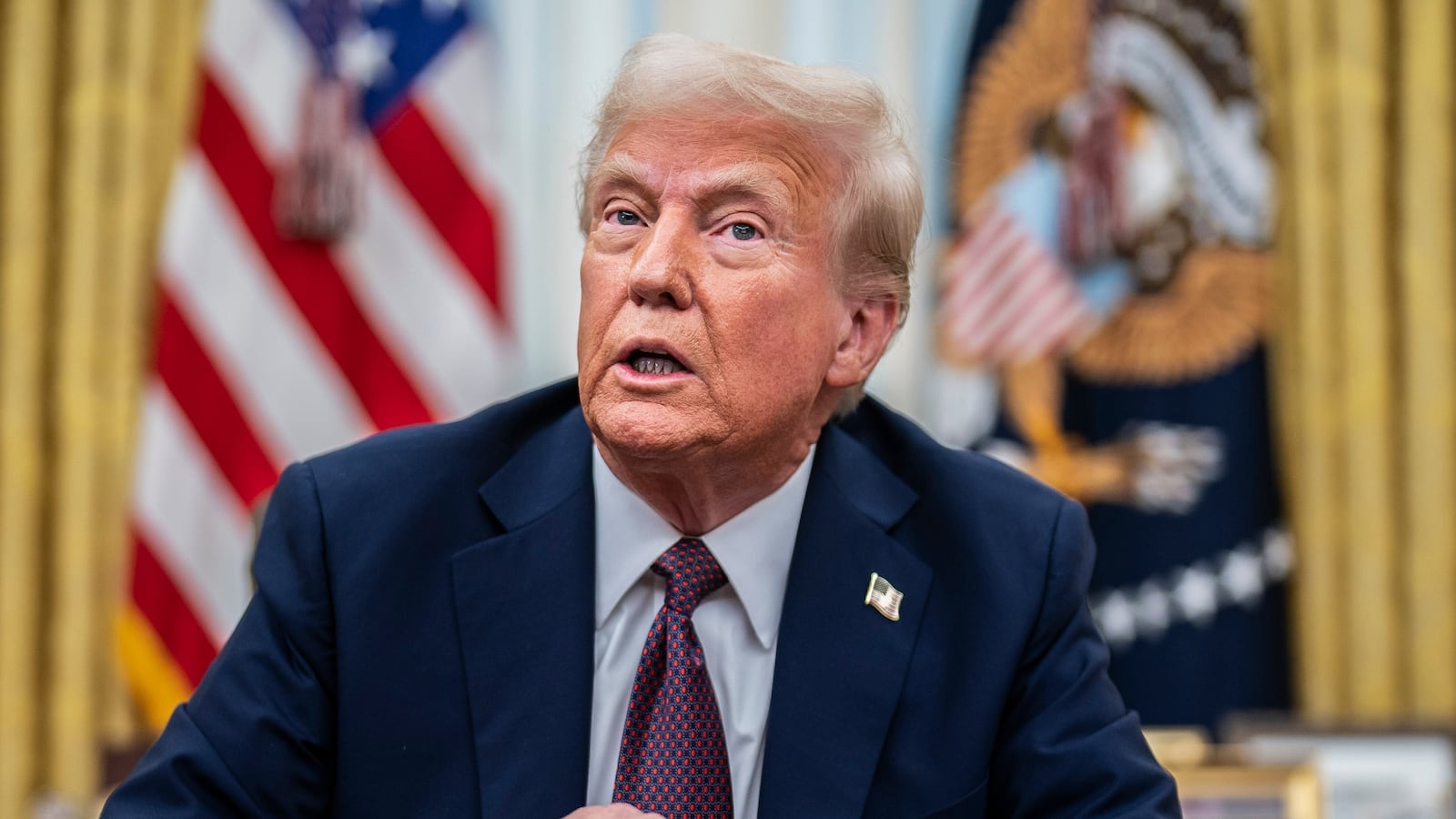
President Donald Trump has blown up at a traditional ally after its leader was mean about his war in Iran.
German Chancellor Friedrich Merz got into the president’s crosshairs on Monday when he said Washington “quite obviously went into this war without any strategy,” and that “a whole nation is being humiliated by the Iranian leadership, especially by these so-called Revolutionary Guards.”

“He doesn’t know what he’s talking about!” Trump fumed on Truth Social the day after. He added another rebuke on Wednesday, and he is clearly still stewing over the 70-year-old’s comments days later.
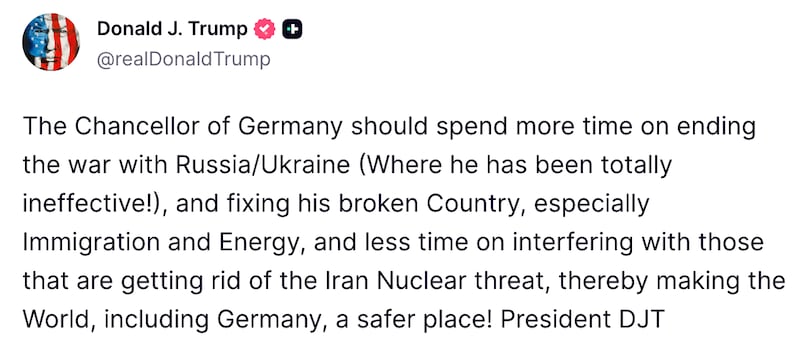
Referencing another war, one that he said he would solve on day one of his presidency, Trump on Thursday fumed, “The Chancellor of Germany should spend more time on ending the war with Russia/Ukraine (Where he has been totally ineffective!), and fixing his broken Country, especially Immigration and Energy, and less time on interfering with those that are getting rid of the Iran Nuclear threat, thereby making the World, including Germany, a safer place! President DJT.”
Merz set up Trump’s three-day spiral while speaking to students in the town of Marsberg, in North Rhine-Westphalia, on Monday.
“The Iranians are clearly stronger than expected, and the Americans clearly have no truly convincing strategy in the negotiations either,” Merz said.
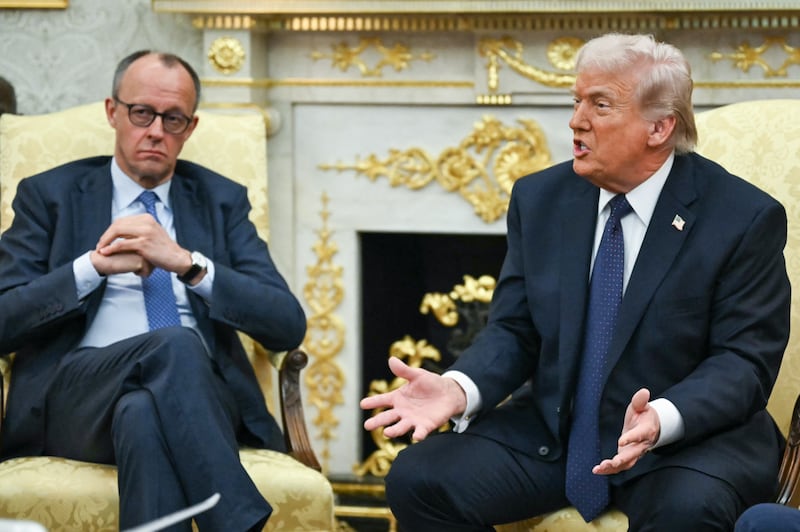
He then drew a parallel with America’s past Middle East conflicts. “The problem with conflicts like this is always: you don’t just have to get in, you have to get out again,” he said. “We saw that very painfully in Afghanistan for 20 years. We saw it in Iraq.”
In response, Trump claimed in his Tuesday Truth Social post that Merz “thinks it’s OK for Iran to have a Nuclear Weapon.” Merz hasn’t said that.
Meanwhile, negotiations to end the conflict have stalled over Iran’s reluctance to acquiesce on nuclear measures, and because of Trump’s ongoing blockade of the Strait of Hormuz, a vital shipping channel that links Gulf energy to the rest of the world.
Merz has been an outspoken Trump critic. At February’s Munich Security Conference, he said there was now “a deep divide” between Europe and the U.S. because of the tantrum-prone U.S. president.