
House Republicans left Washington, D.C. for a seven-week pre-midterms recess this week, but not before one of their own predicted disaster in blunt terms.
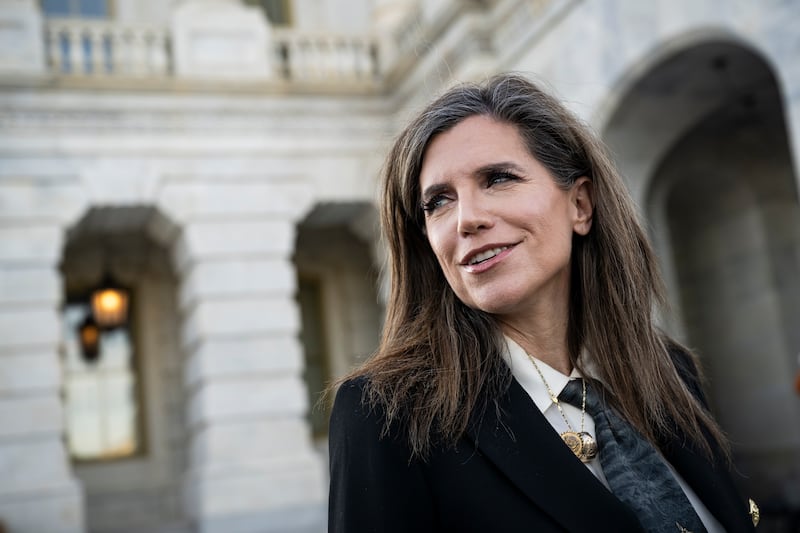
“The midterms are going to be a f--king bloodbath,” Rep. Nancy Mace of South Carolina told reporters at the Capitol.
Mace, who is not returning to Congress next year after a failed run for governor, made the comment as her party scrambled through a week of visible anxiety over the rising cost of living.

Seven Republicans broke ranks to vote for a resolution rebuking President Donald Trump’s war in Iran, three more than any previous vote on the conflict. Mace joined with her GOP colleagues Rep. Tom Barrett (Michigan), Rep. Warren Davidson (Ohio), Rep. Brian Fitzpatrick (Pennsylvania), Rep. Thomas Massie (Kentucky), Rep. Mariannette Miller-Meeks (Iowa), and Rep. Zach Nunn (Iowa) in supporting the resolution.
Other GOP members made an unsuccessful last-minute push to suspend the federal gas tax, and one of the House’s final votes of the week targeted utility costs tied to data centers.
The economic backdrop is grim for the party as the Iran conflict has pushed gas and diesel prices to record levels in parts of the country, growing anxiety over AI infrastructure is driving up electric bills, and a new Federal Reserve interest rate hike is weighing on borrowing costs.
Republican Rep. Rich McCormick of Georgia said he expects a “close” election and understands why colleagues pushed for more action. “This is about the time where people start paying attention,” he said. “And there’s only so much you can control.”
Republican Rep. Mike Simpson of Idaho put it more starkly. “You can’t deny what people feel,” he said. “We make a mistake if we go and say the fundamentals of the economy are great, and they really are. But that doesn’t help if you can’t afford gas or you can’t afford groceries or you can’t afford a new house.”
Two of the seven Republicans who voted against the Iran war effort, Nunn and Miller-Meeks, represent Iowa, where spiking fuel prices have hit the agriculture industry hard.
“I will not vote to keep our soldiers in an open-ended war, with Iowans paying too much at the pump,” Miller-Meeks said in a statement. Fellow Iowan Ashley Hinson, who is running for the Senate, announced the same day she would skip a rally with Vice President JD Vance, citing a scheduling conflict.
Mace cited the war’s “financial consequences” in explaining her vote to CNN, saying, “I voted my conscience.”
Some Republicans are now openly worried their fate is tied to a president whose approval rating has sunk to one of the lowest of any commander in chief.
“I’m fearful that the president’s numbers are a ball and chain that will be hard to overcome,” Rep. Don Bacon of Nebraska, a moderate not seeking re-election, told The New York Times earlier this month.
“I’m worried that we’ve lost a lot of our swing voters. In the Midwest, tariffs aren’t popular. Ukraine polls at 70 percent, why aren’t we doing more for them? Nebraskans don’t like chaos and all the name-calling and treating our allies bad.”
Election analyst Nate Silver said Republicans’ failure to close the polling gap since Labor Day may already be decisive, pointing to Democrats’ roughly 8.5-point lead as evidence a GOP rebound is increasingly unlikely this close to November.
Silver said the trend matched what his forecast model had already flagged: likely voter polling was tilting toward Democrats. RealClearPolling’s mid-September average puts the Democratic lead over Republicans on the generic congressional ballot at 8.6 points.