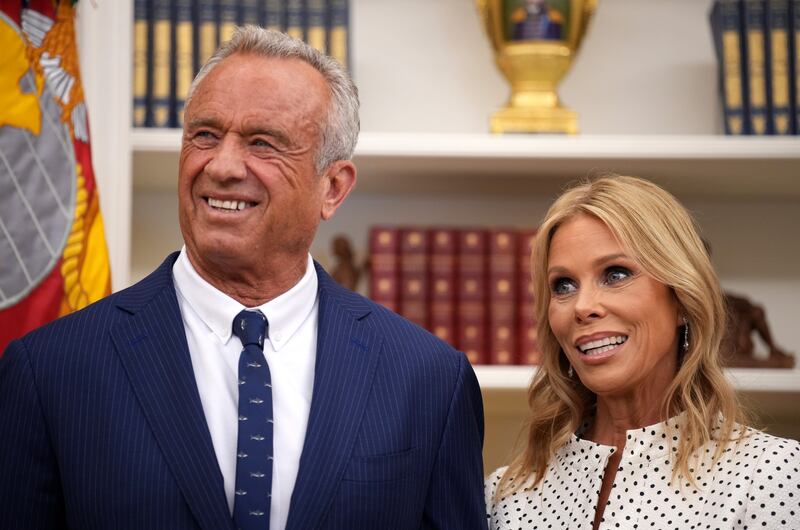
Robert F. Kennedy Jr.’s wife says her husband’s lack of medical expertise is not a concern in his role overseeing the nation’s health and well-being.
Cheryl Hines appeared on Fox & Friends on Monday morning, where she addressed backlash to her husband’s appointment as the Trump administration’s Health and Human Services secretary.
“For whatever reason, people have been coming after Bobby, saying he wasn’t qualified because he wasn’t a doctor,” Hines said. “And I just wanted to point out that 90 percent of the [Health and Human Services] secretaries have not been doctors. And one of them was an economist.”
While it’s true that many HHS secretaries in the past have not been physicians, most of the outrage over Kennedy’s appointment has been due to his anti-science beliefs and stance on vaccines rather than his lack of a medical background.
Kennedy’s blatant disregard for widely accepted scientific truths, including his vehement anti-vaccine stance and propagation of debunked conspiracy theories like chemtrails, has caused an uproar among medical professionals.
In April, the American Public Health Association released a statement calling Kennedy and his policies a “danger to the public’s health,” decrying his mass firings of staff at the Centers for Disease Control and Prevention and the Food and Drug Administration.
The APHA and other public health groups have cited his efforts to cut $11 billion in funding to state and local public health, his refusal to recommend vaccination in the wake of a measles resurgence, and his promotion of therapies unsupported by scientific evidence as grounds for his removal or resignation, among other policies and actions.
“Americans deserve better than someone who is trying to impose his unscientific and judgmental view of public health and science,” APHA Executive Director Georges C. Benjamin, MD, wrote in the statement.

“As a physician, I pledged to first do no harm and to speak up when I see harm being done by others. I ask my colleagues to join me and speak up,” Benjamin continued. “Secretary Robert Kennedy is a danger to the public’s health and should resign or be fired.”
Kennedy’s actions in office have proven their concerns warranted.
On Friday, the HHS secretary’s Advisory Committee on Immunization Practices (ACIP) voted to end the recommendation that all babies get vaccinated for Hepatitis B—a decision that reverses 34 years of medical precedent.
ACIP, which consists of at least three known vaccine skeptics appointed by Kennedy, voted 8-3 to pass the new guidelines, and it will be up to Kennedy’s HHS deputy, acting CDC Director Jim O’Neill, to pass or reject them.
Outrage over the decision was widespread across the political spectrum, with GOP Sen. Bill Cassidy calling it a “mistake.”
“The hepatitis B vaccine is safe and effective,” Cassidy wrote on X. “The birth dose is a recommendation, NOT a mandate. Before the birth dose was recommended, 20,000 newborns a year were infected with hepatitis B. Now it’s fewer than 20.”
Kennedy and President Donald Trump also sparked an uproar in September after holding a press conference to claim that the widely used pain-reliever acetaminophen, commonly known as Tylenol, should not be used by pregnant women because it increases the risk of autism in their children.
“Anyone who takes this stuff during pregnancy, unless they have to, is irresponsible,” Trump said during a Cabinet meeting on Oct. 9, supporting Kennedy’s stance on the matter.

Kennedy later walked back his assertion, however, telling reporters, “The causative association between Tylenol given in pregnancy and the perinatal periods is not sufficient to say it definitely causes autism. But it’s very suggestive.”
“There should be a cautious approach to it,” he added. “That’s why our message to patients, to mothers, to people who are pregnant and to the mothers of young children is: Consult your physician.”
The World Health Organization shared a statement in September clarifying that there is “currently no conclusive scientific evidence confirming a possible link between autism and use of acetaminophen (also known as paracetamol) during pregnancy.”