A rift has emerged in the White House over President Donald Trump’s sudden decision to scrap a planned executive order on artificial intelligence.
Trump, 79, pulled the directive after David Sacks, his former AI czar and a Silicon Valley billionaire known for his early involvement in PayPal, turned spokesperson for industry insiders to voice concerns about the measure. Now, warring factions have emerged, according to Politico.

Three camps diverge on how to deal with the emerging technology. Sacks favors less regulation, with an eye on speed as China races ahead in developing AI tech. White House insiders told Politico that Secretary of Defense Pete Hegseth and his understudy, former Silicon Valley bigwig and Trump’s Under Secretary of Defense for Research and Engineering, Emil Michael, are more cautious. They fear that less regulation could lead to sloppiness, letting rivals capitalize in a more sinister manner.
One current official said they are “AI hawks who are afraid of it, who think that it could be exploited for nefarious purposes, who want to make sure that we do everything we can to make sure it [doesn’t] go to China.”
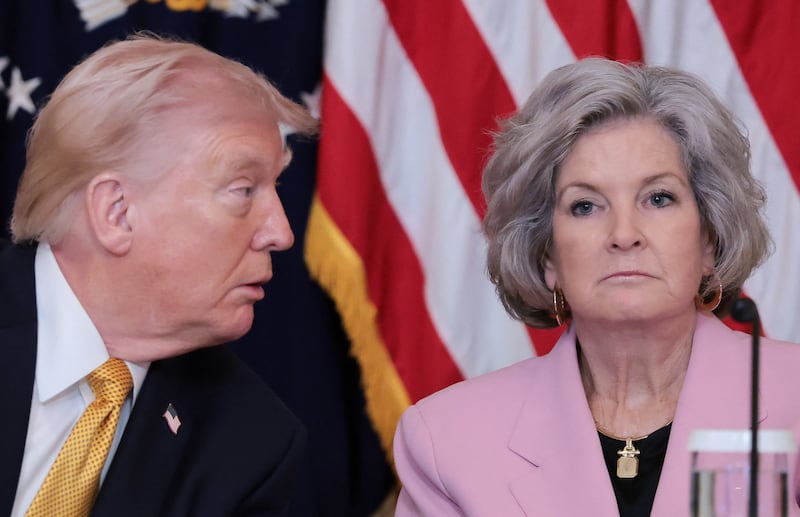
Trump’s Chief of Staff Susie Wiles and Treasury Secretary Scott Bessent are on the fence, sources said. They want a regulatory framework that would ask companies to keep the government in the loop about their work, but at their discretion.
This framework resembles the order that Trump shelved, despite it being developed for months, according to one official. Under this order, the White House would ask AI companies to voluntarily allow the government to review their latest AI models before the public could use them—but without legally requiring them to do so.
“It wasn’t government telling these companies what they could and couldn’t do, but it requested that the U.S. government get a first look at any new models, just to be sure that they couldn’t be exploited by bad actors,” the first senior White House official told Politico. “It wasn’t mandatory, but we did get an agreement from all of them that they would abide by it.”
There is still potential to convince Trump to adopt this approach, especially since his stance seems to change in real-time. “This isn’t canceled, it’s postponed,” the official said. “And might a clause here or there be changed? Possibly. But it’s also possible that we talk to the president about it, and he says, ‘Yeah, that sounds logical. Let’s just go do it.’”
Sacks had his ear, convincing him to change tack. But that does not mean his decision is final. “David [Sacks] wants more of a hands-off approach to Al, and Hegseth doesn’t think it goes far enough,” a second White House official said. “[National Cyber Director] Sean Cairncross [is] caught in the middle trying to do something that makes both industry happy and protects the USG [U.S. government].”
The official line is that the administration “is committed to addressing the challenges posed by this emerging technology,” according to a White House spokesperson. “The President’s team is united in executing his bold agenda and maintaining this critical balance,” they added.
The speed at which the government has addressed AI issues can’t match the speed at which the technology is developing. Trump’s order looked all set until Athropic released Mythos, a program that can spot vulnerabilities in online systems before cyber-criminals can exploit them.
That forced the administration into a behind-the-scenes scramble. Officials knew of the program in February, and by the time it was released in April, they were concerned about the risk it could pose to critical infrastructure and national security, an official said. “Susie, as much as she’s trying to straddle the middle line, she’s very much concerned, and is a bit more hawkish than middle of the road,” the person said.
What followed was a flurry of hush-hush high-level meetings between government officials and executives at OpenAI, Google, and Anthropic. A deal was brokered and looked set to be signed until Sacks phoned up the president to share industry concerns.
On May 21, just hours before ink was supposed to hit paper, Sacks talked Trump into a U-turn. “David Sacks, just having supported what [the group was] doing, just thought better of it, and contacted the president and said, ‘I think you’re making a mistake,’” the first senior White House official said.
Negotiations are “back to square one” with each faction trying to convince the president of the best route to go down, according to Politico.
The White House has been contacted for comment.