Roberts Scrambles to Gag SCOTUS Staff After Pro-Trump Ruling Leaks
One law professor said the move was a sign of the court’s “weakness.”
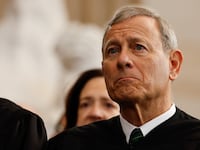
Chip Somodevilla/Pool/AFP via Getty Images
Chief Justice John Roberts has started asking Supreme Court staff to sign non-disclosure agreements after a pro-Donald Trump judicial decision and memo were leaked to the press.
Roberts, 71, likes to describe court members and employees as a family, and for years relied on more low-key measures to keep the court’s decision-making process secret, The New York Times reported.

He lectured clerks at the start of each term and distributed a written code of conduct that instructed clerks of their “duties of complete confidentiality, accuracy, and loyalty,” which only mentioned the possibility of unspecified sanctions in the case of breaches.

Supreme Court Chief Justice John Roberts began imposing NDAs on staff after the Times quoted a confidential memo in which he pushed the other justices to grant President Trump sweeping immunity from prosecution.
Chip Somodevilla/Getty Images
But two weeks after Trump was re-elected in 2024, Roberts summoned the court’s employees and asked them to sign legally binding NDAs requiring them to keep the court’s inner workings secret, five sources told the Times.
The agreements, which new arrivals have also been required to sign, threaten legal action if clerks or other members of the court’s support staff reveal confidential information, the paper’s sources said.

It’s not clear whether the justices themselves were also asked to sign confidentiality agreements, as the court declined to comment to the Times.
Sign Up for Our Cheat Sheet Newsletter
By clicking “SUBSCRIBE” you agree to our Terms of Use and Privacy Policy.
The Daily Beast has reached out for comment as well.

Roberts’ crackdown follows a series of humiliating court leaks that have plagued the court since Politico was given a draft decision of the 2022 Dobbs v. Jackson case that overturned the federal right to an abortion.
The court has also been rocked by revelations about disagreements among the justices, including a bitter debate about a case involving Idaho’s abortion ban, a battle over the court’s toothless ethics rules, and a confidential memo in which Roberts pushed to grant Trump broad immunity from prosecution.

Roberts’ decision to impose NDAs came just weeks after the Times quoted from the confidential immunity memos, according to the Times.
The move comes as critics are calling for more transparency at the Supreme Court, which is facing record-low public trust as the conservative justices greenlight the vast majority of Trump’s policies.

Leaks have revealed deep divisions among the U.S. Supreme Court justices: Amy Coney Barrett, Neil Gorsuch, Brett Kavanaugh, Ketanji Brown Jackson, Sonia Sotomayor, Clarence Thomas, Chief Justice John Roberts, Jr., Samuel Alito, and Elena Kagan.
Evelyn Hockstein/Reuters
Roberts, however, went in the other direction and mandated more secrecy, not less.
The last time prior to 2024 that Supreme Court clerks were asked to sign a document agreeing to abide by the court’s confidentiality rules appears to have been in the late 1990s, after a former clerk published a tell-all book in 1998, according to the Times.

Those documents, however, did not amount to legal NDAs, according to some of the clerks that signed them.
The switch to formal contracts is “a sign of the court’s own weakness” and the erosion of internal cohesion, Mark Fenster, a University of Florida law professor, told the Times.
See more of our coverage in your search results.

Got a tip? Send it to The Daily Beast here.
Register below to read this article for free or subscribe
to unlock unlimited access to The Daily Beast.
Monthly
$1
First month then $5.99/month
Annual
$35
First year then $59.99/year
Premium
$79
First year then $119.99/year
*Substack access provided by the next business day, using your subscription email. Choosing the Premium plan constitutes your permission to share your subscription email with Substack and your agreement to Substack’s Privacy Policy.
Already have an account? Sign In
Looks like you already have a subscription!
You're all set!
Thanks for subscribing.
Sign in or create an account
Login dialog
Loading comments…