Sailor Sent on Trump Mission Gets Evacuated After Monkey Attack
He was taken to his ship’s base in Japan for medical treatment.

MLADEN ANTONOV/AFP via Getty Images
An American sailor working on a Navy minesweeper ship was evacuated for medical treatment after he was attacked by a monkey on the way to the Strait of Hormuz.
Identified only as an electronics technician aboard the USS Chief, the sailor was confronted by the monkey on a shore in Phuket, Thailand, where the vessel had made a stopover, Axios reports.
“Weird stuff happens. This was definitely an unknown unknown,” an unnamed military official told the outlet.
The unidentified service member is now recovering at the ship’s forward base in Sasebo, Japan, after being scratched by the animal.

Details on the species of monkey involved in the attack have not been released, but the aggressive long-tailed macaque is a well-known native of Thailand.
One source told Axios that military officials normally worry that “sailors ashore would be at risk of catching a disease from some other activity, not from a monkey.”
Sign Up for Our Cheat Sheet Newsletter
By clicking “SUBSCRIBE” you agree to our Terms of Use and Privacy Policy.
A spokesperson for the U.S. 7th Fleet said the monkey attack did not cause any “operational impacts or delays” to the minesweeping ship. The home of the U.S. 7th Fleet in Japan, incidentally, has had previous run-ins with a monkey. A Japanese macaque missing its left hand was spotted lurking around the Yokosuka Naval Base in August 2025, prompting warnings to residents to stay away from the primate.

An Avenger-class minesweeper ship.
PH1 Michelle R. Hammond/U.S Navy
News of the bizarre monkey encounter comes as the Trump administration seeks to open the Strait of Hormuz to oil tanker traffic.
On Thursday, President Trump announced U.S. minesweepers were clearing the sea passage — through which about 20 percent of global oil travels — of Iranian mines. In a Truth Social post, Trump also ordered the Navy to “shoot and kill any boat, small boats ... putting mines in the waters of the Strait of Hormuz.”
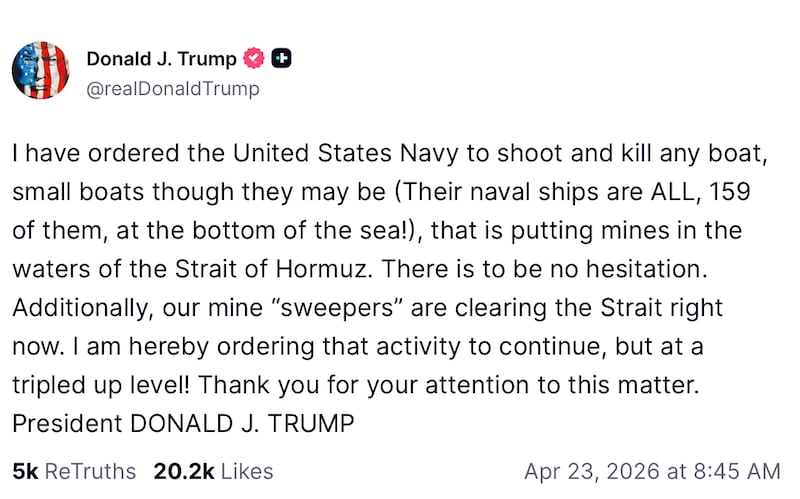
President Trump is threatening to shoot small boats placing mines in the Strait of Hormuz.
Truth Social
The USS Chief, in particular, is an Avenger-class ship that usually hosts 84 sailors aboard.
The effort to de-mine the strait comes as Iran announced the seizure of two cargo ships in the region. American forces have also targeted ships linked to Iran, with the Pentagon revealing that Navy SEALs had boarded a vessel in the Indian Ocean this week.

JD Vance's previous trip to Pakistan to discuss peace with Iran proved fruitless. Getty.
Pool/Getty Images
The two countries are currently observing a ceasefire, though meaningful progress towards peace remains elusive. This week, Vice President JD Vance backed out of plans to travel to Pakistan to resume negotiations with Tehran.

Gas prices at an Exxon station in Washington D.C. as the price of oil and gas has surged amid the U.S.-Israeli conflict with Iran.
Ken Cedeno/Reuters
The most visible result of the continued war has been a surge in energy prices. Since the U.S. and Israel first began strikes against Iran on Feb. 28, the price of gas has climbed past $4 a gallon on average across the country, the first time prices have crossed that mark since 2022.
See more of our coverage in your search results.

Got a tip? Send it to The Daily Beast here.
Register below to read this article for free or subscribe
to unlock unlimited access to The Daily Beast.
Monthly
$1
First month then $5.99/month
Annual
$35
First year then $59.99/year
Premium
$79
First year then $119.99/year
*Substack access provided by the next business day, using your subscription email. Choosing the Premium plan constitutes your permission to share your subscription email with Substack and your agreement to Substack’s Privacy Policy.
Already have an account? Sign In
Looks like you already have a subscription!
You're all set!
Thanks for subscribing.
Sign in or create an account
Login dialog
Loading comments…