Secrecy Shrouds Conservative PAC Pouring Money Into State Races
Prosperity Alliance has no website, no social media presence, and no record of any advertising—but they told the IRS 60% of their budget is going toward ‘public education.’

Photo Illustration by The Daily Beast
This story originally appeared in The Daily Beast newsletter, Pay Dirt. Sign up for that newsletter: HERE.
A pair of Ohio lawmakers are waging legal battles against a secretive super PAC pouring hundreds of thousands of dollars in dark money into a handful of statehouse contests around the country. Documentation obtained exclusively by PAY DIRT sheds new light on how the group’s sole funder has attempted to navigate federal tax and election laws in an effort to keep the sources of that money secret.
The Conservative Alliance PAC (CAPAC) is currently facing lawsuits from Ohio state representative Larry Householder, the statehouse’s former speaker, and Jim Trakas, a candidate for the state’s sixth house district. Both say they were defamed by CAPAC, charges the group denies. Householder’s lawsuit remains in Perry County, Ohio, while Trakas’s has been moved to a federal court in the state.
Both lawsuits also name a number John Does as defendants, since it’s not entirely clear who is behind the group. CAPAC’s address is a P.O. box in Alexandria, Virginia, and its treasurer is Chris Marston, a Virginia election compliance attorney who is popular among conservative dark money-backed political groups. Marston has signed all of the group’s Federal Communications Commission paperwork for its broadcast advertisements, and received court summonses for the Householder and Trakas lawsuits.
According to Federal Election Commission filings, CAPAC has received all of its money—more than $750,000—from a single source: a dark money group called Prosperity Alliance Inc. It’s used that money to buy attack ads and mailers in statehouse contests in Ohio and Oklahoma. Prosperity Alliance was incorporated in Virginia in May, and lists its address as a P.O. box in Washington. Its sole listed employee, Tyler Conner, is also the treasurer of a South Carolina-focused super PAC that’s received about 87% of its money this cycle from a pair of dark money groups. Conner did not respond to multiple messages left at the Google Voice number he lists in IRS documentation.
Sign Up for Our Beast Digest Newsletter
By clicking “SUBSCRIBE” you agree to our Terms of Use and Privacy Policy.
Prosperity Alliance has not only provided every penny of CAPAC’s income, it’s done so in near perfect synchronicity with the super PAC’s expenditures, suggesting close coordination between the two, and an effort to route CAPAC’s funds through a non-disclosing entity rather than have its donors provide those funds directly.
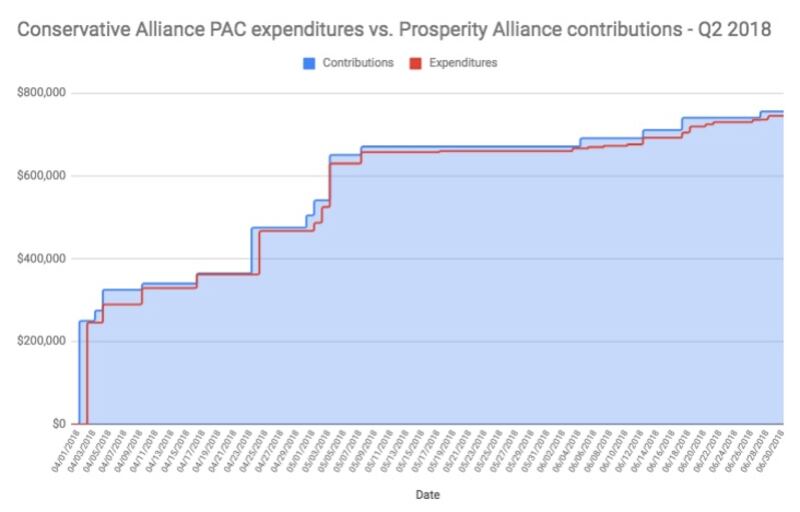
As we have previously explained, that sort of arrangement generally hamstrings donors’ attempts to influence elections, as less than half the money they launder through dark money groups can be spent on elections. The IRS requires that such groups spend no more than 49% of their money each year on political activity, including direct advertising and contributions to political groups such as super PACs. But Prosperity Alliance’s finances, as revealed in records obtained exclusively by PAY DIRT, suggest that it’s doing little beyond funding this explicitly political super PAC.
Prosperity Alliance applied for tax exemption as a 501(c)(4) “social welfare” organization in August 2017. In its application to the IRS, the group said that it planned to spend a total of $350,000 in its first fiscal year, from May 2017 through April 2018, including just $50,000 in contributions to third party organizations. But the group donated $475,000 to CAPAC in that time. In other words, Prosperity Alliance would’ve had to spend nearly three times what it told the IRS it would for its political expenditures to fall at or below the 49% threshold, and that’s assuming it engaged in no political activity beyond its CAPAC contributions.
The group also told the IRS that it planned to devote 60% of its budget to “public education” activities, including “press releases, press conferences, letters to the editor, websites, email, social media, television, radio, Internet advertising and direct mail and events.” But there’s no evidence that it’s done any of that. Prosperity Alliance has no website, no social media presence, and the FCC has no record of the group running any advertising. Prosperity Alliance-funded CPAC ads, such as a series of anti-Trakas mailers revealed as part of that defamation lawsuit and a pair of websites attacking and promoting two Oklahoma statehouse candidates, are not educational in nature; they explicitly call votes for or against candidates for office.
Those facts raise some serious red flags, according to ethics watchdogs. “It appears that CAPAC is a front to launder dark money from Prosperity Alliance into” political contests, wrote Brendan Fischer, the director of federal and FEC reform programs at the Campaign Legal Center. “It seems that Prosperity Alliance would still have to spend some money on non-electoral advocacy to maintain its tax-exempt status.”
It’s not clear whether it has done so, and the group’s first annual filing with the IRS won’t be publicly available until well after the 2018 election. That information—and really any insight into who is behind CAPAC and its funder—might be of interest to voters on the receiving end of ads from a group accused of defamation by its targets.
See more of our coverage in your search results.

Got a tip? Send it to The Daily Beast here.
Register below to read this article for free or subscribe
to unlock unlimited access to The Daily Beast.
Monthly
$1
First month then $5.99/month
Annual
$35
First year then $59.99/year
Premium
$79
First year then $119.99/year
*Substack access provided by the next business day, using your subscription email. Choosing the Premium plan constitutes your permission to share your subscription email with Substack and your agreement to Substack’s Privacy Policy.
Already have an account? Sign In
Looks like you already have a subscription!
You're all set!
Thanks for subscribing.