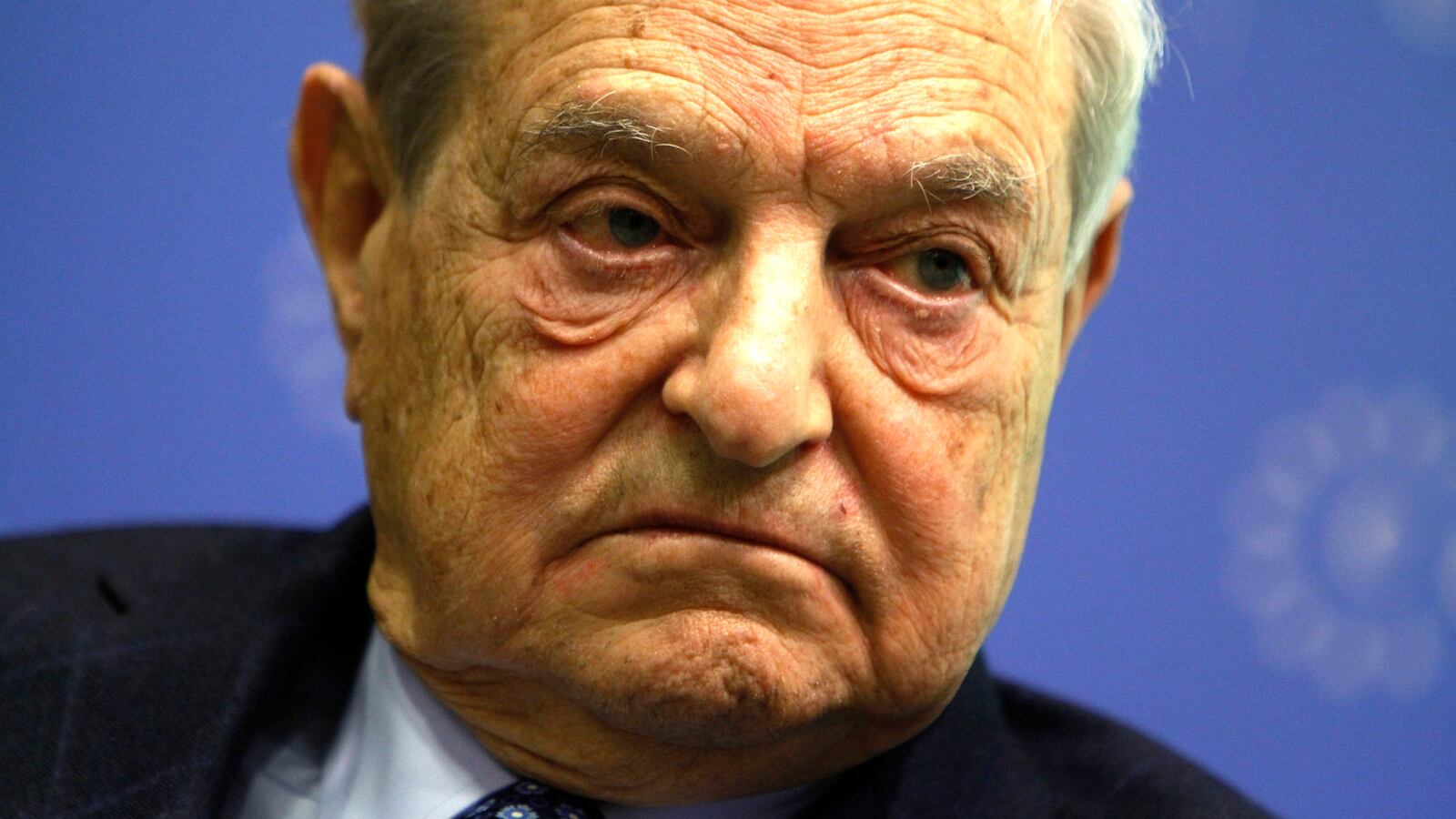
George Soros has been in headlines of late for the recent attempt on his life and conspiratorial allegations of his involvement in hot-button immigration issues currently dominating political debates. Far less attention has been devoted to Soros’ ongoing efforts to remake laws surrounding U.S. lobbyists and public-relations agents for foreign governments.
The Open Society Policy Center, the lobbying arm of Soros’ sprawling network of charities and advocacy groups, has quietly dropped millions of dollars this year in an attempt to steer proposals to overhaul the Foreign Agents Registration Act. But unlike many progressive organizations and legislators, the group’s primary concern isn’t surreptitious Russian influence on the American political process. In fact, Soros’ group is worried that overzealous Democrats will go too far, cast too wide a net, and turn FARA into a suppressing force that stigmatizes foreign-funded NGOs in the U.S. and prompts foreign governments to crack down on American ones.
With little fanfare, the OSPC has quickly become one of the country’s top lobbying spenders. It dropped more than $20 million on its federal influence operation in the first nine months of the year, according to congressional disclosure records, including $7.7 million in the third quarter alone. That makes the group the fourth largest lobbying spender of 2018, behind only the U.S. Chamber of Commerce, the National Association of Realtors, and the pharmaceutical industry’s top trade association.
Among OSPC’s most pressing priorities has been an effort to shape proposed changes to FARA, the law that has forced disclosure of “foreign agents” operating on U.S. soil since it was enacted to counter Nazi influence campaigns in the late 1930s. Congress has considered a rash of proposals to strengthen the law since last year, largely in response to efforts by the Russian government to influence the 2016 presidential election and U.S. political debates since then.
Mort Halperin, a senior adviser to the Open Society Foundations, acknowledges the perceived urgency of those efforts, but worries that well-meaning attempts to strengthen the act will be used to crack down on Open Society’s activities abroad, and on some groups operating in the U.S. using funds derived from foreign governments.
“There is a split within the liberal NGO community and therefore a split among members of Congress, some of whom find our arguments more persuasive, and some of whom find the arguments of the people who are concerned about transparency and accountability more persuasive,” Halperin told PAY DIRT in an interview this week.
Open Society has two primary concerns with FARA overhaul efforts, he said. First is that foreign governments, ostensibly seeking to mirror U.S. laws, would instead use the occasion of a strengthening of FARA to beef up their own laws, and use them to go after antagonistic NGOs that receive foreign funding.
The second concern is that stepped up FARA enforcement in the U.S. might ensnare progressive groups that Open Society supports. Halperin cited Greenpeace and Transparency International as potential FARA registration targets if the Justice Department, which oversees the law, considerably steps up enforcement.
Top Republicans on the House Natural Resources Committee recently sent a letter to the World Resources Institute requesting information on its work in China, and questioning whether the group might need to register as a foreign agent as a result of that work. Halperin pointed to those sorts of interrogatories to underscore his concerns with efforts to beef up FARA.
“If the statutes were strengthened, they would be more concerned that it would be used for that purpose, even though many of the people supporting the strengthening of the act, including many liberals, are doing so because they have in mind agents of Russia in the United States,” he said. “We think you have to ask… who might it be used against.”
The Russian government is suspected to have funded environmental activism in Europe, so the concern isn’t entirely without merit. But more tangibly for the purposes of FARA enforcement, the statute does not by its nature restrict lobbying or advocacy by foreign agents. Rather, it requires disclosure of information about an agent’s funding and activities. Better, advocates say, to err on the side of more disclosure, which won’t significantly encumber an NGO’s activities in any case.
Halperin rejects that suggestion, pointing to both the administrative costs of FARA compliance and the stigma that comes with labeling one’s product the work of an agent of a foreign power. “We think that makes it misleading to say that it’s just a registration statute so go ahead and register,” he said.
But Halperin insists that Open Society values the transparency that a foreign-agent disclosure law can produce. “It’s a hard issue because there are important open-society values on both sides, so we’re eager to find a way to a bill that satisfies people on both sides of this within the liberal community, and we think that’s doable if both sides recognize the legitimacy of the concerns on the other side,” he said.
“Or,” he added, “we just stop the bill and people have to deal with these concerns in order to get something passed.”
Get the data: