President Donald Trump has largely failed to implement his proposals to significantly reduce the federal government’s budget, as they have been repeatedly rejected by Congress, according to a report.
Analysis of federal budget records by the Penn Wharton Budget Model and The New York Times identified multiple instances in which the president sought large-scale spending reductions at U.S. agencies.
However, when it came to Congress approving these measures for the 2026 budget, lawmakers enacted only a fraction of the proposed severe spending cuts, or even approved slight increases.
Overall, the GOP-controlled Congress is on course to approve more than $1.6 trillion in discretionary spending for 2026, which amounts to hardly any change from the previous fiscal year, according to the Times. Last May, Trump proposed slashing $163 billion in federal spending for the fiscal year.
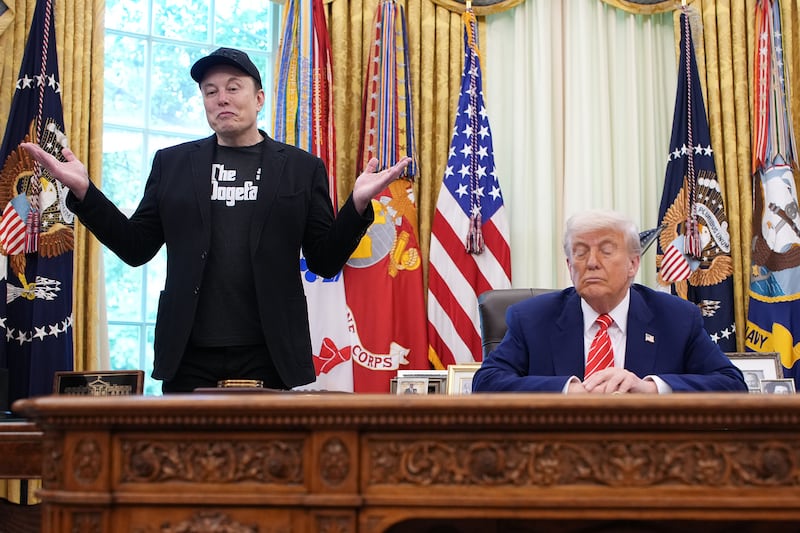
Trump and his on-again, off-again ally, Elon Musk, made reducing government “waste” and spending one of the administration’s main priorities during the president’s first year back in office.
While Musk’s Department of Government Efficiency (DOGE) dissolved last Novemebr eight months ahead of schedule after severely underperforming its goals, Trump still managed to gut the government in some ways. That included laying off thousands of federal workers, dismantling several agencies, and significantly withdrawing foreign aid distributed through the United States Agency for International Development.

However, Marc Goldwein, senior vice president at the Committee for a Responsible Federal Budget, told the Times that Trump did not “get a big nominal cut in spending” in Congress for the 2026 fiscal year, despite urging lawmakers to do so.
While Trump took steps last year to dismantle the Department of Education, Congress instead adopted a bipartisan funding deal in January that provided $79 billion for the agency, a slight increase from 2025.
The Trump administration sought to slash the Environmental Protection Agency’s budget by approximately 54 percent for fiscal year 2026. Instead, Congress approved a reduction of just 4 percent, according to an analysis of the data.
Lawmakers also rejected severe cuts proposed for agencies, including the United States Department of Commerce, where the White House sought a 16 percent reduction, and the United States Department of Health and Human Services and United States Department of Labor, where a 28 percent reduction was demanded, according to the Times.
Elsewhere, Trump sought to cut research funding at the National Science Foundation by more than half, but Congress ultimately reduced it by only around 4 percent of its total budget.
James C. Capretta, a senior fellow at the American Enterprise Institute, told the Times that lawmakers rejecting steep cuts proposed by Trump proves a “disconnect” between the president’s political agenda and the “bipartisan process on the Hill that surrounds the appropriations process.”
The Daily Beast has contacted the White House for comment.