A Trumpy Supreme Court justice has taken aim at a legal principle dating back to the 19th century.
Clarence Thomas, a George H.W. Bush appointee and reliably conservative justice, urged his fellow Supreme Court justices to reconsider a 169-year-old doctrine known as judicial estoppel.
Estoppel prevents a party from taking a position that contradicts a position they held in an earlier legal proceeding. It’s designed “‘to protect the integrity of the judicial process’ by ‘prohibiting parties from deliberately changing positions’ to gain an unfair advantage.”
The long-standing doctrine was first recognized in an 1857 decision by the Tennessee Supreme Court, according to Thomas. But he thinks it’s time to start reconsidering it.
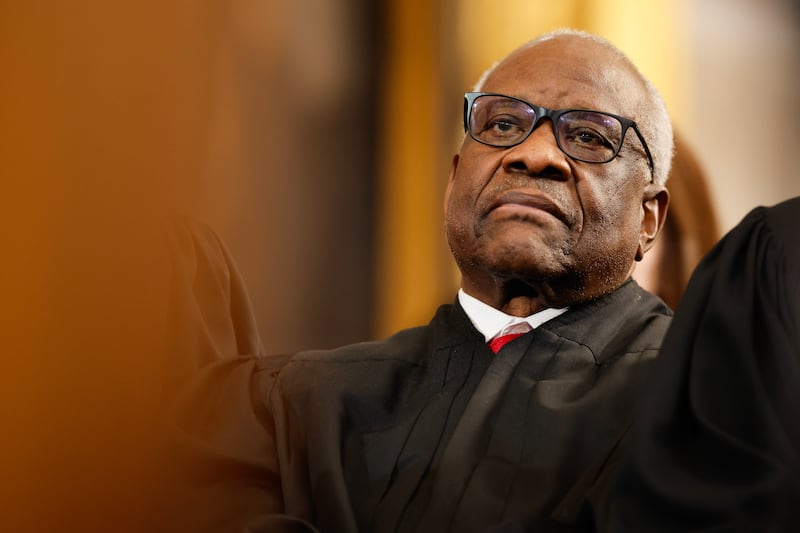
“I write separately to express doubt about the foundation of the doctrine of judicial estoppel,” he wrote in his concurring opinion on a unanimous decision over a routine bankruptcy case.
“Judicial estoppel generally prevents a party from asserting a position in one lawsuit that contradicts its position in a previous proceeding,” he explained. “Lower federal courts have applied this doctrine broadly without clear authority to do so, and with only limited support from this Court’s precedents. In a future case, we should reexamine it.”
Thomas argued that the doctrine appears to have no basis in any statute, Federal Rule of Civil Procedure, or any traditional inherent power of federal courts.

“Despite the widespread modern adoption of judicial estoppel, its foundation remains questionable,” he wrote. “It is unclear what gives federal courts the authority to bar suits based on judicial estoppel.”
Often, Thomas continued, “federal courts treat judicial estoppel as a matter of federal law and feel free to craft their own standards and extend the doctrine to new contexts.”
“Judicial estoppel has secured widespread acceptance in the Courts of Appeals without any clear authority in statutes, rules of procedure, or this Court’s precedents. In a future case, this doctrine merits a closer look,” he concluded.