
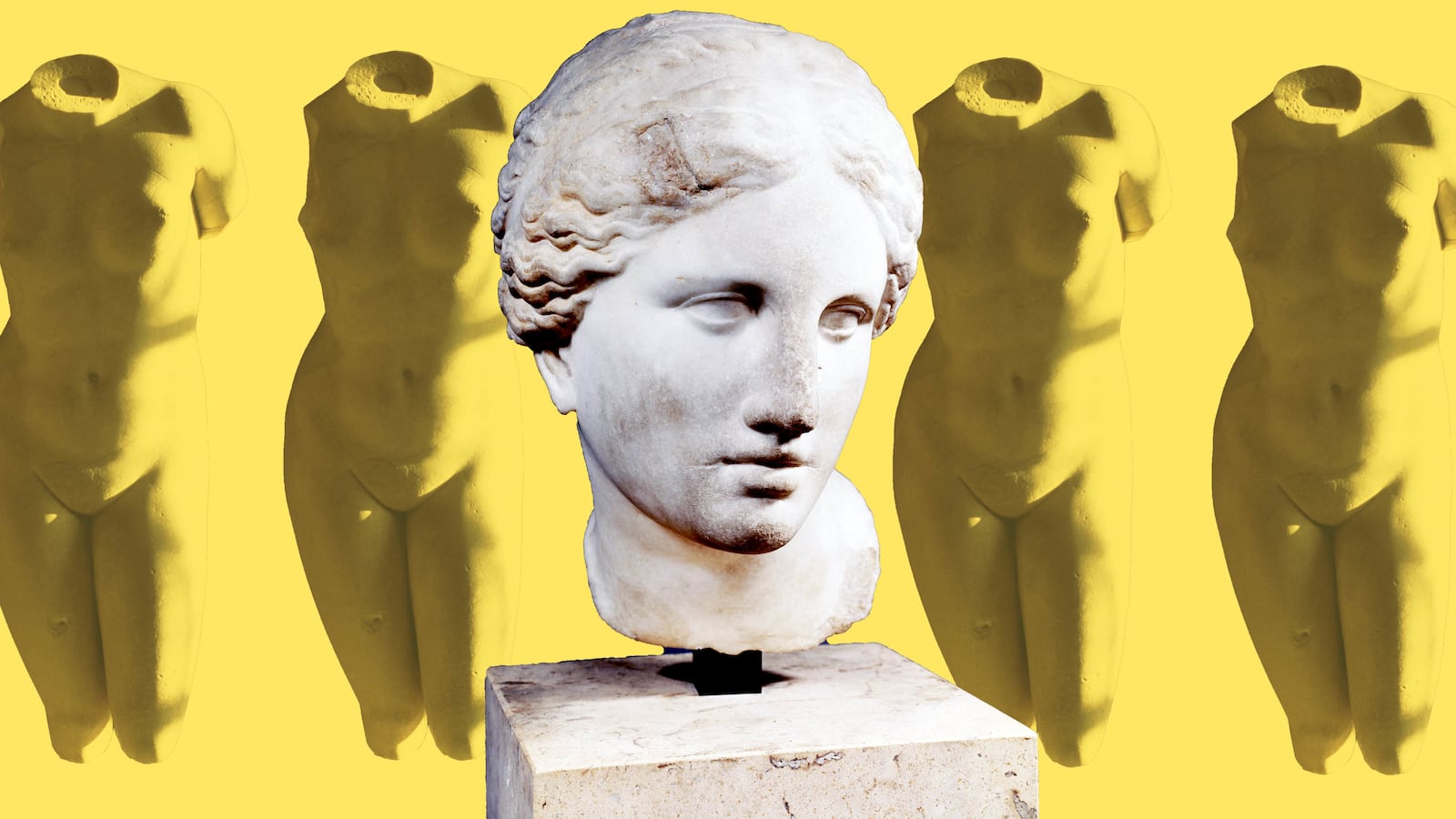
Tourists came from near and far to see her. Women visited to pay their respects and beseech her to fulfill their hopes and dreams, while prominent families gave offerings to her on behalf of their female relatives. And at least one man, so the story goes, was so overcome with lust that his worshiping took an indecent turn, the shame of which caused him to throw himself off a cliff.
She was the Aphrodite of Knidos, one of the finest and most famous ancient Greek sculptures created by one of the finest ancient Greek sculptors of the era. She was the first of her kind, the earliest nude sculpture of a woman known in history, and she represented an artistic revolution.

But her reign began nearly 2,400 years ago, and, though the passing millennia have been kind to her legacy, the original Aphrodite of Knidos by the grand sculptor Praxiteles has not survived. While art scholars and admirers still worship the original nude Goddess of Love, all that is left of her are the many copies that pay homage to her memory.
Sculpting was in Praxiteles’ blood. His father plied the chisel and stone before him, and his sons would follow in his footsteps. But in the family’s long line of artistically inclined men, Praxiteles was the most adept, the most famous. Hundreds of years after he crafted his masterpieces in the fourth century B.C., wealthy Romans would snap up his work like he was the Greek Jean-Michel Basquiat.
Given his renown, Praxiteles must have been an obvious choice when the residents of the island of Kos decided they were in need of a new Aphrodite to grace their temple floor. Commission in hand, the sculptor got to work.
Praxiteles was an innovative artist. As the Getty Museum notes, he came up with “his own scheme of proportions for representing the human body,” and he “invented new ways of depicting the gods.” In his hands, the deities were not stiff and regal figures; Praxiteles carved more life-like representations that portrayed a fluidity and naturalness that was more human than stone.
But when it came to his new Aphrodite, he wanted to push this innovation even further. Up to this point, it was not unusual for men to be sculpted in the buff. But now, Praxiteles wanted to do the same for a woman.
Embarking on his great artistic odyssey, our famous sculptor wasn’t left to just his chisel and imagination. He called on his girlfriend, the renowned courtesan Phryne, to serve as his model. His beloved was a particularly apt stand-in for a statue that would become the first woman of her kind.
In the fourth century B.C., courtesans, or hetarai as they were known, enjoyed a greater freedom than the typical ancient Greek woman. As Natalie Haynes writes for the BBC, “Phryne was also notable for the independence she exhibited and for a wit and curiosity that put her in the same circles as 4th Century BCE Athens’ philosophers.” She wasn’t ashamed of her place in society, and insisted on being taken seriously for who she was.
One story has Phryne offering to fund the reconstruction of the walls of Thebes after the city was sacked by Alexander the Great. “Her one stipulation was that the new walls must bear an inscription, declaring that they had been demolished by Alexander and rebuilt by Phryne the courtesan,” Haynes writes.
Praxiteles had all the makings of a success. He was a talented artist at the top of his game; he had a guaranteed commission; and he had a model known for her mind and beauty. But given the audacity of his task—a woman in the nude for all to see? Gasp!—he came up with a back-up plan.
When the sculptor returned to the island of Kos, he unveiled two new sculptures for the people to choose from. Both were Aphrodites: one, a stunning but ordinary goddess in all of her refined drapery; the other his naked masterpiece.
The statue that would come to be known as the Aphrodite of Knidos stands slightly titled forward as if she has just taken off her robe. One hand slightly grazes her breast, the the other offers the briefest nod at modesty as it hovers in front of her pubic bone as if on its way to dropping her robe on the floor.
In How Do We Look, historian Mary Beard cites the eroticism of this first nude female sculpture. “The hands alone are a giveaway here. Are they modestly trying to cover her up? Are they pointing in the direction of what the viewer wants to see most? Or are they simply a tease? Whatever the answer, Praxiteles has established that edgy relationship between a statue of a woman and an assumed male viewer that has never been lost from the history of European art.”
The residents of Kos were scandalized. They would take the clothed version, thank you very much. But the islanders of Knidos were not quite so prudish… or at least, they knew a good deal when they saw one. They were willing to take the rejected Aphrodite for their own temple.
And thus a sensation was born. “The little temple in which it is placed is open on all sides, so that the beauties of the statue admit of being seen from every point of view; an arrangement which was favoured by the goddess herself, it is generally believed,” Pliny the Elder writes in Natural History.
In an epigram by the ancient poet Callimachus, Aphrodite’s curiosity is peaked after hearing tales of this likeness and she travels “through the waves to Knidos” to check it out. Upon seeing the sculpture, she exclaims, “Where did Praxiteles see me naked?”
Accolades rained down on the Aphrodite of Knidos and visitors abounded. While there were plenty of women who paid their respects to the goddess and made her offerings as they prayed for love and good marriages and the health of their children, there were also those male viewers whose intentions were a little less pure.
In one story recounted by the ancient satirist Lucian, a temple attendant explained a stain on the marble as the expression of one young man’s overzealous lust. The man, who came from a prominent family, would spend all day in the temple in what at first was believed to be “pious awe.”
But that was not enough for him. One evening, he hid in a chamber until dark when the temple was empty and he emerged to spend the night with his love. The next morning, the “marks of his amorous embraces were seen after day came and the goddess had that blemish to prove what she'd suffered. The youth concerned is said, according to the popular story told, to have hurled himself over a cliff or down into the waves of the sea and to have vanished utterly.”
The fate of the Aphrodite of Knidos is not known for certain. Pliny writes that years after Aphrodite came to Knidos, King Nicomedes offered to pay off the substantial debt of the island in exchange for the statue. They declined.
But despite the islanders’ best intentions to preserve their treasured goddess, it is believed that at some point it was stolen from the island and ended up in Constantinople, where it was destroyed in a fire in the 5th century A.D.
While Praxiteles’ greatest achievement is no longer, it is not entirely lost. For centuries, it would be this Aphrodite that sculptors would look to as the ideal to serve as a model for their own creations in stone.