
At-home saunas turn what was once a rare escape into a daily ritual. Picture this: At the end of a long day, you step into your outdoor sauna, shut the door, and finally have a chance to be still. In seconds, you’re wrapped in warm, gentle heat and feel the stress begin to melt away. In this space, there are no meetings, no notifications, and no scrolling. Sounds incredible, right? However, before your imagination gets carried away, there are essential questions to ask before buying an at-home sauna.
Do you want a traditional or infrared sauna?
Traditional saunas heat the air between 150°F and 195°F by using an electric heater to heat stones. Pouring water onto the stones creates steam: this is the authentic Finnish sauna experience. Instead of heating the air, infrared saunas heat your body directly at lower temperatures, usually between 120°F and 140°F. They also warm up faster and run on less power.
What’s the exterior made out of?
Your new sauna is going to be sitting outside all year round, so it needs to hold up to heat, sun, cold, rain, and snow. While beautiful, saunas using wooden exteriors like cedar or hemlock require periodic maintenance (like staining and sealing) to prevent rotting, warping, and UV damage. Outdoor units that use aluminum and stainless steel resist the elements without the need for regular upkeep.
Can your home support an outdoor sauna?
An outdoor sauna needs a stable, level surface that can support its weight like a concrete pad or deck rated to support that weight. Grass or soil is not an option–you’ll need something like a concrete slab or paver stone base. You also need a 240-volt dedicated circuit to power the sauna. If you don’t have one, you’ll have to hire an electrician to install one.
What does the sauna warranty cover?
A warranty for an outdoor sauna is a safety net for your investment. Check to ensure that it covers outdoor residential use, the entire sauna (not just the heaters), and the cost of any needed labor. For example, Sun Home Saunas has a limited lifetime warranty with six years of coverage for outside residential use and includes in-home technician visits.
What’s the full cost of sauna ownership?
You’ll want to consider the yearly costs of enjoying your new sauna. A report by Angi showed that a sauna can have annual maintenance costs of up to $350 a year. Also think about the electrical costs: based on the average electricity rate in the U.S. of $0.19 per kilowatt-hour (kWh), a one-hour session in an infrared sauna can range from $0.24 to $0.66 depending on your unit, usage time, and where you live. According to Sun Home Saunas, infrared saunas can range between 1.5 to 3.5 kWh per session. If you use your sauna one hour everyday for a month, you’re looking at anywhere between $7 to $20 in electricity costs per month.
The Health Case for Sauna Use
There’s real research behind why a sauna session feels so good. Regular sauna use has been reported to lower the risk of certain cardiovascular issues like high blood pressure and improve conditions like arthritis. One study even showed a potential connection between sauna use and increased longevity. The overlap with exercise doesn’t stop there. Another study from 2023, athletes who used infrared saunas after resistance training reported less muscle soreness and better overall recovery.
Heat-based therapies have shown promise on the mental health side, too. This study found meaningful reductions in depression symptoms when whole-body heat therapy was integrated with cognitive behavioral therapy.
Who Should and Shouldn’t Buy an Outdoor Sauna?
An outdoor sauna makes the most sense if you own your home, have usable backyard space, plan to use the sauna three to four times a week, and are comfortable with a 240-volt electrical installation (if needed). On the other hand, if you rent, plan on moving soon, or have a lower budget, an indoor sauna is a better option.
The Case for Sun Home Saunas
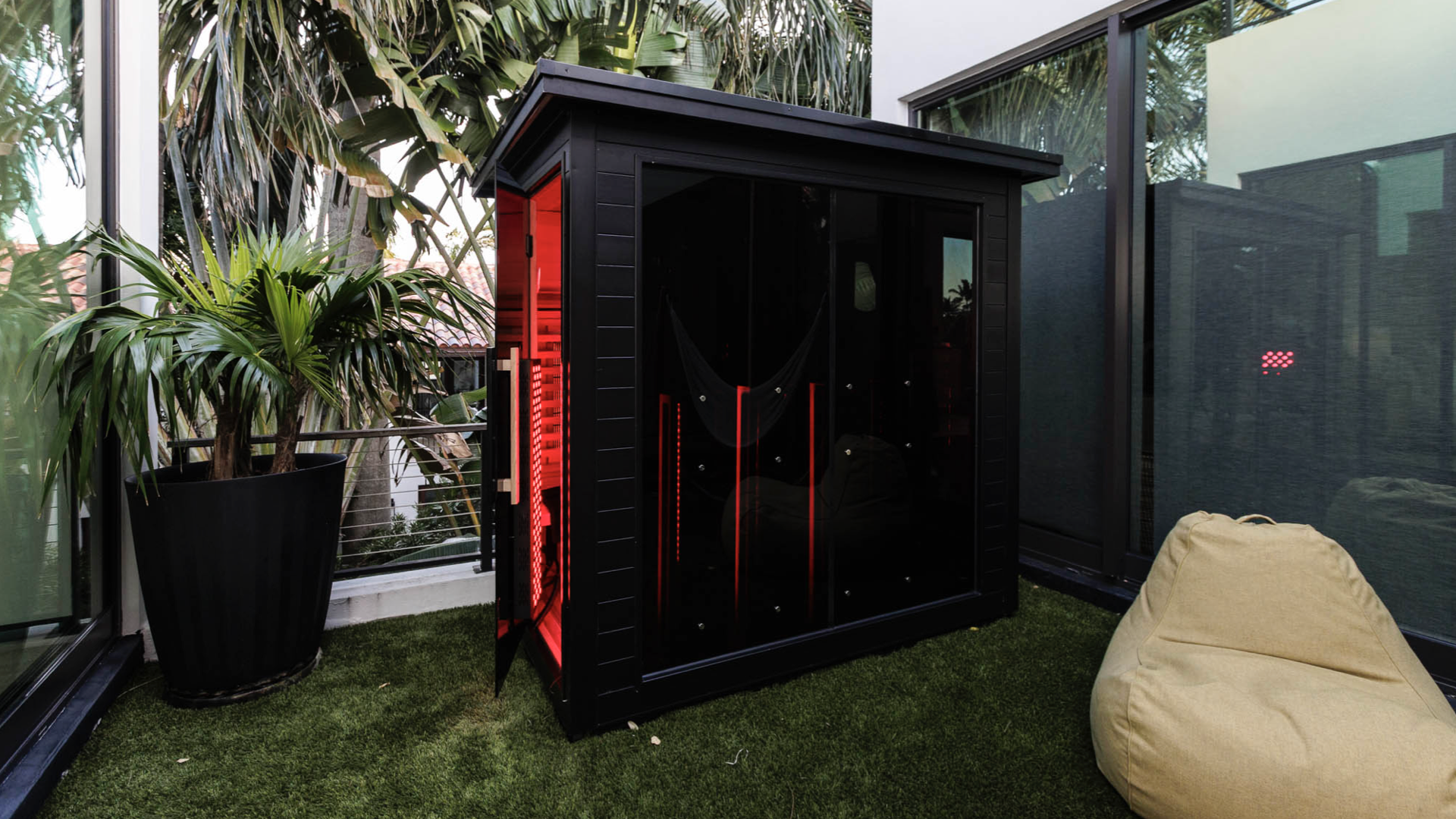
Sun Home Saunas’ Luminar infrared sauna has a durable metal exterior made of aerospace-grade aluminum (the stuff they use for fighter jets and space shuttles) with a stainless steel roof that doesn’t rot, warp, or buckle–no matter what mother nature might throw at it. Since it’s not a wooden exterior, you won’t be shouldering extra costs for routine staining and sealing. A cover is included with your purchase, but Sun Home Saunas says this is not required for weather protection.
Inside, the cabin sports Canadian red cedar which is great for saunas because it is naturally antimicrobial and moisture resistant (and it smells incredible). The black-tinted, double-pane glass not only shields the interior from UV damage but also improves heat retention.
Worried about infrared wavelengths? Don’t be. To test the electromagnetic fields (EMF) of its heating technology, Sun Home Saunas teamed up with Vitatech Electromagnetics. At a typical seated distance of three feet away from the heater, EMF levels ranged from 0.3 to 0.5 milligauss. That’s lower than a blender, toaster, or cell phone.
Sun Home Saunas also worked with VERT Environmental Testing & Consulting Services to test for any volatile organic compounds (VOC) that could be released during a sauna session, like acetone or ethanol. Sun Home Saunas received a LOW classification, with all results falling well below OSHA’s permissible exposure limit.
Sun Home Saunas paid attention to the little details too, like ergonomic, body-contouring backrests, charging ports, and a built-in Bluetooth sound system. There is even a companion app that lets you control the sauna remotely and includes guided breath work and meditation sessions.
Wherever you decide to install your new Luminar, be sure to leave four to six inches of clearance around the unit and 20 to 24 inches above the roof for ventilation and future service access. Additionally, be sure to check your local codes to see if you need any permits (building or electrical) to install an at-home sauna.
The Luminar’s Trade Offs
The Luminar is a high-ticket item, with the five-person and two-person models costing $13,899 and $11,099 respectively. It’s also heavy. The two-person model is almost 900 pounds. Keep in mind that delivery is curbside only; Sun Home Saunas does not facilitate getting the sauna to its final home in your backyard. And it’s worth saying again: unless you have a dedicated 240-volt outlet, you’ll need to get one installed: it’s a product requirement.
Unlike other Sun Home Sauna models, the Luminar doesn’t include red light therapy panels in the base model (though they can be added for an additional cost).
What’s the best outdoor at-home sauna?
Ultimately, the best outdoor sauna in 2026 is the one that best fits your needs and wants across heat type, construction, warranty, and budget (but the Luminar is pretty great).
If you buy something from this post, we may earn a small commission.