
There was one thing on which people on both sides of the pond and on both sides of the class divide could agree in the mid-19th century: they loved the Bard. Though long-dead, Shakespeare was the Steven Spielberg of the day, and with theater tickets available for a very reasonable price (Hamilton producers, look to your thespian ancestors), playhouses were democratic spaces where those from all walks of life came together to see a good show.
Because theater was the closest equivalent to popular entertainment at the time, the stage actors responsible for delivering the Bard’s rhymes were the culture’s A-listers.
In the 1840s, a feud for the history books broke out between two of these leading stars—one from America, one from England. Like all good celebrity gossip, this rivalry played out in the newspapers of the day; and like all good culture wars, the issue at hand went way beyond two famous narcissists trading barbs.
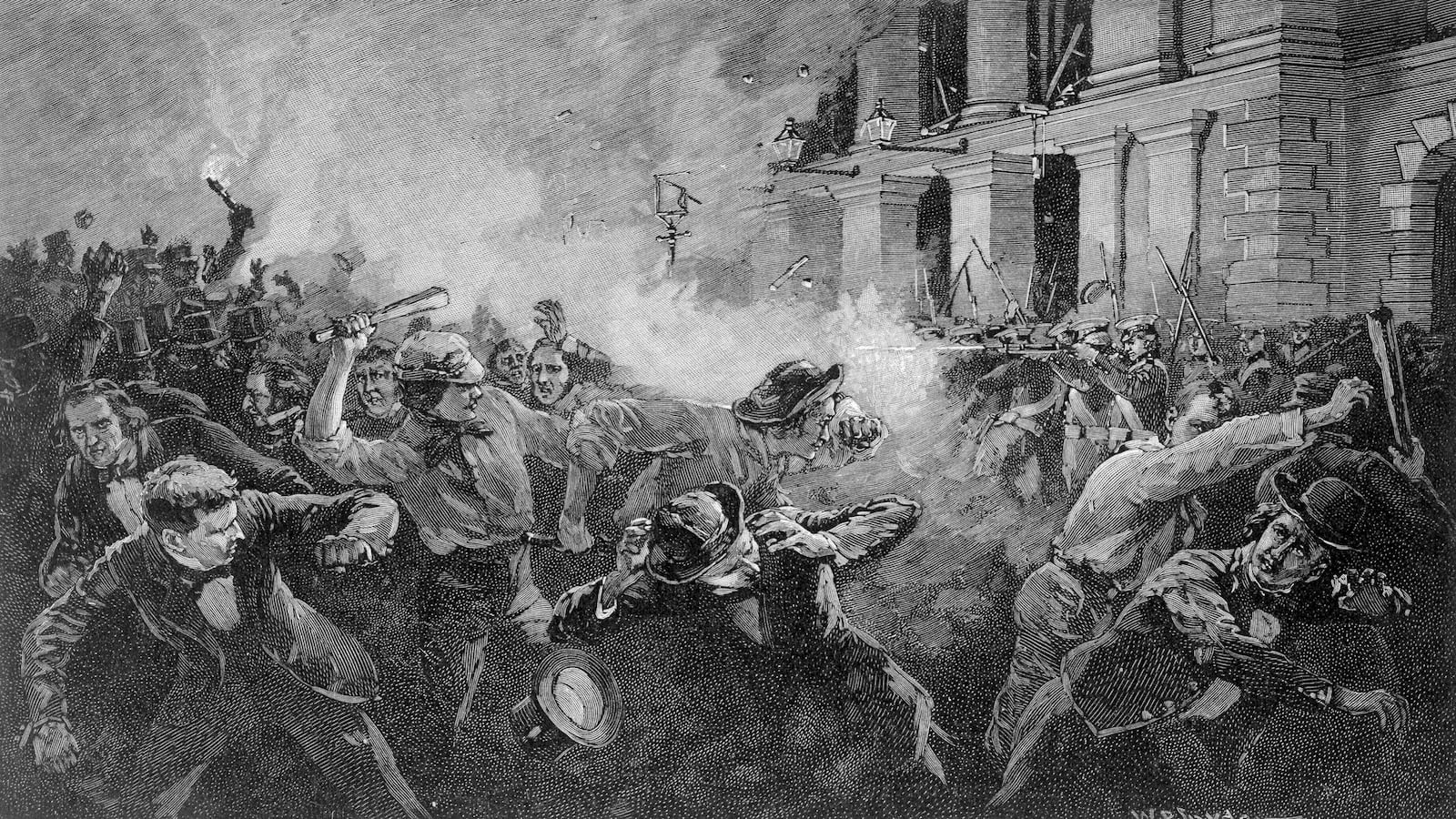
In 1849, this conflict came to a head on one violent and bloody May night. In an event that came to be known as the “Shakespeare Riots” (or the Astor Place Riot), a large protest broke out that ended with the New York militia opening fire on a crowd of thousands of New Yorkers. At least 22 people were killed that night in one of the most violent conflicts New York has ever seen, and theater was changed forever.
Enter William Macready, stage right. London-born Macready was one of the leading Shakespearean actors in the Bard’s homeland. He took his job very seriously, embodying the traditional style of old-English theater. He was “an established, classically trained actor known to portray Hamlet with fey handkerchief-waving,” as Betsey Golden Kellem describes in Smithsonian Magazine.
Macready was beloved in his own country and by the upper crust society of the young America, who still held a spot of fondness for their former aristocratic overlords.
Enter Edwin Forrest, stage left. On the other side of the Atlantic was an actor who was everything the new country set out to be: the Philadelphian was brash, he was innovative, he diverged from the old-school style to play Macbeth with a manly swagger, Hamlet with bold indecision. He didn’t follow the unspoken, yet ingrained, rules of actorly propriety (it would be his rude act that sparked the whole affair), and he refused to apologize for his impertinent behavior.
Forrest, in a nutshell, was America, the America of immigrants, of the working class, of the rising street gangs like the Bowery Boys, of the Tammany Hall machine, all of whom were big fans and supporters.
Both men had celebrated careers before our plot took its dramatic turn. As could be expected, each was more revered in his own country, but they both regularly crossed the ocean to perform on the other’s turf, and they were mostly well-received. Until 1845, that is.
That year Forrest traveled to perform in Victorian England, and found a British press that was not as welcoming as during his previous visits—they didn’t love his portrayal of Othello. Naturally, Forrest decided that the problem couldn’t possibly be his performance; the bad reviews must have been a result of sabotage by his formerly friendly rival Macready.
So, he took the most logical next step. When Macready was starring in Macbeth several months later, Forrest secured a prime seat in the audience and, when the time was right, he began to heckle the other actor.
His booing was obnoxious, it was loud, and it was scandalous. Macready couldn’t let the slight go unchallenged. He hit back in only a slightly more distinguished manner—he wrote a letter to the London Times denouncing Forrest’s talent.
The feud was on and no ocean or logical thought could stop it. While Macready was happy to trash Forrest in the press and incite his supporters to do the same, it was the American who made the most aggressive and bold moves in the thespian conflict.
Back in the U.S. after his heckling debut, Forrest crowed that he had won the exchange and not just for himself, but on behalf of all Americans and the condescending attitude they were subjected to by the Brits.
Two years of press exchanges later, Macready traveled to America on tour. Forrest learned about the performance circuit and decided to book competing shows of his own. When Forrest wasn’t performing in opposition to his rival, he made sure that his supporters in the audience and the American press were showing the Brit what they thought about his theatrical invasion.
When Macready took the stage in Philadelphia, the audience dissolved into blows; a short time later, he was mid-performance in Cincinnati when a severed dead sheep landed on the stage.
While this behavior was certainly more hostile than the day’s performers normally received, it wasn’t completely out of character to have a shockingly boisterous audience in the theater.
As Amanda Foreman wrote in 2015, “The drama onstage was often just a backdrop for the public theater being enacted by the audience. Political venting, social protesting and even rioting were common occurrences—especially in springtime, when the warmer weather let open-air theaters resume business.”
“Riots in those days, especially in theaters, were planned ahead of time,” Professor Bruce McConachie told NPR in 2006. “And they were usually intended to oppose a specific policy at the theater, not always a rival actor, sometimes a stage manager or even a piece of music that might have been played and ruffled the patriotic feathers in the audience. People would break up some furniture, throw things at the stage, and then retire, go home to their dinners, and the theater manager would take care of the problem and life would go on.”
Regardless, one can imagine this behavior was trying for the prim Victorian. The show in New York, he must have thought, would be a welcome relief.
For his May turn as Macbeth, Macready had agreed to perform at a fairly new theater on Astor Place in an upscale neighborhood in New York City. This playhouse was not typical of those of the early 19th century. The Astor Place Theatre was built to cater to its high-class neighbors. Its interiors were lavish (think velvet), there was a dress code (gloves were mandatory), and tickets were uncharacteristically expensive.
This theater stood for everything the working people of New York were fighting against. As the class divide expanded in the city, sentiments were running high against the haves by the have-nots, and the anti-British attitude that already existed in the country that was less than 70 years removed from the Revolutionary War had been exacerbated by the influx of Irish immigrants, who had begun arriving in droves following the beginning of the potato famine four years earlier.
So hearing that the actor who represented British elitism would be performing at none other than the theater that represented New York elitism was a call to arms for the working class in the city.
Forrest, of course, fanned the flames. He decided to stage his own performance of Macbeth during the exact same time, but at the Bowery Theater in the nearby neighborhood where immigrants were trying to eke out a living and the Bowery gangs were flourishing.
Isaiah Rynders, a leader of the Bowery Boys, took on the role of organizing a protest of Macready’s performance. For opening night on May 7, he purchased 500 tickets and seeded the audience with Forrest’s supporters.
“Macready had hardly uttered a single sentence, before his voice was totally drowned in the uproar,” historian J.T. Headley wrote in 1873. Macready tried staring down the audience, he tried out shouting them, he gave them his fiercest looks of disdain and haughtiness. Unsurprisingly, this only provoked them further, and they began tossing potatoes and rotten eggs at him and shouting “Go off the stage, you English fool! Hoo! Three cheers for Ned Forrest!” Once a chair was thrown, Macready ended the performance.
It was enough to drive him out of the country. He planned to leave immediately, but a petition signed by some of the leading members of New York society including Herman Melville and Washington Irving urged him to stay and assured him “that the good sense and respect for order prevailing in this community will sustain you on the subsequent nights of your performance.”
He agreed to take the stage again on May 10.
In anticipation of the performance, Rynders got to work distributing a flyer that called the “working men” to action. “Shall Americans or English Rule! In this City!” it asked (or shouted). It called the Astor Place Theater the “English Aristocratic! Opera House!” and said “We advocate no violence but a free expression of opinion to all public men. Workingmen! Freemen!! Stand by your lawful rights!”
The show began promptly at 7:30 p.m. Things were already looking grim. Tickets had been oversold, and it was the workingmen who had secured seats in protest who were abruptly booted to make space. (They were arrested, jailed, and promptly showed their displeasure by setting their cell on fire.)
Outside the theater doors, the crowd was amassing. The mayor decided the city police couldn’t handle the protestors on their own, so he called in the state militia. The protesters began to throw bricks and stones from the road and nearby construction sites at the theater while screaming things like “I paid for a ticket and they wouldn’t let me in, because I hadn’t kid gloves and a white vest, damn ‘em!” and “Fire if you dare—take the life of a freeborn American for a bloody British actor!”
Against these citizens hurling stones and angry words, the soldiers took up their arms and, under orders from the general, they fired several times straight into the crowd.
It took a little time for the protestors to realize what was happening, and to run for their lives. When the crowd dispersed, dead bodies were found lying on the ground. While the exact number killed is debated, it is believed that at least 22 protesters lost their lives at the hands of the soldiers that night, with over 100 wounded.
The feud that had begun on the stage and in the pages of the papers had ended on the bloody pavement of New York City.
While the citizens of New York were enraged by the violent action taken against them by their own military, (“Why was this murder perpetrated? Was it done for the sake of justice and for the object of preserving order? I think not… To please the aristocracy of this city, at the expense of the lives of the inoffending citizens,” Rynder would say during a protest in front of City Hall the next day), the ensuing protests quickly died out.
Within a few years time, so too did the collective memory of what happened that night. While the Shakespeare Riots were some of the deadliest ever experienced in New York City, they are not widely known today.
For the first time, the stage manager couldn’t clean up the aftermath of an audience brawl and let the show go on. The Shakespeare Riots were the moment that theater would change forever.
As the bullets settled, a cultural shift began that would end in high-brow plays becoming a space for the upper class who could afford the newly expensive tickets and the dress-code expectations, while the working class settled for new forms of entertainment like variety shows. The culture of theater would never quite be the same.