In a month, Florida voters will go to the polls to elect a senator and a new governor.
When they do, the Sunshine State might just have a surprise for national political junkies. Contrary to expectations, both Rick Scott and Ron DeSantis look competitive in what will be a tough year for Republicans. One reason for that is the presence of Puerto Ricans who vote in Florida, coupled with Republican outreach to the Puerto Rican community both in and around Orlando and in the territory itself.
Sounds crazy, right? We’ve recently witnessed President Trump call the Mayor of San Juan “totally incompetent,” and use her tenure as the pretext for an “absolute no” to Puerto Rican statehood. And when all those Puerto Ricans moved to the state after Hurricane Maria, everyone assumed they’d all be voting Democratic.
But they’re not—and Democrats taking rock-solid Puerto Rican support for granted with regard to the Sunshine State should think again.
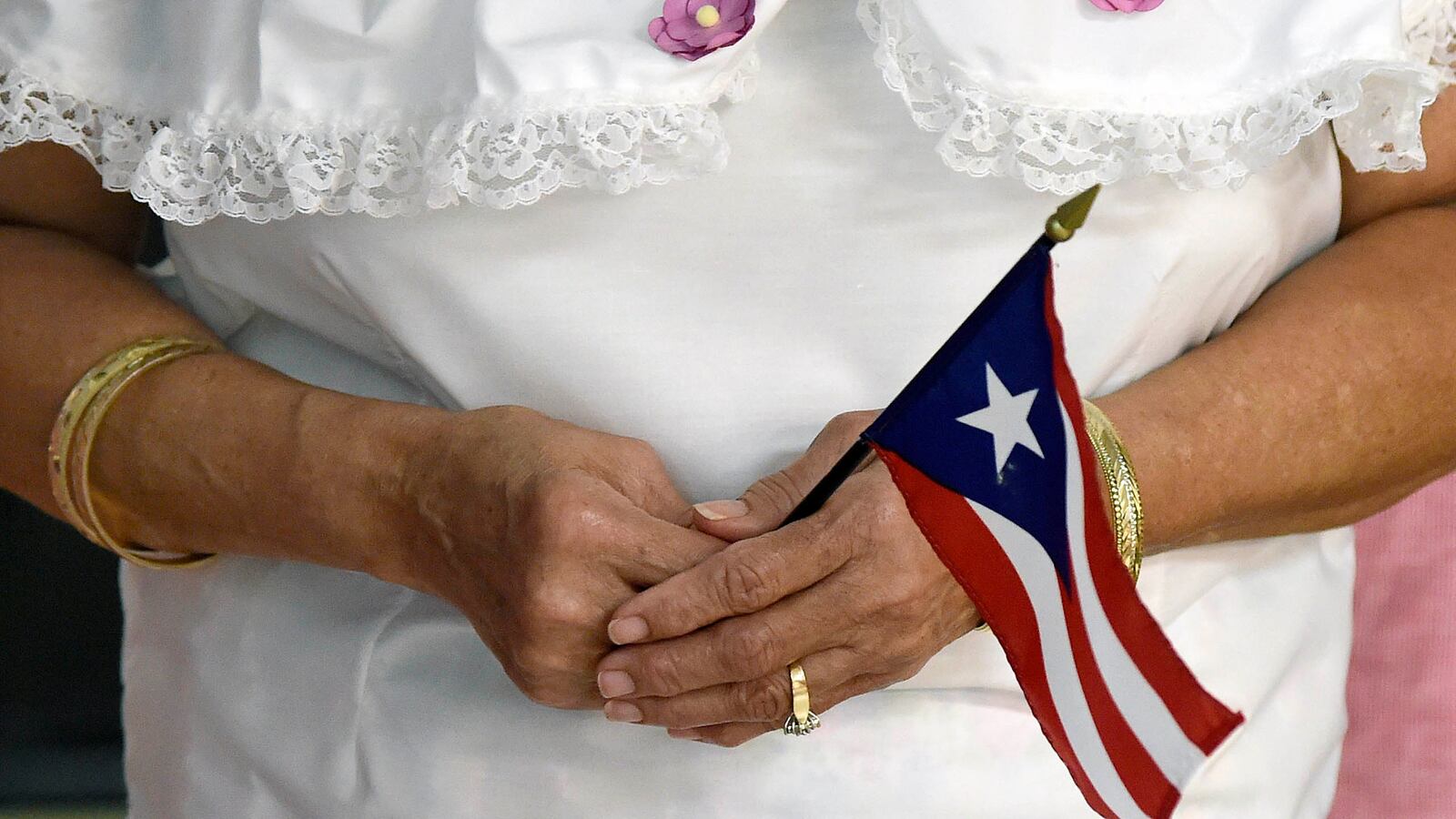
Thanks to Disney and hurricanes, Central Florida is home to a massive chunk of Puerto Ricans. And it turns out that these voters are pretty close to single-issue. What do they vote on? Puerto Rican statehood. Two-thirds support it, and there’s not much variation in support for it by partisan affiliation, age or anything else. Over time, the issue of statehood has become more important to the community.
So, given the influx of Puerto Ricans into the state, supporting Puerto Rican statehood—and prioritizing outreach to Boricuas—is plain common sense.
Trump obviously isn’t doing much of either now, but he did in 2016, when he said that Puerto Ricans “should be entitled to determine for themselves their political status,” i.e., whether to become a state or not. That was a de facto thumbs-up to statehood, since in June 2017, 97 percent of Puerto Rican voters approved moving towards that status, and in 2012, the island also voted for it.
According to Republican political consultants who work in Florida, it helped Trump win the state, too. Though data show that Republican registration among Central Florida Puerto Ricans increased by 7 percent between 2014 and 2017, while Democratic registration has declined by about 8 percent over the same period, the biggest impact was probably Trump “neutralizing” the Puerto Rican vote in the Sunshine State.
Fast forward to 2018, and the Senate race. Both Democratic incumbent Bill Nelson and challenger (and current Gov.) Rick Scott support statehood. But because Scott had a primary challenge—from a Hispanic businessman, no less—he had a reason to be out in public talking about his support for statehood while incumbent Nelson—who had no primary challenger— was lying low.
That dynamic has meant that Scott has been out front of Nelson on statehood rhetorically, and Nelson has bought into that perception with his own rhetoric. Nelson’s campaign website reportedly noted that Scott supports Puerto Rican statehood, “and Nelson agrees.” That makes Nelson look like the follower, not the leader, on this critical issue.
The same might be said of Democratic gubernatorial nominee Andrew Gillum. As of a few weeks ago, consultants working the statehood issue said they were unaware of him taking a stance on the issue. However, this week, he came out in favor of statehood in the context of an endorsement by Puerto Rico’s Governor, Ricardo Rosselló, of both Gillum and Nelson that was notable for how little of an endorsement it really was.
As Rosselló put it regarding the Senate battle, “I really respect and value Gov. Rick Scott and everything he’s done for Puerto Rico… Sometimes it shocks people because they expect that political battles have to be between a superhero and a villain, when in this case in my view it’s two good men that have a lot of value to add.”
“Two good men”—it’s not the stuff of stark political contrasts that Democrats would like. And to add to the fact that Rosselló’s “non-endorsement” sounded pretty danged nice, Scott also has the backing of Puerto Rico’s congressional delegate Jenniffer González Colón, former Gov. Luis Fortuño, current Lt. Gov. Luis Rivera Marin, and Puerto Rico Senate President Thomas Rivera Schatz.
Meanwhile, Republican Ron DeSantis, who also lost out on a Rosselló endorsement, continues to vie for those coveted Boricua votes that Gillum seemed unfocused on, until just days ago.

DeSantis is a co-sponsor of González-Colón’s bill that would pave the way for statehood. He also voted against 2016’s PROMESA Act, which many Puerto Ricans opposed on the basis that it put Puerto Rican finances in the hands of unelected bureaucrats.
DeSantis also notably called out a Republican running to replace him in Congress who talked smack about Puerto Ricans, saying, “Puerto Ricans are U.S. citizens and any suggestion that they should be treated differently than other Americans is beyond the pale… These are our fellow Americans and candidates running for office as Republicans need to be committed to equal treatment under the law for all of our citizens.”
Of course the fact that DeSantis had to make those corrective remarks about Puerto Ricans in the first place underlines the perception among many Hispanics, including Puerto Ricans, that the GOP dislikes and discriminates against them. Trump’s behavior and comments, too, are no help; both Scott and DeSantis are close to the president but cannot afford to appear close to him on Puerto Rican issues.
Maybe it’s just as well that polling shows that 20 percent of Puerto Ricans report voting equally for both parties, i.e., ticket-splitting. Scott and DeSantis could easily end up benefiting from that, while Nelson and Gillum, especially, could end up in closer races than need be because they weren’t out there yelling from the rooftops about statehood until Florida moved past its very, very late-in-the-cycle primary and the general election was underway.
Odds are that the 2018 election will show definitively that in the era of Trump, the GOP is even less popular with Hispanics than it was two, four, six, or ten years ago. But Florida could wind up putting the lie to the notion that Hispanics inherently and strongly lean Democratic. Nelson and Gillum should not be taking Puerto Rican votes in and around Orlando for granted, and neither, frankly, should other Democratic candidates.