Ladies and gentlemen, may I present Jack Norton! He needs no introduction, of course. The Brooklyn-born actor appeared in a remarkable 184 films during his illustrious career, including Calling All Cars, Thanks for the Memory, and the Palm Beach Story. He was much beloved by fans throughout the 1930s and ‘40s. “All he has to do is weave through a swinging door and the audience grins with delight,” wrote a critic in 1944.
Except, of course, that Jack Norton now definitely needs an introduction. I’m pretty sure you’ve never heard of him. He was a character actor, and that character no matter the movie was almost always a drunk. He had numerous walk-on roles in films, often providing comic relief at one society affair or another, instantly identifiable by his pencil mustache and dapper tux. Preston Sturges, legendary director of screwball comedies, loved to toss him a few moments of screen time and a line or two, where he could serve as a sort of comic palate cleanser. Norton’s most notable role? The sodden film director gloriously named A. Pismo Clam, in the 1940 W.C. Fields film, The Bank Dick.
For about a half-century—from Repeal in 1933 until the 1980s—every generation had its own famous film or TV drunk. (Drunks had cameos in vaudeville shows, but they didn’t influence popular culture like later actors.) Walk-on drunks were the court jester, the one who made everyone laugh just by showing up.
W.C. Fields was among the pioneers—I’ve made the argument here that he was the actor who made it socially acceptable to get drunk again after the repeal of Prohibition. Fields was charming in an irascible way, and paved the way for the falling-down toper who became a Hollywood trope for several decades.
Arthur Housman came after Fields, and like Norton, appeared in dozens of films fleetingly, almost always as an endearing inebriate. Then came Norton, who wore his mantle as the national drunk until the early 1950s. In the 1960s, the baton was passed to Hal Smith, the actor who played Otis Campbell, the town rummy on The Andy Griffith Show between 1960 and 1968. He’d stagger in soused at inopportune moments, then lock himself in a cell to sleep it off. His wacky, drink-fueled hallucinations were always good for a few laughs.
The role was then taken up by comedian Foster Brooks, who was often called “the lovable lush.” He was a television and nightclub mainstay, perhaps best known for his appearances on The Johnny Carson Show and at the Dean Martin celebrity roasts, where he managed to interlace his rumbling baritone with various micro-belches, sideways mispronunciations, and nano-repetitions, resulting in a polyphonic symphony of besottedness.
One might think that portraying a drunk would be an easy role for an actor. Walk a little wobbly, slur a few words, and Bob’s your uncle. Yet think of all the unconvincing drunks you’ve see on television and stage, not to mention among your friends who believe their drunk act is flawless. It’s not. All the parts need to fit perfectly, or the act falls apart.
Jack Norton was the Meryl Streep of the lovable inebriates. He studied for his roles and inhabited them, then nailed it each and every time, his regal bearing rendered studiously less regal by drink.
“No drunk’s safe from me,” he once said, describing how he studied drunks. “I prop myself up on a stool and watch the other guy in the mirror.” If he saw a sot weaving down the street, he’d follow him for blocks, picking up movements he could use in his act.
Norton said that after a decade of studying drunks, he could classify them into five types: “those who struggle futilely to maintain dignity, those who would quarrel, those who lapse into confusion, those whose happiness bubbles over, and those who become total wrecks.”
Some of the indicators: the dignified drunk walks very carefully, talks very slowly, and proceeds to wander into briar patches of words, such as, “I’m under the affluence of incohol and the drunker I stand the longer I get.” For the confused drunk, “his legs are rubber and he has all sorts of trouble with doors and elevators and strange ladies.” The wild drunk was the hardest (and his least favorite) role to play: “He’s the boy who swipes drinks out from under other guys’ noses. He has trouble focusing, and his conversation doesn’t make sense.”
Norton’s preferred role was that of the happy drunk. As one critic at the time described it, “Norton gets on a most beautiful glow, a foggy aura of happiness and good will, an attitude of witless camaraderie as bright and bloodshot as the dawning sun.”
Foster Brooks was another who honed his art, and thought long about the role he was playing. Unlike Norton, he’s easy to find on YouTube. But like Norton, he understood that no one archetypal drunk existed, and each of the types progressed from bumbling to blotto along the continuum of an evening. He had to pick one and find a point to land.
Jack Norton’s drunk, Brooks once said, “was falling down drunk. My guy isn’t like that. He’s not objectionable.”
Brooks character aligned more with the “dignified drunk” in Norton’s typology. “I think of the drunk as a favorite uncle who wouldn’t offend anyone,” Brooks once said. “He’s a man who has just had one too many and is doing his best to keep everyone from knowing it. He really doesn’t understand what people are laughing about. The drunk doesn’t think his speech is slurred. He believes he’s fooling people.”
Brooks act was refined enough that it often fooled people who weren’t in on it. When he showed up on stage or live television, someone invariably thought he was an everyday actor who’d had one bracer too many backstage, then sat on the edge of their seat to see if he’d make it through. One of his first performances as a lush was on the Perry Como Show, where he was introduced as a film producer whose job it was to edit down big screen films for the small screen. (His most famous work, he reported, was “The Three Commandments.”) It wasn’t until much later that he took on more serious acting roles, no doubt disappointing audiences who expected him to bobble and slur.
Being famous for being drunk was his cross to bear. “People come up to me and pretend to be drunk,” he told a reporter in 1976. “I don’t quite know what they expect me to do. Should I laugh, or should I say that’s a better drunk than I do, or what?”
The era of the comic drunk began to draw to a close in the 1970s. The decade began with the U.S. Congress passing the Comprehensive Alcohol Abuse and Alcoholism Prevention Treatment and Rehabilitation Act, and ended with the founding of Mothers Against Drunk Driving. Alcoholism was increasingly considered a disease, and making fun of an illness was society’s red line.
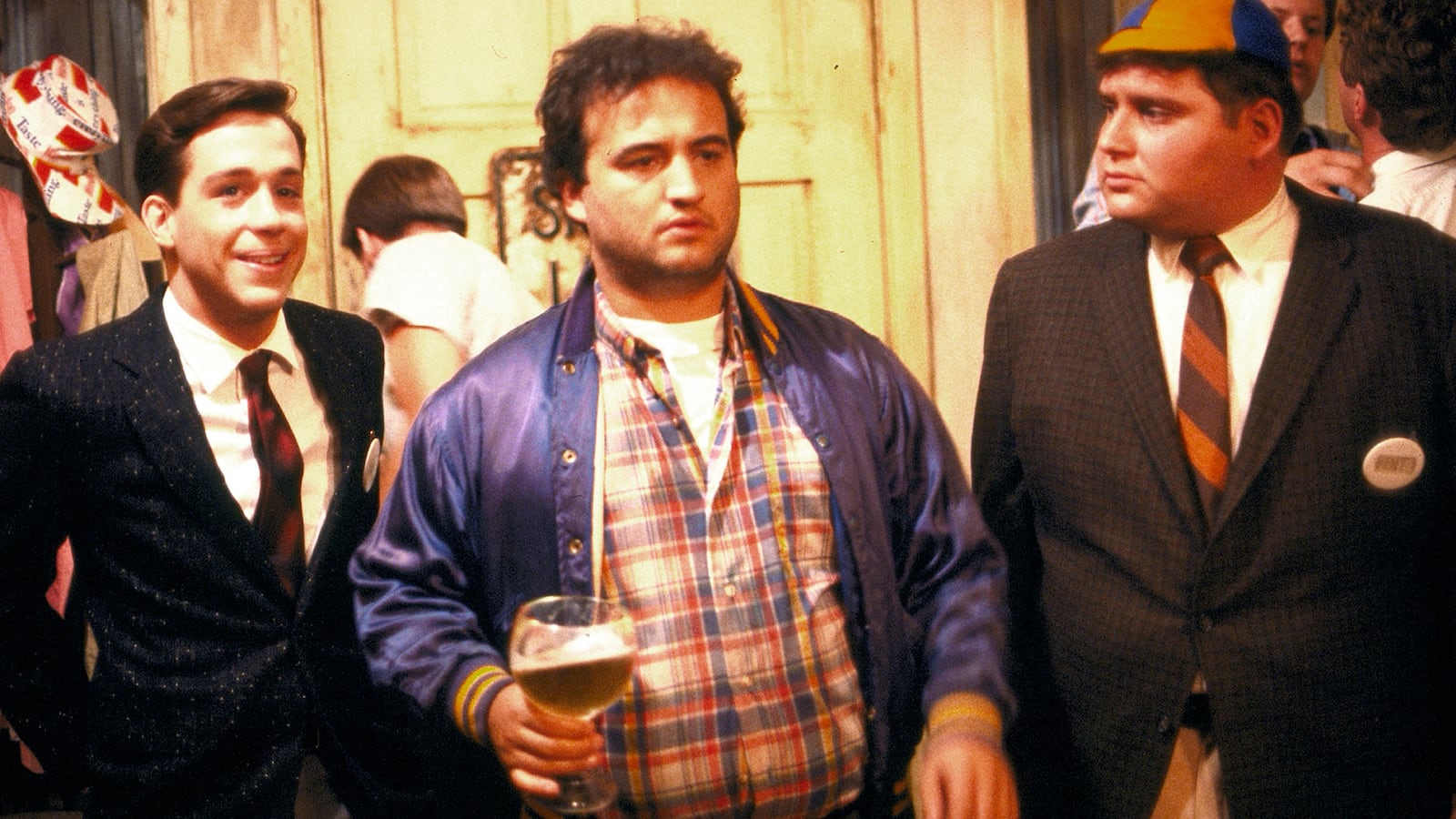
Public inebriates still appeared on screen—John Belushi in Animal House (1978), Dudley Moore in Arthur (1981), Kate Hudson in Almost Famous (2000)—but the drunkenness was invariably part of a more fleshed-out role. (Stoners arguably took over the job of comic walk-on relief about the same time. Think: Cheech and Chong’s Up in Smoke in 1978; Sean Penn in Fast Times at Ridgemont High in 1982). In the 1986 Andy Griffith revival, Return to Mayberry, even Otis had sobered up and now drove an ice cream truck.
The era of the character actor drunk was over. When drunks appeared on the screen, they wore a mantle of pathos, an asterisk that conveyed the notion “Funny, but sad.”
Notably, neither Norton nor Brooks actually drank much. Norton would have one cocktail at a party, then accept a second drink to carry around as a shield so nobody handed him another. Brooks gave up drinking in 1965 on a $10 bet and never went back.
In real life, both were outstanding role models for youth, both serious and sober about their craft.