The One Stereotype That Gloria Steinem Shockingly Busted
She may have been a feminist icon, but she was in on the joke.

Janet Fries/Getty Images
The old joke “How many feminists does it take to screw in a light bulb?” has no punchline. Instead, the joke teller waits for the other person to offer a response, then jumps in angrily to say, “That’s not funny!”
Of all the stereotypes that Gloria Steinem destroyed, my favorite was that feminists don’t have a sense of humor. Gloria was funny. How funny was she? She was funny enough that she received an Emmy nomination for being on the writing staff of the 1965 satirical news show, That Was the Week That Was, where her fellow writers included Buck Henry (Get Smart, The Graduate), Herb Sargent (SNL Weekend Update), and Thomas Meehan (book for the musical The Producers).
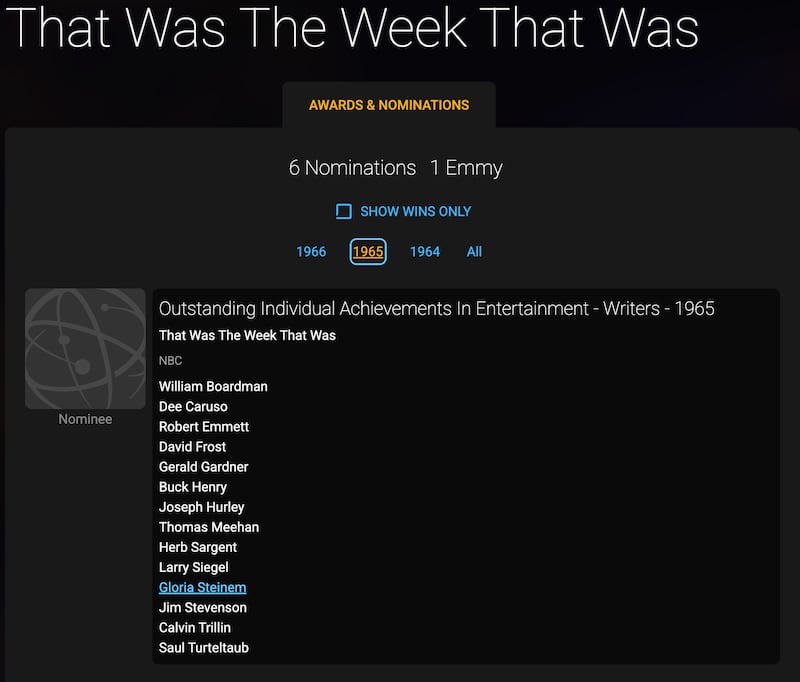
Gloria Steinem was among those nominated for an Emmy in 1965.
Television Academy
She remained a fan of comedy all her life and spoke often about how laughter is “the one free emotion.” No one can compel another person to laugh, she argued, so if someone laughed, it was because they wanted to. The person laughing was in total control.
When Gloria and I first met in 2011, I’d been a comedy writer for three decades and had recently outed myself as a loudmouthed feminist by writing an article that criticized David Letterman and two other late-night talk shows for having zero women on their writing staffs. I’d been the second woman to ever write for Late Night with David Letterman–the first being comedic genius Merrill Markoe–which gave me standing to discuss how the hiring practices on the shows were part of the problem.
The story got traction and, within six months, all three shows had added at least one woman to their writers’ rooms. Gloria was pleased to hear it. As we got to know each other, she talked about the work that she’d been doing recently. She told me she had just returned from India with horrifying stories of women being enslaved and girls being allowed to die before the age of three because their parents didn’t think it was worth spending money getting them medical treatment.
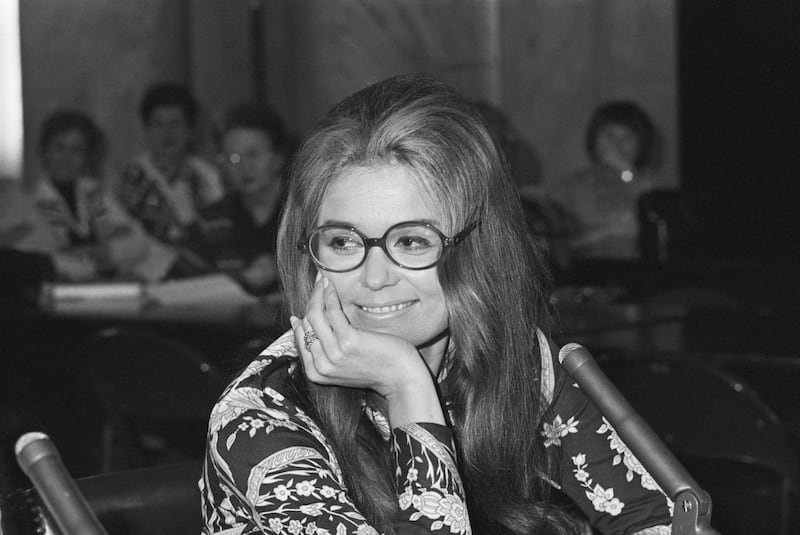
Gloria Steinem, then 36, photographed in 1970.
Bettmann/Bettmann Archive
It was sobering, and my feminist focus seemed trifling compared to hers, so I blurted out, “I can’t believe I care about getting women hired on late-night TV when that’s going on in India.”
Sign Up for The Swamp Newsletter
By clicking “SUBSCRIBE” you agree to our Terms of Use and Privacy Policy.
Gloria leaned forward and placed a hand on my arm. “Oh no,” she said, kindly. “You worry about late-night TV. I’ll worry about India.” She flashed me a knowing smile. It was funny to state it that bluntly, and she knew it. But her point was serious. Fighting patriarchy required a man-to-man defense.
“We need to worry less about doing what is most important, and more about doing whatever we can,” she later wrote. “The truth is that we can’t know which act in the present will make the most difference in the future, but we can behave as if everything we do matters.”

President Barack Obama awarded Steinem the Presidential Medal of Freedom in 2013.
Larry Downing/Reuters
Not long after that first meeting, I saw that the Women’s Media Center had an upcoming awards show hosted by Wanda Sykes. I had an idea for a humor piece to promote the event and asked Gloria if she wanted to write it with me. She said yes.
The concept was basically a Letterman Top Ten list with the category: How would the media be different if it were run by 97 percent women instead of 97 percent men? Some of the entries included:
- 60 Minutes would be 30 Minutes because, frankly, who has the time?
- At the end of romantic comedies, the wise-cracking best friend would get the guy.
- The Real Housewives of Beverly Hills, New York and Atlanta would actually be real housewives of Beverly Hills, New York and Atlanta.
- To preserve realism, when characters get pregnant on TV shows, the actresses would be required to pad not just their bellies, but their butts.
- Violence against women would be the subject of lead news stories, not just opening teasers for crime shows.

Social media feeds are filled with women grinning alongside Gloria selfies. This makes sense, since she spent her life traveling the country, meeting people, and spreading a message of equality. She started out as a feminist but in later years said she preferred the word “humanist.” Her fight for social justice extended to all.
There are many tears being shed at the news of Gloria’s death. What she meant to so many compels us to be sad. But I believe she’d also like us to find something joyful and give our laughter freely. So to honor her, I’d like to offer some new possible punchlines for the joke at the top that reflect the reality of being a feminist screwing in a lightbulb:
“How many feminists does it take to screw in a light bulb?”
“One, but a man will take the credit.”
“How many feminists does it take to screw in a light bulb?”
“One. But I’m not a feminist, so I’m happy to do it for free and thank you for the opportunity.”

Gloria Steinem speaks at the Women's March in Washington, on January 21, 2017.
Shannon Stapleton/REUTERS
“How many feminists does it take to screw in a light bulb?”
“Why change the bulb when there’s plenty of light coming through the glass ceiling?”
“How many feminists does it take to screw in a light bulb?
“Three. One to get arrested for trying… one to fight until it’s legal…and one to stand on the shoulders of the other two.”
See more of our coverage in your search results.

Got a tip? Send it to The Daily Beast here.
Register below to read this article for free or subscribe
to unlock unlimited access to The Daily Beast.
Monthly
$1
First month then $5.99/month
Annual
$35
First year then $59.99/year
Premium
$79
First year then $119.99/year
*Substack access provided by the next business day, using your subscription email. Choosing the Premium plan constitutes your permission to share your subscription email with Substack and your agreement to Substack’s Privacy Policy.
Already have an account? Sign In
Looks like you already have a subscription!
You're all set!
Thanks for subscribing.
Sign in or create an account
Login dialog
Loading comments…