The Unbearable Male Privilege of Beto O’Rourke
Beto doesn’t deserve all the criticism he gets. But his run for the president is showing, once more, the deep inequities in our political culture.
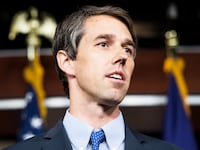
Bill Clark/Getty
Women often jokingly exhort one another to have the confidence of a mediocre white man. The joke is as much about the society that enables and supports unearned hubris as it is about the men it references.
Is Beto O’Rourke mediocre? Maybe not. He’s charismatic and had the guts to run for a statewide elected position in Texas as a real Democrat—something even Wendy Davis, who famously and literally stood up for reproductive rights, didn’t do when she took the “blue dog” approach of positioning herself as a pro-gun Democrat. But his three terms as a member of the House of Representatives were unremarkable, and his policy positions are so vague that one is hard-pressed to outline a single one.
Humility is not a quality found in politics, generally, but there’s something particularly stunning about a man who spent the aftermath of his failed Senate bid doing a sort of “On The Road” soul-search tease of his presidential bid with a Vanity Fair profile in which he declared he is “born for this” and followed it up with a stunningly dull video formally announcing that bid—a video in which he talked straight to the camera for more than three minutes while his wife sat eerily silent beside him.
It’s impossible to imagine a female candidate for whom this approach could work. Can you imagine if Stacey Abrams went on a vision-quest road trip, joked that her spouse (who happens to be the primary breadwinner in the family) mostly raises her kids, then rambled at a camera for three and a half minutes to announce she is simply called to be president? The collective eye-rolling from the nation’s political pundit class might alter the Earth’s orbit.

Many of the critiques of Beto ring hollow. Sure, he lost his Senate bid to Ted Cruz. But he came far closer than many Texas Democrats could have hoped, and the momentum his campaign built helped surge down-ballot Dems in that very red state to victory. And to claim that losing a statewide campaign in Texas means he couldn’t win the presidency is historically ignorant: Both Lyndon B. Johnson and George W. Bush did just that.
Certainly, Beto’s presidential bid could potentially shape up to be galvanizing for voters and impressive in its result. Perhaps he will have actual policy positions! But thus far, Beto’s campaign is telling us more about the institutional problems in our political system—and the way we report and comment on it—than anything else.
Get the best of The Beast delivered right to your inbox
By clicking “SUBSCRIBE” you agree to our Terms of Use and Privacy Policy.
Media coverage tends to fixate on novelty and personality over achievements and substance, and it’s unclear whether or not that is a response to what voters want. Do news consumers truly prefer charm over policy, or are we the ones deciding that Beto’s likability is more interesting than, for example, Elizabeth Warren’s detailed plan to break up Silicon Valley’s corporate giants? Warren’s idea is undeniably groundbreaking, and she has a track record of smarts and diligence that suggests that she can actually accomplish the important goals she highlights. Meanwhile, we don’t even really know what Beto’s goals are, beyond—according to his launch video—avoiding “peril.”
When we look for a compelling story, does it have to be at the cost of an informative one? Just because certain policy ideas have been covered before, does that necessarily mean that they’re not worth highlighting, especially when a candidate is outlining actual specific details about them?
There’s also the difference in what Beto is allowed to express without criticism. He can say he’s unsure of himself, that he lost of a sense of purpose, that he feels self-doubt. Honestly, that’s nice to see in a man, particularly one in politics! But it’s disappointing when you consider how poorly it would be received coming from a woman. If Kirsten Gillibrand, for example, were to express self-doubt, she would likely be attacked—even more than she already is—for being uncertain, unprepared, or, even worse, emotional.
It’s not news that women—in politics and probably every other arena—have to be at least twice as qualified and still expect at least twice as much criticism and doubt. But the Beto reception points to a problem that persists specifically in presidential politics today, for both Democrats and (as the current presidency clearly illustrates) Republicans: We have a bias towards newness, conflict, and theater. And we place an outsized premium on figuring out which candidate can win without enough consideration as to who will do a good job should they win.
We’re only a day into the Beto candidacy—there’s certainly still a chance that he could impress, inform, and demonstrate an ability to succeed once in office. But so far, the rollout of his campaign seems to be little more than an exercise in vanity that would’ve gotten a female candidate laughed out of the news cycle.
See more of our coverage in your search results.

Got a tip? Send it to The Daily Beast here.
Register below to read this article for free or subscribe
to unlock unlimited access to The Daily Beast.
Monthly
$1
First month then $5.99/month
Annual
$35
First year then $59.99/year
Premium
$79
First year then $119.99/year
*Substack access provided by the next business day, using your subscription email. Choosing the Premium plan constitutes your permission to share your subscription email with Substack and your agreement to Substack’s Privacy Policy.
Already have an account? Sign In
Looks like you already have a subscription!
You're all set!
Thanks for subscribing.