A Robot May End Up Building the Battery of the Future
Another job taken away from humans.
Sergey Klopotov via Getty
In the search for a better battery, researchers have explored options ranging from using molten salt, trees and plants, and even crabs and shrimp. One of the biggest hurdles in the way of fully electrifying cars, trains, and planes, though, is the fact that it takes so much time to simply make a battery. Much of that time is devoted to finding and experimenting with the correct materials to make an electrolyte—the solution in which positive ions flow through a battery in order to provide your devices with the juice it needs to run
But that all might change soon. In a study published Tuesday in the journal Nature Communications, researchers have devised a system using a robot and an AI in order to find the best recipe for a lithium-ion battery’s electrolyte much quicker than traditional methods. The study’s authors say that the system could even lead to faster charging and longer lasting batteries.
“Developing high-energy and efficient battery technologies is a crucial aspect of advancing the electrification of transportation and aviation,” the authors wrote. “However, battery innovations can take years to deliver.” They add that non-liquid electrolyte batteries have “many design variables” when it comes to selecting the right combinations of solvents and salts—resulting in a resource-intensive process.

That’s why the team created a Rube Goldberg-esque robotics platform dubbed Clio that’s capable of mixing and formulating liquid samples in order to identify the best electrolytes. The robot was combined with an AI software dubbed Dragonfly that planned the experiment and also created a material sampling strategy for Clio to mix and match the right formulas.
The system was capable of autonomously finding electrolyte formulations in two working days—which is six-times faster than a typical random search. Moreover, when the electrolytes were tested in lithium-ion pouch cells, the researchers found that they were able to charge more quickly against the baseline experiment with a commercially-available electrolyte solution.
Batteries that can be created faster and more efficiently without sacrificing performance or quality is the holy grail for the future of everything from consumer electronics to transportation. While Clio and Dragonfly are still in their nascent stages, the experiment demonstrates that bots can help build a better battery—and that could be the thing we need to power the future.
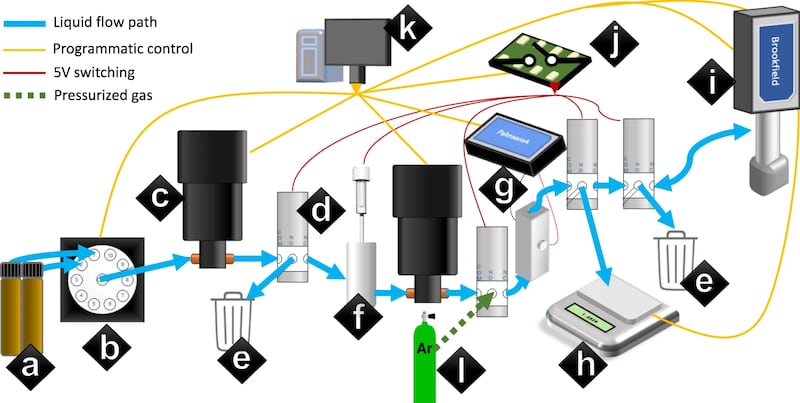
Clio is capable of mixing and formulating liquid samples in order to identify the best electrolytes.
Nature Communications
See more of our coverage in your search results.

Got a tip? Send it to The Daily Beast here.
Register below to read this article for free or subscribe
to unlock unlimited access to The Daily Beast.
Monthly
$1
First month then $5.99/month
Annual
$35
First year then $59.99/year
Premium
$79
First year then $119.99/year
*Substack access provided by the next business day, using your subscription email. Choosing the Premium plan constitutes your permission to share your subscription email with Substack and your agreement to Substack’s Privacy Policy.
Already have an account? Sign In
Looks like you already have a subscription!
You're all set!
Thanks for subscribing.