Inflation soared in March as President Donald Trump’s war in Iran drove up prices for Americans across the country, with energy costs skyrocketing due to the conflict.
The Consumer Price Index for March showed prices were up 3.3 percent from a year ago, as the inflation rate shot up to 0.9 percent last month, up from 0.3 percent in February.
The acceleration of price increases in March was the biggest one-month jump in costs since June 2022, despite the president’s insistence that he’s solved inflation.
Energy costs rose the most as consumers saw gas prices surge above $4 over the past month, with the war having a ripple effect across the globe.
The report showed annual inflation was higher last month than it was during President Joe Biden’s final month in office.
Meanwhile, consumer confidence plunged to a record low in April, a University of Michigan survey showed, as Americans fear the ongoing impact of the war.
The price of gas, according to the CPI, was up more than 21 percent last month alone. making it the largest monthly increase ever since the CPI was first published in 1967.
Meanwhile, the cost of oil soared more than 30 percent in March. It was the largest monthly increase in oil prices since February 2000 and brought the cost of oil up 40 percent from a year ago.
Overall, energy costs jumped 10.9 percent, the largest monthly increase for the index since September 2005.
While the U.S. is in a fragile ceasefire with Iran, shipping through the Strait of Hormuz remains disrupted even as Trump has demanded it be reopened immediately. The president even accused Iran of not keeping the agreement late Thursday, but the details around the deal remain vague.

At the same time, airfare prices were up 2.7 percent in March up from the 1.4 percent increase the month before. Airfare is up nearly 15 percent from a year ago.
While the cost of food showed no changes in price from February to March, according to the CPI, economists have already warned that the costs could go up later this spring and summer as farmers and others struggle with increased costs.
Other costs of other goods are also expected to go up as they hit shelves later this year due to the increases in the price of shipping.
While Americans are feeling the strain of the war half a world away, incomes are barely keeping up with the strain. Wage growth is up 3.5 percent year-over-year, according to the CPI, so it has been almost entirely eaten away by the higher costs of living with prices up 3.3 percent from a year ago.
In response to Daily Beast’s inquiry about the latest data showing prices up and some monthly energy cost increases being the largest in decades or in the case of gasoline ever recorded, the White House pointed to a statement on social media.
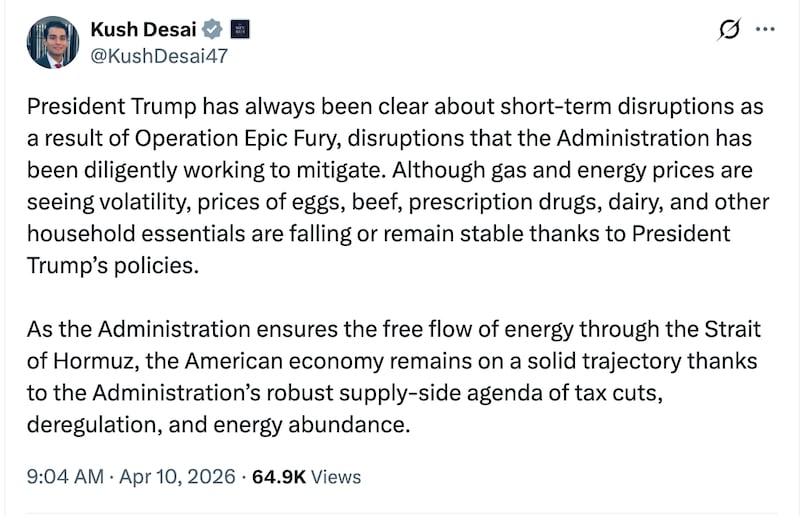
“President Trump has always been clear about short-term disruptions as a result of Operation Epic Fury, disruptions that the Administration has been diligently working to mitigate,” spokesperson Kush Desai posted on X.
He argued that while energy costs are volatile, prices for food, prescription drugs and other household goods are down or remain stable.
“As the Administration ensures the free flow of energy through the Strait of Hormuz, the American economy remains on a solid trajectory thanks to the Administration’s robust supply-side agenda of tax cuts, deregulation, and energy abundance,” he claimed.
But the timing on when there would be the “free flow” of shipping through the crucial waterway still remains unclear.
Trump’s top economic adviser, Kevin Hassett, appeared on Fox Business on Friday morning, where he was pressed about price increases. In the end, he resorted to talking about the lower cost of eggs, which have fallen dramatically from a year ago. It’s the same example the president repeatedly brings up when touting lower costs, even before the war.
In response, Stuart Varney even told Hassett, “That was a bit of a filibuster.”