President Donald Trump’s disastrous second stint at the White House has set off a market fireworks display not seen since the eve of the 2007 financial crisis that cratered the global economy.
In simple terms, investors are reluctant to lend the government money, and are demanding more in return. That innocent-sounding tidbit signals that everything from mortgages to car loans and credit cards is about to get more expensive.
It’s happened partly because of the carnage Trump, 80, has inflicted by borrowing more cash himself, going to war with Iran, failing to curb inflation, and handing out favors to his pals in the AI industry.

The shift slams hard into the president’s claims of having ushered in a veritable golden age of U.S. economics. He told a Las Vegas rally earlier this month that his administration has achieved the “greatest economy we’ve ever had by far,” with only a touch less self-assurance than when he told Fox Business in February that “I think we have the greatest economy actually ever in history.”
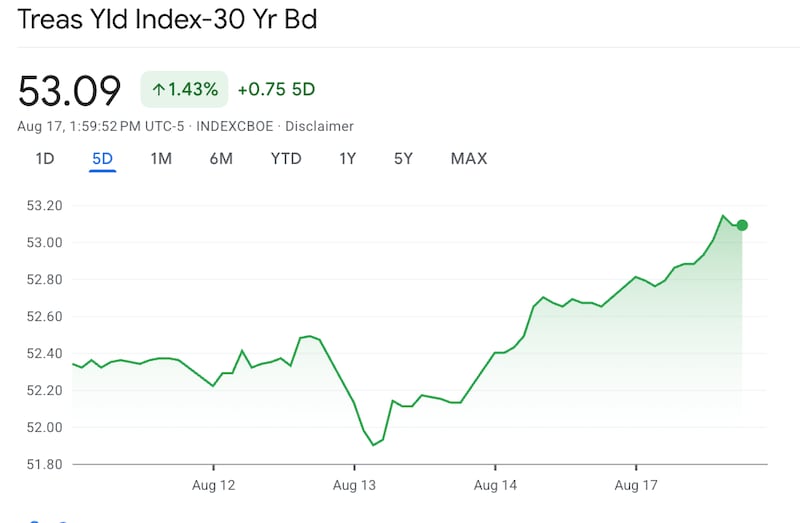
Washington has long spent more than it brings in. To cover some of the gap, it borrows, selling bonds to investors who hand over cash now in return for that money back, plus interest, at the end of a fixed term. What the government pays those lenders is called the “yield,” and the market sets it. When lending to Washington looks risky, investors demand more. When it looks safe, they’ll accept less.
The yield on 30-year bonds issued by the U.S. Treasury hit 5.327 percent on Tuesday, Reuters reports. That’s a whisker below where it stood in 2007, when it topped out at 5.44 percent just before the global financial system began to fall apart.

What came next was more than a decade of cheap money. Central banks cut interest rates to the bone just to keep people spending and economies moving, and borrowing money stayed unusually cheap for years. Because the 30-year Treasury yield is considered the benchmark for long-term borrowing across the country, Tuesday’s figure is a sign the cheap era is finished, and that getting financial help is going to cost everyday Americans more for a long, long time.
A key factor driving the 30-year-yield up has been how much Trump is borrowing for his MAGA agenda. At $827 billion, the government now spends more on interest payments to lenders than on the military. Every new bond his administration sells adds to a pile investors already worry it might not be able to pay back, and so the more it borrows, the more it has to pay to get their money.
The president’s war with Iran, now in its sixth month, has only made things worse. The Strait of Hormuz, through which roughly a fifth of global oil supply passes each year, has remained closed throughout the conflict. Costs soared above $90 a barrel on Tuesday, and when oil costs more, everything it helps make, grow, or move does too.
Rising prices across the board are what’s known as inflation, which also spooks investors because it eats into what they’d get in return for lending to the government. Trump has failed to rein that in as well, with the Federal Reserve’s measure of inflation leaping 3.4 percent through July.
Trump has also been at pains to boost the AI sector since retaking the White House. That effort has seen tech giants build AI data centers on a colossal scale and borrow money at a rate to match from the same investors the government is otherwise courting. When two big borrowers compete, the lender gets to name their price, driving up the yield.
Tuesday’s shift comes ahead of November’s crucial midterm elections, when Republicans face what will be a bruising battle to retain control of the House and Senate. Voters have consistently ranked the economy, and in particular cost-of-living concerns, as a chief anxiety ahead of those polls, handing Democrats a stonking eight-point lead on the generic Congressional ballot.
The Daily Beast has contacted the White House for comment on this story.