Donald Trump’s attempt to calm nerves about his war on Iran will likely come at a price to American consumers after it sent global oil prices sharply higher.
“We’re now totally independent of the Middle East, and yet we are there to help,” the president said in a televised speech Wednesday night, marking his first address to the nation since he ordered air strikes on Iran more than a month ago in a war that has already pushed U.S. gas prices up to $4 a gallon.

“We don’t have to be there, we don’t need their oil, we don’t need anything they have, but we’re there to help our allies,” Trump said. He added that his administration was “nearing completion” of its core objectives in the war, and that “the gas prices will rapidly come back down” once it is concluded.
Trump began speaking at 9 p.m. By the time he was done, 18 minutes and 39 seconds later, Brent crude, the global benchmark for oil prices, had jumped 3.2 percent to $104.44 per barrel, with West Texas Intermediate up 2.2 percent to $102.36 per barrel. Those rises continued through the night, with Brent up 6.5 percent to $107.78 per barrel and WTI up 5.9 percent to $106.02 per barrel as of Thursday morning.
All three major U.S. stock futures indices dropped by more than 1 percent. European stock markets opened Thursday to similar falls, with even sharper declines seen in Asia.
That’s partly because markets had somewhat rallied over the past few days in the expectation—or at least the hope—that Trump might signal an imminent end to hostilities.
Instead, the president told viewers the conflict will last for at least another two to three weeks, during which he plans to hit Iran “extremely hard” in order to bomb it back to the “Stone Ages,” likely targeting key electricity plants in the event no ceasefire deal is reached.
Iran has made clear over the past few weeks that it views any attacks on its energy infrastructure as a red line. After Israel struck the regime’s massive South Pars gas field on March 18, Tehran launched retaliatory missile and drone strikes against oil and gas facilities across the Gulf, hitting targets in Saudi Arabia, Qatar, Kuwait, and the UAE, all U.S. allies.
The Iranian foreign minister warned in the aftermath of those attacks the regime had used only a “fraction” of its power, and that it would show “zero restraint” if its infrastructure were targeted again. It has since tightened its chokehold on the Strait of Hormuz, a vital naval trade corridor through which one-fifth of global oil supplies passes.

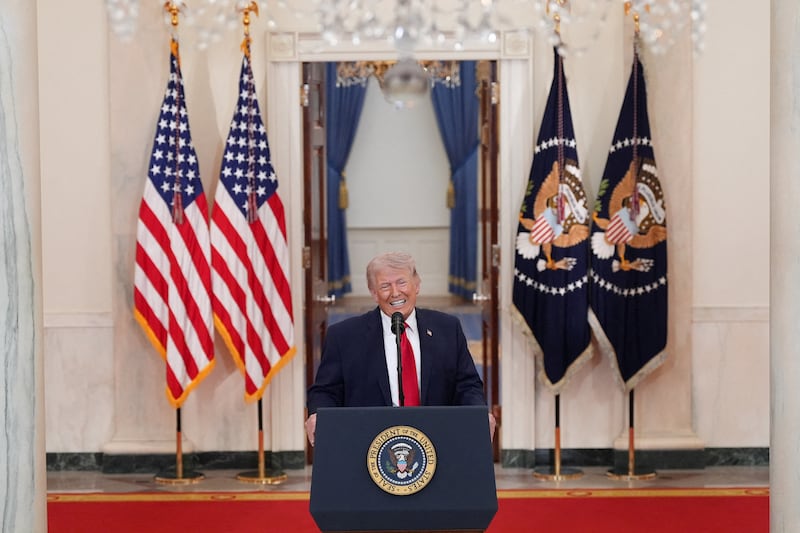
Pundits were quick to attribute market chaos to Trump’s confused suggestion that the war is on the one hand nearing an end, but at the same time likely only to intensify in the near future.
“There was a bit of inherent contradiction in saying that the objectives are very nearly complete, it’s almost over, but we’re going to attack Iran into the Stone Age over the next few weeks,” CNN host John Berman remarked after the president concluded his address.

“If you want a sense of how the reaction is being felt around the world, I’ve been watching oil prices, both Brent Crude and West Texas,” he said. “Up 3 to 4 percent in just the last hour while the president’s been speaking.”
Panelist Col. Cedric Leighton was of the same mind. “What that indicates to me is that the markets aren’t really buying what the president is saying,” he said. “I think there will be some costs associated with that, in terms of popular support.”
The Daily Beast has contacted the White House for comment on this story.