
America’s relationships with some of its closest allies appear to be fraying as public opinion shifts sharply under Donald Trump.
According to a new Gallup poll, conducted between February 2 and 16 among 1,001 adults, Americans’ views of two of its closest allies, Canada and Great Britain, have reached a record low.
Some 80 percent of Americans view Canada favorably, while 76 percent view Great Britain favorably. That is an 11 and 12-point decrease since last year.
The decline was mostly driven by Republicans. Among GOP voters, favorable views of Canada fell sharply by 23 points, while positive perceptions of Great Britain dropped by 20 points.
Independent voters also showed declining support for both nations, with favorable opinions of Britain dropping to 72 percent from 77 percent last year, and positive views of Canada falling to 80 percent from 89 percent the previous year.
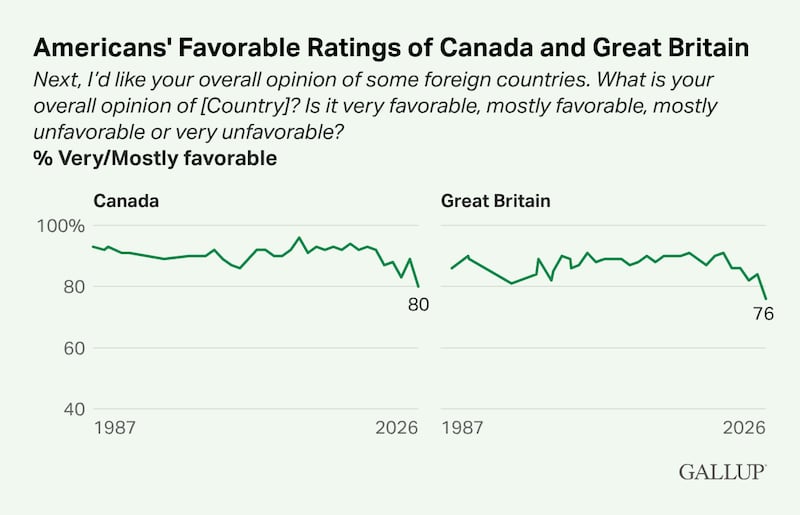
Democrats moved in the opposite direction on Canada, where favorable opinions ticked up by 3 points, though their views of Great Britain slipped slightly, declining by 4 points. However, their opinion of the U.K. remained broadly in line with trends seen over the past decade.
The Daily Beast has contacted the White House for comment.
It comes as Trump has spent much of the first 14 months of his second term consistently provoking and criticizing America’s traditional allies.
Trump has floated the idea of annexing Canada and making it the 51st U.S. state, and slapped tariffs on Canadian steel, aluminium, and automobiles.
The move sparked trade tensions, which Canada met with its own retaliation. Trump has also recently threatened to block the opening of a $4.6 billion bridge connecting Detroit, Michigan, with Windsor, Ontario, demanding that the U.S. be given 50 percent ownership.
The 79-year-old president also picked a fight with Canada’s Olympic hockey team after the U.S. men’s hockey team defeated Canada for Olympic gold at the Winter Games.

In a provocative move, the White House shared a graphic showing an American bald eagle standing over a Canadian goose, a direct jab at the country.
The post came in response to a remark by former Canadian Prime Minister Justin Trudeau from February last year, in which he said: “You can’t take our country—and you can’t take our game.”
Meanwhile, Trump has publicly insulted Britain’s Prime Minister Keir Starmer, rebuking him over the UK’s response to the U.S. military campaign in Iran.
Trump told The Telegraph he was “very disappointed” that Starmer initially declined to allow American forces to use British military bases, such as Diego Garcia and RAF Fairford, as launch points for strikes against Iranian targets—a rare rebuff in the long‑standing “special relationship” between Washington and London.
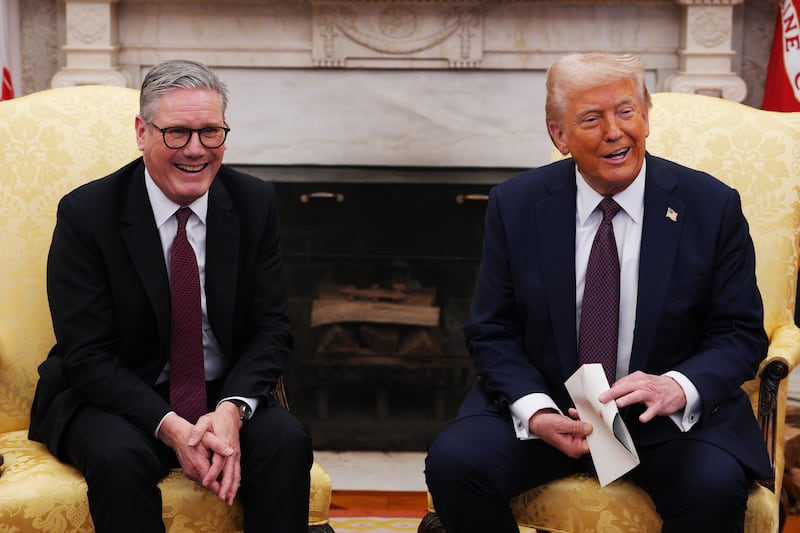
Trump has since taken to his Truth Social platform to critique the UK, calling it “our once Great Ally” and saying “we don’t need people that join wars after we’ve already won,” after London signaled possible deployment of aircraft carriers to the Middle East.
Starmer defended Britain’s more cautious approach, saying he needed to be satisfied that any military action was legal and well‑planned before granting support.
Trump has also ruffled the feathers of U.S. allies with his threat to annex Greenland.
Starmer has been firm that Greenland’s future belongs to the Danish realm and its people alone, telling the BBC that decisions about the territory should be made only by Denmark and Greenland.
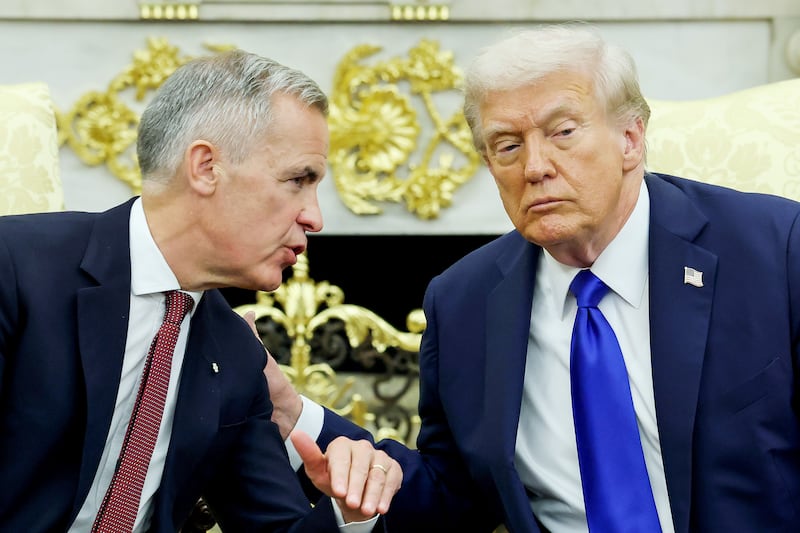
Canadian Prime Minister Mark Carney also publicly sided with Denmark and Greenland, affirming that Greenland’s fate should be determined by its own people and Danish authorities.
Amid the tensions between the allies, the feeling in Canada and Britain is mutual.
A POLITICO Poll conducted Feb. 6–9 found Canadians are far more likely than Europeans to view the U.S. as a greater threat to global peace than Russia. Nearly half of Canadians, 48 percent, ranked the United States as the biggest threat to world peace, compared with just 29 percent naming Russia.
The same poll found that the majority of Canadians do not believe the U.S. is a reliable ally.
In the UK, YouGov polling from December 2025 found that 40 percent of Brits think the special relationship between the U.K. and the U.S. is “not very close,” while 18 percent said it is “not at all close.”