President Donald Trump is scrambling to contain the economic consequences from his war with Iran—consequences he was repeatedly warned about before launching the campaign.
The Treasury Department announced on Friday that decades-old sanctions on Iranian oil have been lifted on 140 million barrels that have already been shipped out of the Strait of Hormuz, a move that will likely help Iran finance its war effort against the U.S.

Iran’s closing of the Strait has been one of the worst crises for the White House since the war began on Feb. 28. The Trump White House has tried and failed to build a coalition of allies to reopen the Strait of Hormuz. Before Trump launched his deadly war three weeks ago, around 20 percent of the world’s shipments passed through the Strait.
Treasury Secretary Scott Bessent wrote on social media Friday night that lifting the sanctions — first imposed after Iran’s 1979 revolution — will help “to relieve the temporary pressures on supply caused by Iran.”
Leading up to the war, Trump had been repeatedly warned by his top generals that Iran would likely disrupt the Strait of Hormuz in response to a U.S. attack.
In several briefings, Gen. Dan Caine, the chairman of the Joint Chiefs of Staff, warned the president that Iran would send missiles and drones to the area, but the president moved forward with an attack anyway.
The sanctions lift has left experts and lawmakers puzzled, as they argue that it will provide Iran with a sudden influx of cash, up to $14 billion by one estimate, that will only help it as it fights against the U.S.
“This move directly contradicts Trump’s own statements that the United States is considering winding down this conflict,” Brett Erickson, managing principal at Obsidian Risk Advisors, which specializes in financial crime and regulatory issues, told the Washington Post.
“You don’t unsanction Iranian oil if you’re winding down. This is the action of an administration that has no exit ramp and knows it. The word for that is desperation,” he continued.

Danny Citrinowicz, a senior researcher on Iran at the Institute for National Security Studies, told NBC News that “The U.S. is funding a war against itself.”
“What we are seeing is really a flawed campaign, not in terms of operational size, but from the strategic preparation for the campaign itself,” he said. “The oil price is becoming much more important than eliminating this regime in Iran.”
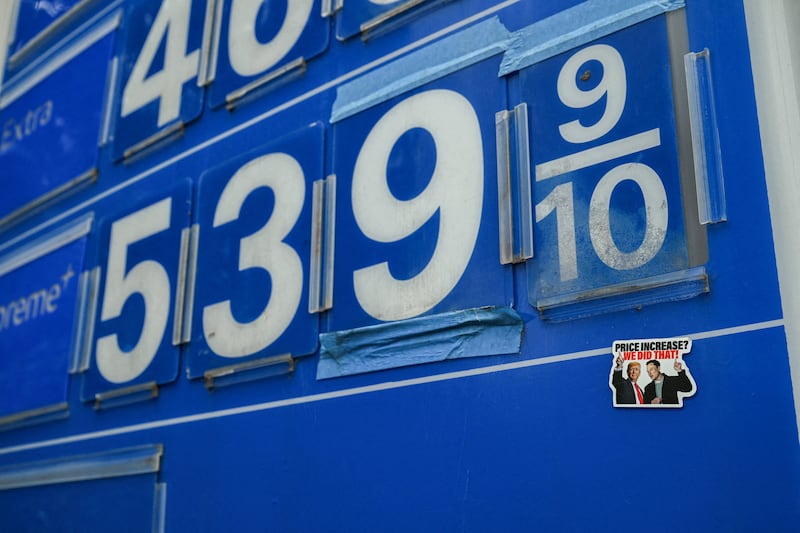
Gas prices for American consumers have risen about 93 cents per gallon, and the price of U.S. crude oil has skyrocketed more than 70 percent since the beginning of the year.

In an even more worrying sign for consumers ahead of the summer travel season, United Airlines CEO Scott Kirby wrote to employees in an email that the company is prepared to cancel some flights as it anticipates higher oil prices due to the war.
“Our plans assume oil goes to $175/barrel and doesn’t get back down to $100/barrel until the end of 2027,” Kirby wrote. “Honestly, I think there’s a good chance it won’t be that bad,” he wrote, but added that “there isn’t much downside for us to preparing for that outcome.”