
If anyone was expecting moderate Republicans in Congress to temper Donald Trump’s more extreme plans on immigration and tariffs, the president-elect doesn’t plan to give them the chance, Trump told lawmakers this week.
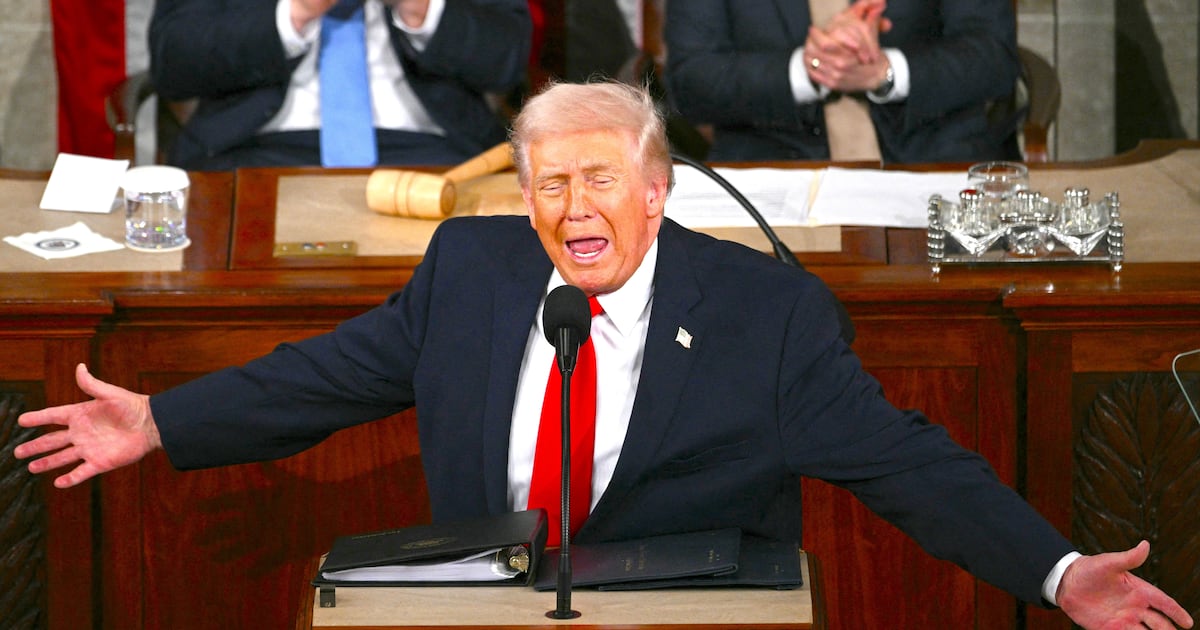
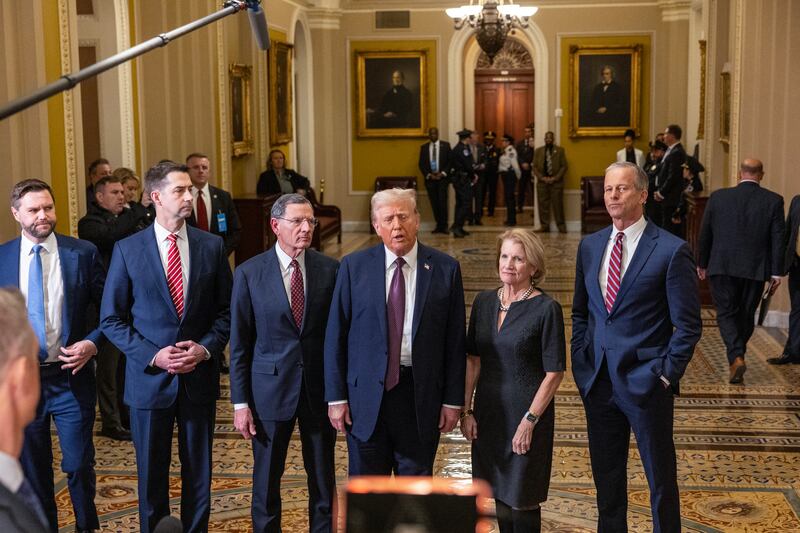
During a two-hour meeting with Senate Republicans, Trump said he plans to immediately enact his MAGA vision instead of waiting for Congress to act, according to a new report in the Wall Street Journal. He has already prepared about 100 executive orders, and he has no qualms testing the legal limits of presidential authority, he said.

For months, Trump’s aides have been looking at obscure laws passed about 50 years ago that he can invoke to unilaterally carry out his plans and bypass congressional funding limits. Instead of feeling preemptively constrained by constitutional checks and balances, he plans to do what he wants and take his chances with the courts, the Journal reported.
“The American people can bank on President Trump using his executive power on day one to deliver on the promises he made to them on the campaign trail.” Trump transition spokesperson Karoline Leavitt told the Daily Beast in a statement.
For example, to help pay for his mass deportations, he plans to use the 1976 National Emergencies Act, which he also used to fund parts of his border wall during his first term. Previous presidents used the act to fund things like the response to the Sept. 11, 2001, terror attacks—not to fund something Congress had explicitly declined to pay for, the Journal noted.
Trump is also eyeing a provision in the 1944 Public Health Service Act called Title 42 that lets the government expel migrants coming from countries with communicable diseases. The Centers for Disease Control and Prevention used it to lock border entry during the COVID-19 pandemic, and now, Trump is disease-shopping to find a new excuse to invoke it.
He also reportedly plans to issue an executive order limiting birthright citizenship, even though the 14th Amendment to the Constitution explicitly says, “All persons born or naturalized in the United States, and subject to the jurisdiction thereof, are citizens of the United States.”
Instead of taking on the near-impossible task of changing the Constitution, he apparently wants to issue an executive order and then argue to the Supreme Court that the 14th Amendment doesn’t actually guarantee birthright citizenship.
Meanwhile, on the tariff front, Trump is reportedly intrigued by the idea of using the 1977 International Emergency Economic Powers Act—which lets the president impose tariffs and economic sanctions during times of war or another national emergency—or the 1974 Trade Act, which allows tariffs to be used to address national security concerns.

In theory, those laws don’t just give the president unchecked power, though. The Supreme Court has held that any time a federal agency tries to enact a policy with “vast economic and political significance,” the courts have to scrutinize the law in question to determine whether Congress actually intended to give the agency that power.
The Supreme Court used this so-called “major questions doctrine,” to strike down two of President Joe Biden’s key policies in 2022 and 2023. It remains to be seen whether the justices will hold Trump—who appointed three of them to the bench—to the same standard.
This week, Trump announced he planned to create an “external revenue service” to collect “tariffs, duties and all revenue that come from foreign sources,” which in theory would need to be approved by Congress.

The announcement obscures the fact that “tariff” is just a fancy word for an American tax paid by American businesses on imported goods, with the added costs typically passed on to American consumers.
In November, Trump proposed a 25 percent tariff on all products from Mexico and Canada and a 10 percent tariff on products from China. That would amount to about $272 billion in taxes, economists told CNN at the time, which would in turn drive up prices.
Business groups are already lobbying the president for tariff exceptions and carve-outs, the Journal reported. That might explain in part why so many of America’s billionaires—whose companies rely on Chinese manufacturing—are flocking to Washington, D.C., for Trump’s inauguration on Monday.