Donald Trump has vowed to “keep bombing our little hearts out” if he doesn’t get his way on Iran, in a wild rant where he repeatedly contradicted himself over the war he started.
Days after insisting he didn’t want a ceasefire because Iran was being “obliterated,” the president claimed his administration was now having “productive talks” to end the conflict.
He also suggested there could be “a very serious form of regime change” in Iran, despite saying earlier that this was not one of his objectives.
But the 79-year-old president couldn’t name which “top” Iranian official the U.S was speaking to as part of the talks—even as he insisted that Iran was prepared to give up its entire nuclear program.
And after saying last week that “we don’t need” the Strait of Hormuz, where 20 percent of the world’s oil usually flows, Trump bizarrely claimed that he could end up having control of the critical waterway once it was unblocked.
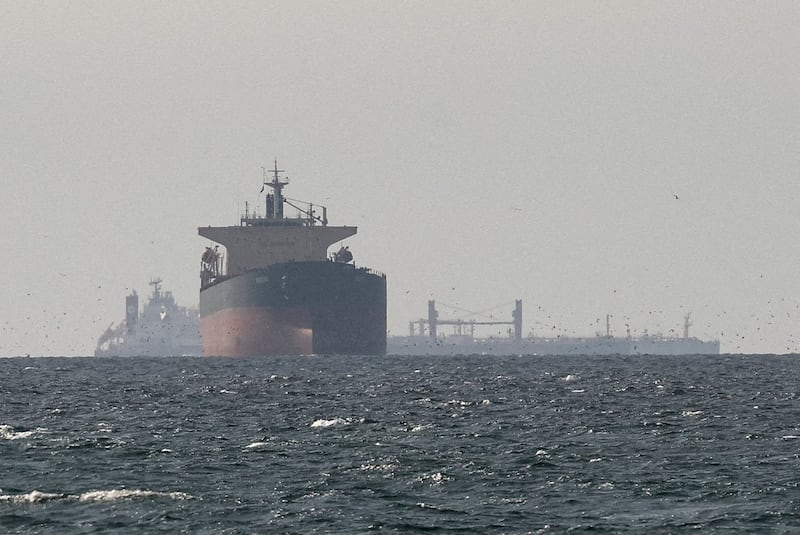
“Me and the ayatollah, whoever the next ayatollah is,” Trump said when asked who would have authority of the Strait if the war ended.
“Maybe me,” he added.
Trump’s comments, made to reporters before he left Palm Beach on Monday morning, added confusion to what has already been a war underpinned by mixed messages, contradicting statements, and wild claims from both sides.
On Saturday, for instance, the president sent the markets into a frenzy by announcing he would destroy Iran’s power plants if they didn’t fully open the Strait of Hormuz within 48 hours.
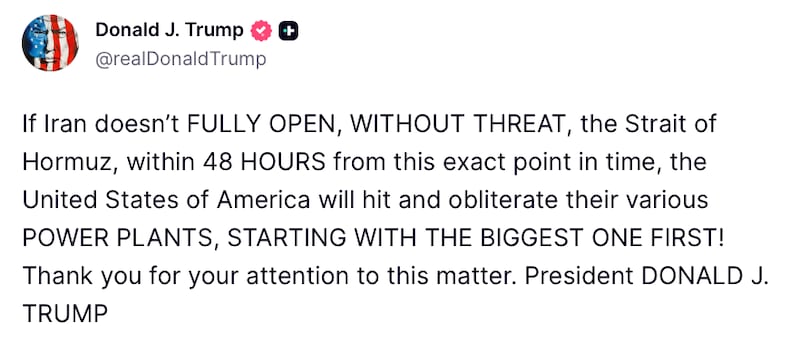
But on Monday morning, merely hours ahead of his deadline and after threats of retaliation from Iran, Trump announced he had given orders to postpone any military strikes against Iranian power plants for five days because the two countries had “very good and productive conversations.”
“If it goes well, we’re going to end up settling this. Otherwise, we just keep bombing our little hearts out,” he told reporters.
But Trump’s claims of talks were immediately rejected by Iran, with an unnamed official telling state media: “There is no direct or indirect contact with Trump. He retreated after hearing that our targets would be all power plants in West Asia.”

A Middle East-based diplomatic source also told the Daily Beast that some of America’s Gulf allies were caught off guard by Trump’s announcement and viewed it as a pause intended to bring down oil prices and attract more assets to the region, rather than an exit strategy.
Trump’s comments briefly sent the price of the Brent crude oil benchmark down around 13 per cent, to below $100 a barrel.
“It’s certainly convenient that there were productive talks going on so that our markets would come back up,” Trump’s former National Security Adviser John Bolton told CNN.
“I think the basic problem remains the regime: as long as they’re there, they now have palpable proof that if they close the Strait of Hormuz, the world’s economy suffers.
“So their leverage is significantly up if we allow this to continue.”
Trump, however, insisted that his son in law Jared Kushner and special envoy Steve Witkoff had discussions with Iranian representatives on Sunday, and would continue to do so again today.
“Tomorrow morning, their time, we were expected to blow up their largest electric generating plants that cost over $10 billion to build,” he said.
“One shot: it’s gone; it collapses. Why would they want that? So they called—I didn’t call—they called. They want to make a deal.”

He said there were about “15 points” of agreement to settle, with Iran giving up its nuclear weapons as “number one, two and three.”
Asked if Iran had said yes to that demand, he replied: “They’ve agreed.”
But negotiations over Iran’s nuclear program were also underway before Trump decided to join Israel in the war against Iran on February 28.
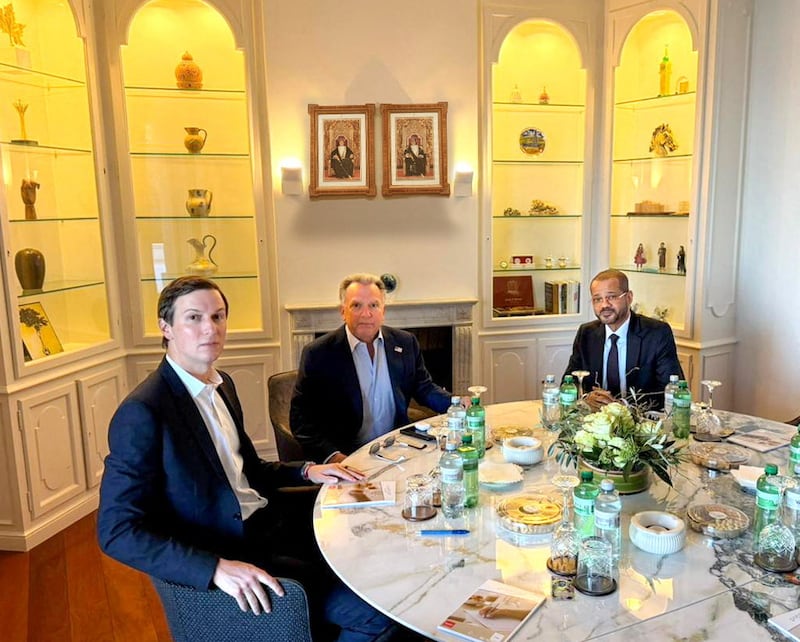
At the time, Oman was acting as a mediator, and while there were sticking points, Oman’s foreign minister said a “breakthrough” was close.
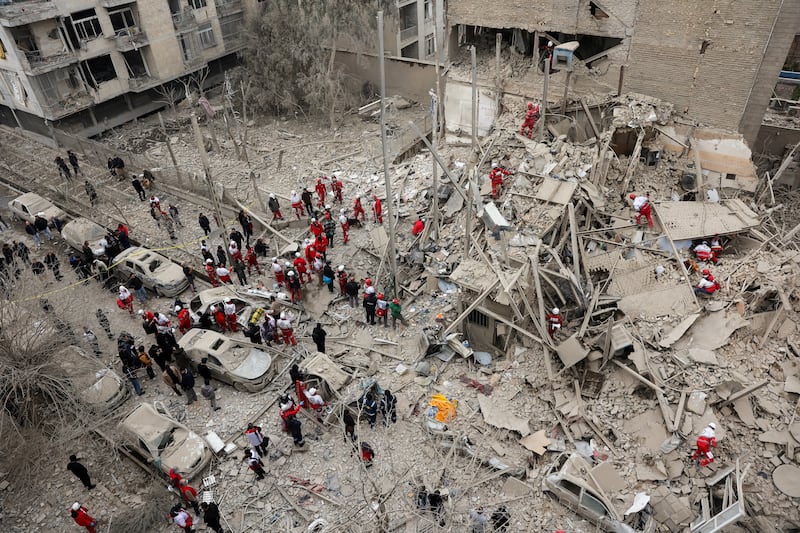
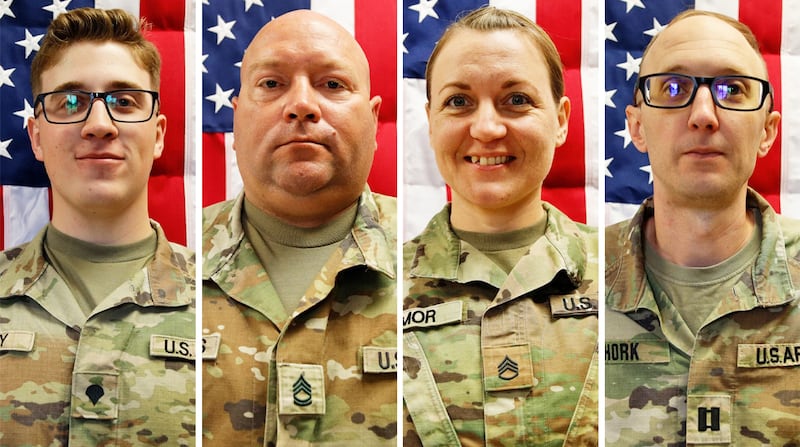
Trump nonetheless decided to strike, getting the U.S. embroiled in a conflict that was not authorized by Congress and has so far killed at least 13 US service members and thousands of Iranian civilians.
It has also sparked a global energy crisis, with the average national fuel price in the U.S. now at $3.94 a gallon.
Asked last week if he wanted a ceasefire, Trump told reporters: “You don’t do a ceasefire when you’re literally obliterating the other side.”
To add to the confusion, he also put out a Truth Social post saying the war could wind down soon, even as the Pentagon sent three warships and thousands more Marines to the region, and was reportedly making “heavy preparations” for the use of ground troops.
The Pentagon also sought additional funding of about $200 billion for the war, with Trump saying it was “a small price to pay to stay tippy top.”