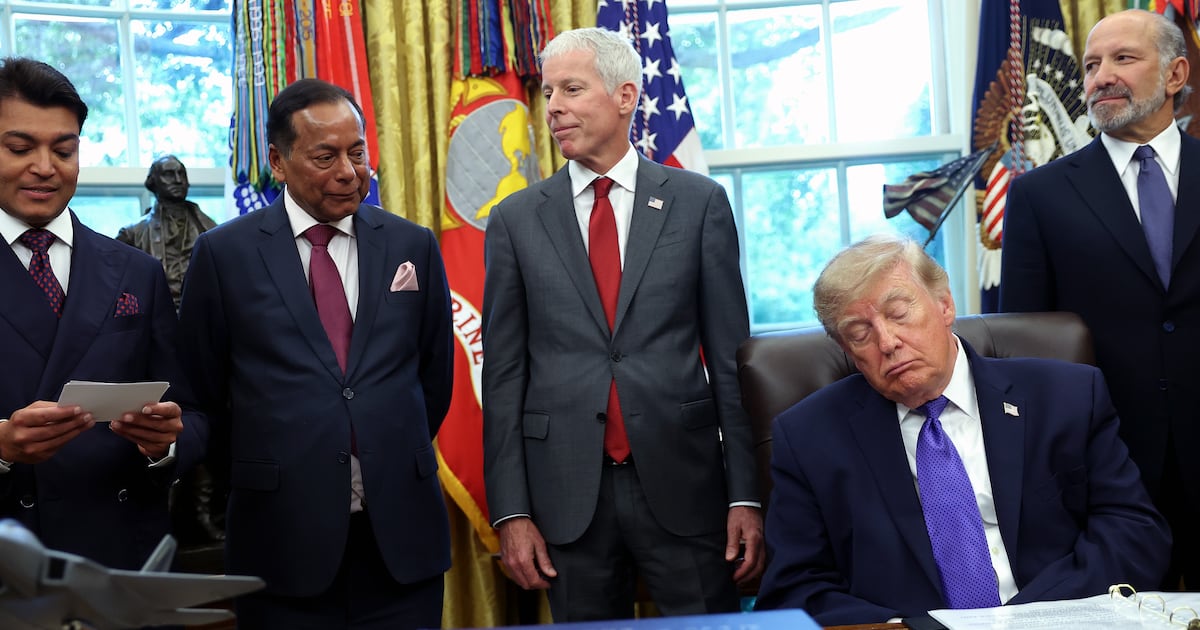
Donald Trump used a secret backroom arrangement to ensure the deal to build his tacky East Wing ballroom went to his preferred contractor.
Officials steered the $500 million agreement with Clark Construction through the Executive Residence, an arm of the Executive Office of the President that ordinarily buys furniture and art, covers entertainment, and handles repairs at the mansion, according to The Washington Post.
That office sits outside federal rules that require agencies to seek competing offers and to lay out spending publicly. Structuring the deal this way allowed Trump to dodge scrutiny of the arrangement and avoid exposing it to competition.

Avoiding competition allowed the administration to sidestep a process that has historically worked to keep prices down for a job of this scale, the Post reported. “I would certainly expect them to compete a project of this size and complexity,” Anthony Costa, a former General Services Administration official who handled federal real estate work across four administrations, told the Post.
Trump, 80, got personally involved in the haggling, records show. On March 4—days after launching his war with Iran—he talked down what a Clark subsidiary would charge for concrete, trimming $2.3 million from an opening figure above $47 million.
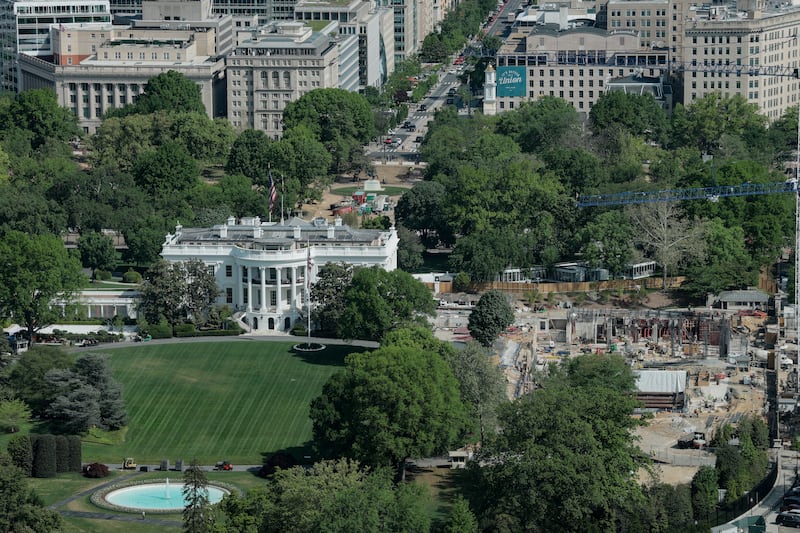
The price tag has more than tripled since the ballroom was unveiled in July, with taxpayers expected to foot roughly half of it. The company internally valued the work at $200 million in July 2025, a figure that has since ballooned to $600 million.
Trump insisted donors would cover the bill. He told The New York Times in January that Clark had offered to do the work for free. “They said: ‘Sir, we’ll do it for nothing. This is the greatest honor’,” he said.

The Virginia firm, the largest builder in the D.C. region, stands to profit handsomely. A March estimate put its haul at $65 million across overhead, profit, and on-site staffing.
Clark also flagged plans to pass demolition, excavation, and other tasks to 11 or more subcontractors without competition, two of them in-house subsidiaries.
A White House official told the Post the deal ran through the Executive Residence because that office “will be the primary support of the facility,” adding the Executive Office of the President “consistently executes contracts following the law.”
A Clark spokesperson said the firm uses “established procurement and contracting processes for each project.” Joshua Fisher, who directs the White House Office of Administration, said that bids were skipped because disclosing the project’s needs would “compromise national security,” echoing the president’s repeated efforts to cast the rebuild as a defense concern.
The Daily Beast has contacted the White House for further comment.