
As National Park Service workers poured gallons of hydrogen peroxide into Donald Trump’s newly overhauled Lincoln Memorial Reflecting Pool, observers worried about the families of nonvoters that actually use the water: ducks and their ducklings.
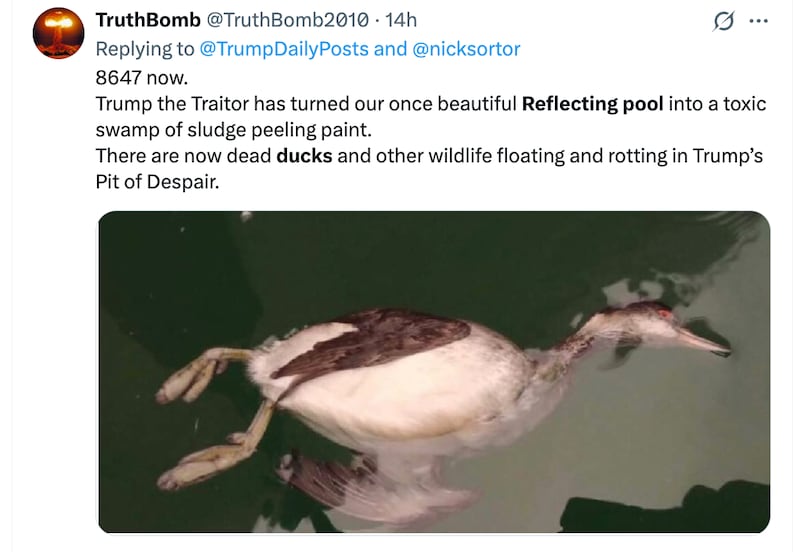
It’s a “bad day to be a duck,” remarked a NOTUS reporter on X this week while watching the desperate bid to control blooming algae with chemicals. Some people on social media claim to have seen dead ducks in the pool.
The massive algae bloom is only one of the problems engulfing the renovated Reflecting Pool that Trump blew $14 million on and repeatedly gushed over. His “American flag blue” paint and/or the pool sealant is also peeling off the bottom of the pool and floating to the surface.

As for the algae-fighting hydrogen peroxide, it’s definitely not safe to guzzle. But some experts are convinced that if it’s diluted enough it is unlikely to seriously affect the ducks or other birds in the pool.
A 3 percent concentration is generally considered safe. Containers of hydrogen peroxide being poured into the Reflecting Pool were marked as a “12 percent” solution, Common Dreams reported. A 12 percent solution is strong enough to “cause problems if inhaled and burns if the chemical touches the skin,” according to the Centers for Disease Control and Prevention, which has detailed warnings and suggestions for “medical management” of the chemical.
Hydrogen peroxide is “not absorbed by the skin, but can cause systemic toxicity when inhaled or ingested,” notes the CDC. It’s also a “powerful” oxidizing agent; when it comes in contact with organic material, spontaneous combustion can occur," the agency warns.
It’s not known how much of the bleaching chemical is being dumped into the Reflecting Pool that many ducks use as a pond. In addition, at this time of year several tiny ducklings are trailing their moms in the water. Their size could make them more vulnerable to toxins.
“Hydrogen peroxide is generally considered less environmentally destructive as its compounds readily break down in water,” The New Republic noted this week. “But the high concentration could nonetheless pose a risk to some of the pool’s frequent visitors, such as ducks or other birds.”
It could also be a colossal waste of time. Washington, D.C.-based pediatrician Michael O’Brien noted on X that dumping hydrogen peroxide into the pool will not fix the algae problem.
“Y’all, not to be a huge nerd but for the reflecting pool you would need a minimum of about 8,000 liters of 12% hydrogen peroxide to reach the 50 parts per million concentration to kill algae,” he wrote.
“Is this what happens when you have 0 scientists in your administration?”