Trump’s SCOTUS Pick Delivers Epic Blow to President
The Trump administration “has not carried its burden” in trying to justify the federalization of troops in Chicago, the court ruled.

Andrew Harnik/Getty Images
The Supreme Court has thwarted Donald Trump’s deployment of National Guard troops to Chicago—with Brett Kavanaugh’s help.
In the unsigned order, the court wrote that the Trump administration had no sufficient justification to federalize the troops in the Democratic-led city, where Immigration and Customs Enforcement agents have been carrying out “Operation Midway Blitz.”
“At this preliminary stage, the government has failed to identify a source of authority that would allow the military to execute the laws in Illinois,” the court determined.

The Trump administration “has not carried its burden to show that” it had the authority to have members of the National Guard protect ICE agents, the court added in its emergency docket ruling.
Federal law permits the president to federalize the National Guard when “regular forces” aren’t enough to help him execute the laws. The court said it was “likely” that “regular forces” means the standing military, and not federal agents like those in ICE.
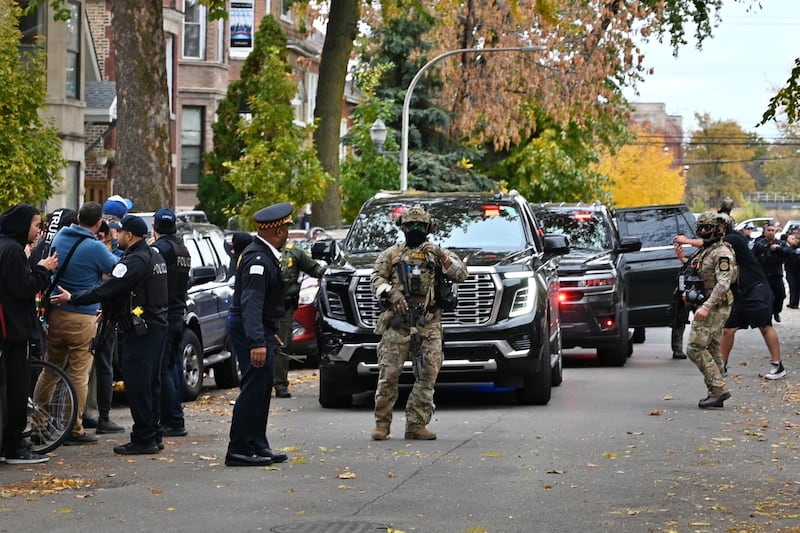
ICE agents conduct operations in Chicago’s Little Village neighborhood last month. The Supreme Court has blocked President Trump from federalizing National Guard troops to support them.
Anadolu via Getty Images
Kavanaugh, whom Trump nominated to the bench in 2018 after the retirement of Anthony Kennedy, concurred.
Sign Up for The Swamp Newsletter
By clicking “SUBSCRIBE” you agree to our Terms of Use and Privacy Policy.
“…[I]t does not appear that the President has yet made the statutorily required determination that he is ‘unable’ with the U.S. military, as distinct from federal civilian law enforcement officers, to ensure the execution of federal law in Illinois,” he wrote.
But Kavanaugh, 60, did explain that he would have denied the government’s claim on narrower grounds.

“The Court’s legal interpretation, as I understand it, could lead to potentially significant implications for future crises that we cannot now foresee‚” he warned, offering an example of a mob threatening to storm a courthouse where security is outnumbered and troops cannot mobilize in time.
“Under the Court’s order today, even in those circumstances the President presumably could not federalize the National Guard,” he wrote.

Kavanaugh ultimately agreed with the court’s determination, but said he would have done so on narrower grounds.
The Washington Post via Getty Images
Justices Samuel Alito, Clarence Thomas and Neil Gorsuch dissented.
“The court fails to explain why the president’s inherent constitutional authority to protect federal officers and property is not sufficient to justify the use of National Guard members in the relevant area for precisely that purpose,” Alito wrote.
Alito, 75, claimed the majority on the court had “no basis for rejecting the president’s determination that he was unable to execute the federal immigration laws using the civilian law enforcement resources at his command.”

“Whatever one may think about the current administration’s enforcement of the immigration laws or the way ICE has conducted its operations, the protection of federal officers from potentially lethal attacks should not be thwarted.”
In a statement to the Daily Beast, White House spokesperson Abigail Jackson said Trump remains committed to his immigration crackdown.
“The President promised the American people he would work tirelessly to enforce our immigration laws and protect federal personnel from violent rioters. He activated the National Guard to protect federal law enforcement officers, and to ensure rioters did not destroy federal buildings and property,” Jackson said. “Nothing in today’s ruling detracts from that core agenda. The Administration will continue working day in and day out to safeguard the American public.”
See more of our coverage in your search results.

Got a tip? Send it to The Daily Beast here.
Register below to read this article for free or subscribe
to unlock unlimited access to The Daily Beast.
Monthly
$1
First month then $5.99/month
Annual
$35
First year then $59.99/year
Premium
$79
First year then $119.99/year
*Substack access provided by the next business day, using your subscription email. Choosing the Premium plan constitutes your permission to share your subscription email with Substack and your agreement to Substack’s Privacy Policy.
Already have an account? Sign In
Looks like you already have a subscription!
You're all set!
Thanks for subscribing.
Sign in or create an account
Login dialog
Loading comments…