Sailors Reveal Nightmare Conditions Aboard Trump Warship
Sailors from the USS Abraham Lincoln are speaking out about the punishing conditions they endured at sea.
Photo Illustration by Victoria Sunday/The Daily Beast/Getty Images/Reuters
Sailors aboard the USS Abraham Lincoln made port in Thailand this week after a record-setting deployment, and new accounts from the crew are revealing just how punishing the mission became.
On shore leave for the first time in nine months, sailors from the Lincoln and USS Frank E. Petersen Jr. told The Wall Street Journal that the worst thing about their grueling deployment was not knowing when it would be over.
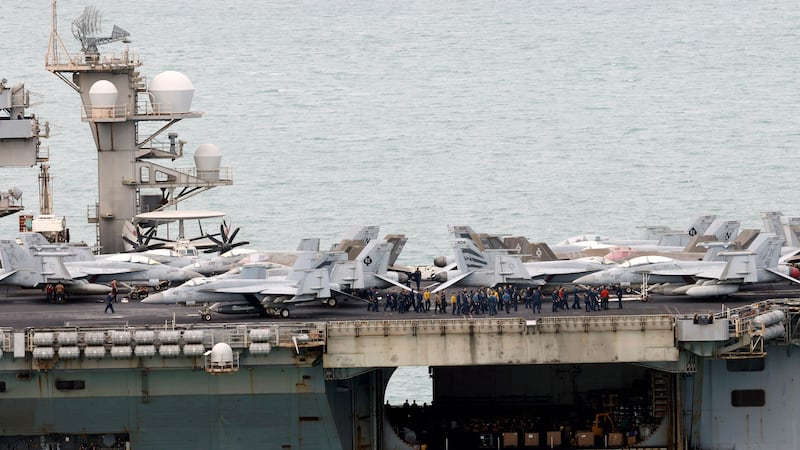
The rusty USS Abraham Lincoln is photographed right before docking in Thailand.
RUNGROJ YONGRIT/EPA/Shutterstock/Shutterstock
“This deployment was a deal breaker for a lot of people,” Lucas Shepardson, 24, a machinist’s mate on the Petersen, told the Journal.
“People just realized they don’t want to do this for another 20 years.”
He added that he wouldn’t be renewing his contract when he returned to his home port in Hawaii.
Get the best of The Beast delivered right to your inbox
By clicking “SUBSCRIBE” you agree to our Terms of Use and Privacy Policy.
Shepardson said reports of rationing were true, but that he always felt he’d eaten enough. “Yes, it was less, but it was definitely enough,” he said.

But fellow Petersen sailor Michael Gonzales said that there were days when he felt hungry. Three members of the kitchen crew confirmed that supplies were rationed to avoid running out during the extended deployment, with conditions making resupplying impossible for stretches.
Loneliness, cramped quarters, and frustration at the endlessly extended deployment also led to mental health concerns. Working 12-hour shifts with no end in sight, the crew of more than 5,000 held spelling bees or lip-syncing competitions to boost morale.
The Pentagon and Naval Fleet Command did not immediately respond to requests for comment. But in response to concerns raised by the families of service members, Acting Navy Secretary Hung Cao issued a statement last month about conditions on the Lincoln.

U.S. Acting Secretary of the Navy Hung Cao.
Elizabeth Frantz/REUTERS
“Deployments are hard,” he said. “Combat operations make them harder. War is hell and normal routines are disrupted. One of the hardest aspects about warfighting beyond knowingly placing our service members in harm’s way is that even with the best planning and communication, change and uncertainty will always be in play.”
Cao acknowledged that there had been some mental health issues, supply rationing, and that calls home had been limited at times. He also said meal plans were adjusted when fresh resupply was unavailable, but that no meals were missed.
For most of the deployment, the carriers had no Wi-Fi for security reasons, making it hard to communicate with friends and family—although the Petersen had internet-accessible computers with secure connections for emailing home, sailors said.

Captain Dan Keeler, USS Abraham Lincoln's commanding officer, gives a souvenir to Pattaya Mayor Poramase Ngampiches as members of the U.S. military arrive at Hard Rock Hotel Pattaya for a welcoming ceremony.
Chalinee Thirasupa/REUTERS
Cao said the Lincoln had flown over 10,000 sorties and dropped 1.5 million pounds of ordnance.
Some crew also said the deck’s non-slip coating began to wear away as months of use without maintenance downtime took its toll, though they said they could still navigate the deck safely.
The sailors also said they were proud to have completed the deployment, and said the experience had “deepened the camaraderie among the crew,” according to the Journal.

In total, the Lincoln spent 286 days on its deployment before reaching Thailand, with around 200 days in an active war zone. Although the USS Gerald R. Ford holds the record for the longest deployment of 11 months, the Lincoln’s lack of port visits meant the sailors spent longer at sea.
Frustrated over criticism of the long stretch, President Donald Trump—who has never served in the military and who received five military deferments during the Vietnam War, including one for “bone spurs”—said in August that the Lincoln’s deployment had been “not nearly long enough.”
See more of our coverage in your search results.

Got a tip? Send it to The Daily Beast here.
Register below to read this article for free or subscribe
to unlock unlimited access to The Daily Beast.
Monthly
$1
First month then $5.99/month
Annual
$35
First year then $59.99/year
Premium
$79
First year then $119.99/year
*Substack access provided by the next business day, using your subscription email. Choosing the Premium plan constitutes your permission to share your subscription email with Substack and your agreement to Substack’s Privacy Policy.
Already have an account? Sign In
Looks like you already have a subscription!
You're all set!
Thanks for subscribing.
Sign in or create an account
Login dialog
Loading comments…