
A Russian general who figured heavily in President Vladimir Putin’s military propaganda campaigns has been killed in a drone strike.

The Russian leader has become increasingly paranoid about his safety and that of his top military brass following a spate of killings both on the battlefield and off, including several assassinations over the past few months in St. Petersburg and the capital city of Moscow.
As a sign of how highly Putin values his spin doctors, the 73-year-old has also encouraged his mouthpieces on Kremlin-controlled media to hire personal security details over concerns that they too could be targeted.
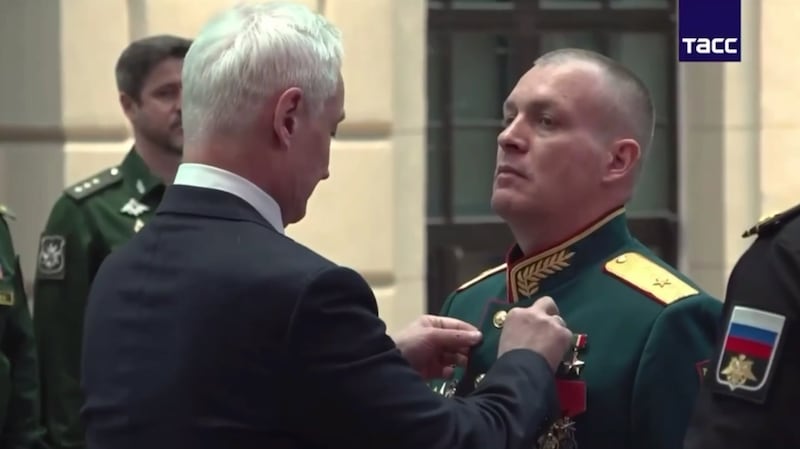
Now, Putin appears to have suffered a double blow with the loss of a Russian general who was trotted out on state media as an example of Russia’s military brilliance, according to the Kyiv Post.
Major General Anton Feliksovich Grunis, 46, was killed Saturday near the village of Kindrativka in the Donetsk region, according to Ukrainian military and independent news sources.
Although Russia had not officially confirmed his death as of Wednesday, early reports appeared in an encrypted channel for Russian officers on the messaging app Telegram, according to the Post. Comments in the channel implied he died in combat.
Ukrainian army sources released footage of kamikaze drones detonating inside buildings that officials said confirmed Grunis’ killing, but the video didn’t conclusively show any Russian soldiers being hit.
Less than three weeks ago, on Aug. 28, Russia’s Ministry of Defense released footage of Grunis being awarded the Hero of the Russian Federation, Russia’s highest medal for bravery, for success in battle, the Kyiv Post reported.
The general told interviewers he was confident Russia would succeed against Ukraine.
He was repeatedly depicted as an elite, frontline fighter with the call sign “The Terrible,” while his command, the 4th Motor Rifle, was presented in Defense Ministry content as a superior, unstoppable unit, according to the Kyiv Post.
In truth, however, the unit has been plagued by scandals, and in June, Grunis claimed credit for capturing a major Ukrainian city, Kostiantynivka, that hadn’t actually fallen to the Russians, the Post reported.
Soldiers within the unit have complained about officers demanding money in exchange for not being ordered to carry out dangerous assault missions, according to Ukrainian groups that track Russian combat units.
Troops who did not pay the bribes or accept orders to carry out borderline suicide missions were reportedly locked in open-air pits until they changed their minds, the Kyiv Post reported.

Putin’s domestic problems have also been piling up after nearly five years of war. The country’s air defenses have failed to stop attacks, one-third of Russia’s oil refineries have been crippled by Ukrainian drone attacks, and warehouses belonging to the country’s biggest e-commerce company have gone up in flames.
Russian officials, however, appear prepared to drag out the conflict for years if given the chance.
Ukraine’s President Volodymyr Zelensky is preparing for at least two to three more years of war, The Economist reported in May.