House Republicans are avoiding the spotlight as Americans sour on President Donald Trump’s tanking economy, warmongering, and chaotic leadership.
GOP lawmakers in swing seats up for re-election in November are keeping to themselves as the Department of Homeland Security remains stuck in the longest partial shutdown in U.S. history, The Atlantic reports.
The magazine revealed on Wednesday that only a single battleground Republican, Arizona Rep. David Schweikert, agreed to an interview request about the ongoing DHS shutdown, while over a dozen others up for re-election did not respond.
“Back in their districts, members of Congress—particularly swing-seat Republicans—seem to be in hiding,” the magazine writes. “Hardly any are holding town halls or other well-publicized events that could put them face-to-face with frustrated voters.”

The lack of public appearances is not because lawmakers are hard at work in Washington. The House is in Easter recess until April 14, leaving senators—who have already approved a funding measure—fuming over the lack of progress toward breaking the DHS budget impasse.

“It’s a failure of everyone,” Schweikert, 64, told The Atlantic. “One side is using their rage at DHS to raise money, and the other side—my side—is often terrified to actually have detailed, mathematically honest conversations about population and immigration.”
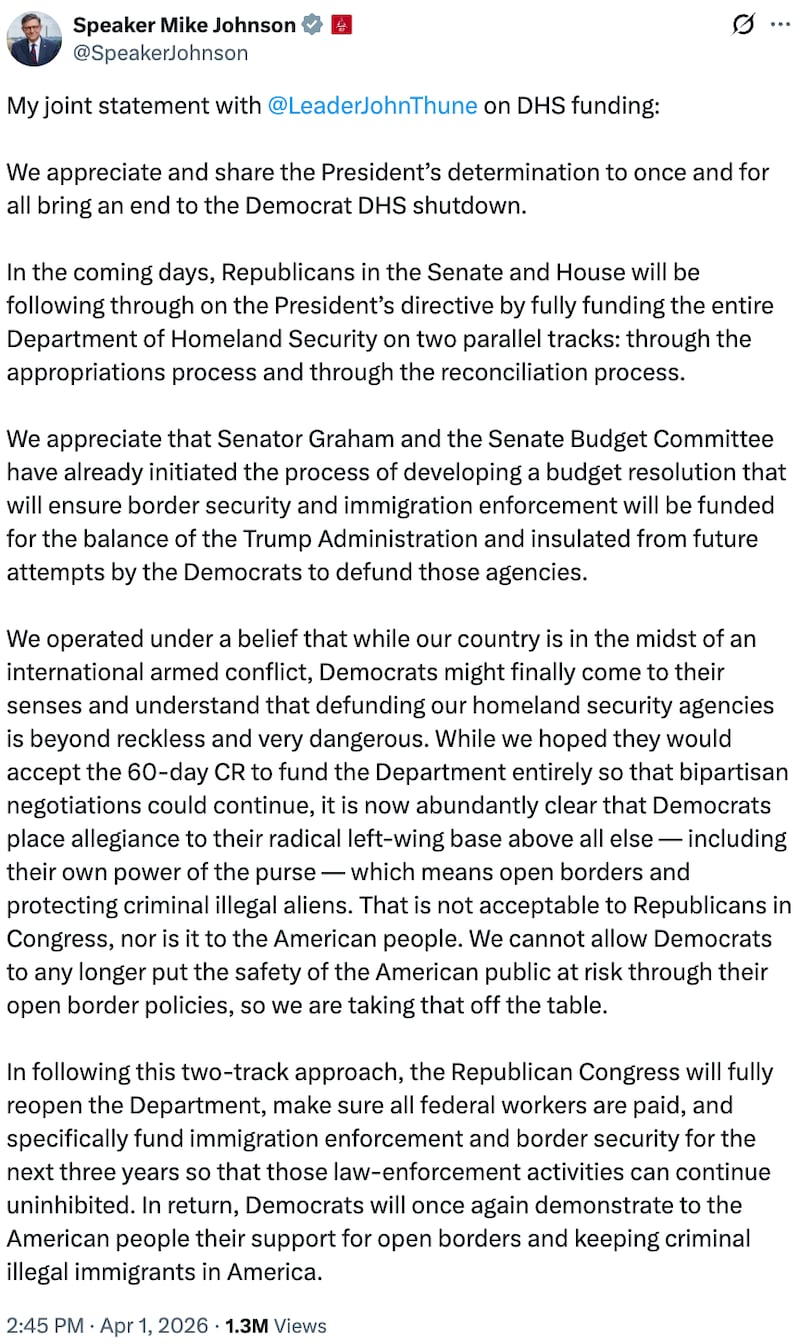
Though Speaker Mike Johnson vowed Wednesday that Congress would heed President Donald Trump’s demands to reopen DHS, the House did not act on Thursday to pass a bipartisan funding deal sent over by the Senate, prolonging the shutdown.
Schweikert blamed the shutdown on everyone: “Republicans, Democrats, leadership.” He said it signals a broader unwillingness among his colleagues to address America’s problems.
“I’m in a 50–50 district, and I keep introducing bills to try to stabilize the debt, and I can’t even get a co-sponsor,” he said.
Schweikert is running for governor of Arizona rather than seeking re-election to Congress. When he launched his gubernatorial bid last year, he deemed Washington “unsavable.”

Other House Republicans reached by The Atlantic, meanwhile, did not agree to an interview to share what they were hearing from constituents—or whether they were planning to hold events to hear from them at all.
One of those lawmakers, Wisconsin Rep. Derrick Van Orden, was caught by TMZ on a trip to Scotland with other House colleagues, including Reps. John McGuire, of Virginia, and David Rouzer, of North Carolina.

Iowa Rep. Mariannette Miller-Meeks pointed The Atlantic to a social media post where she called on fellow lawmakers to return to Capitol Hill to “resolve this impasse.”
“Our office does not share the congresswoman’s schedule,” a spokesperson for Miller-Meeks told the outlet. “She will be busy and has several exciting events planned in the case that Congress remains out of session.”
While the House is out on recess, Americans are reeling from the sting of Trump’s economic agenda, exacerbated by the war with Iran.
A CNN/SSRS poll conducted at the end of March found that Trump’s approval rating on the economy has dropped to a new career low of 31 percent. In a YouGov/Economist survey conducted over the same period, 61 percent of Americans said they feel that gas prices are rising by “a lot” where they live.