As Exit Date Approaches, A Surge Of Green-On-Blues Attacks in Afghanistan
Attacks on coalition troops by Afghan cast further doubt on whether the country can protect its citizens after NATO forces pull out, reports John Ryan.
Anja Niedringhaus / AP Photo
Get the Beast Digest newsletter delivered straight to your inbox
By clicking “SIGN UP” you agree to our Terms of Use and Privacy Policy.
As the US-led coalition in Afghanistan turns over greater responsibility to Afghan forces in advance of the scheduled 2014 end to the war there, American military officials have downplayed the significance of the rising number of so-called “green-on-blue” insider attacks, where uniformed Afghan defectors turn their weapons on their U.S. and NATO counterparts.
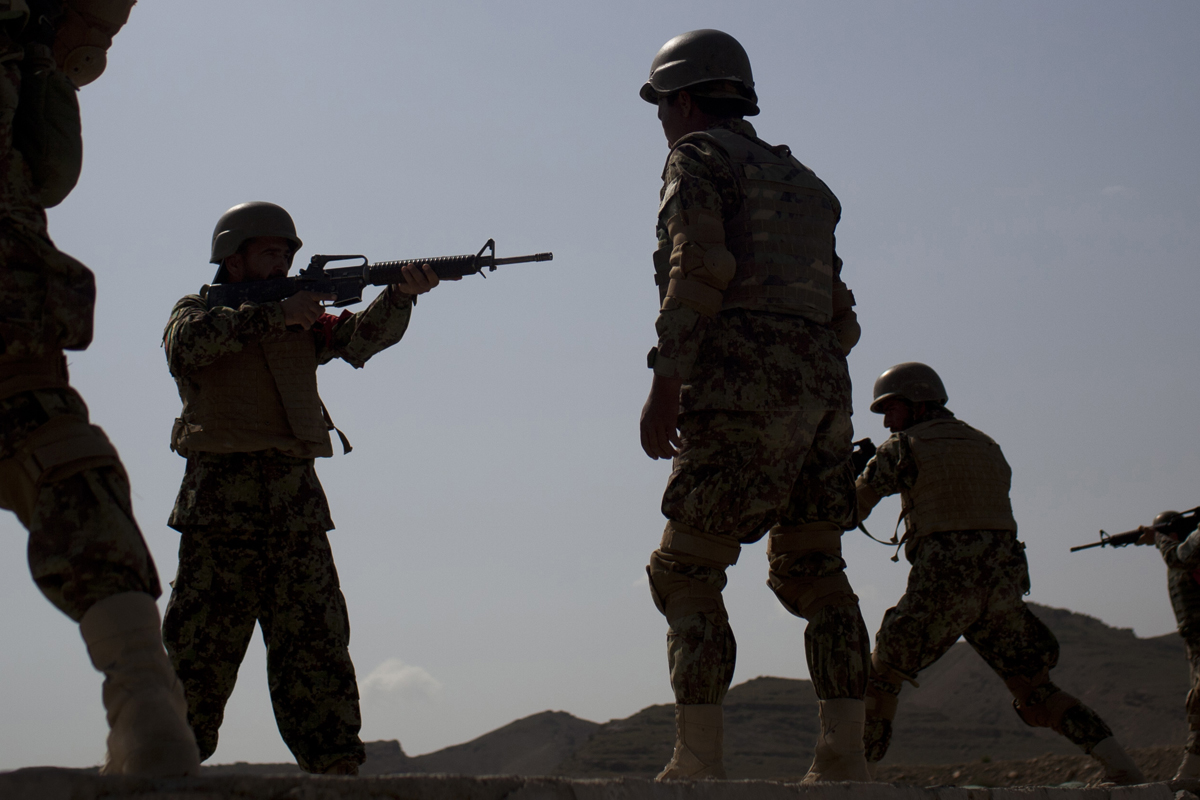
In May, Afghan security forces, estimated at 350,000 personnel, took over primary responsibility for the security of 75 percent of the nation’s population.
But the spike in attacks on coalition troops by Afghan forces—along with rising numbers of incidents where Afghan police and soldiers open fire on their own number and of Taliban attacks on them—casts further doubt on whether Afghanistan, a country ravaged by more than three decades of war and plagued by corruption, defection and global drug trade, can protect its citizens after NATO forces pull out.
Last year, 24,590 Afghan soldiers quit between January and June, compared with 11,423 who deserted in the same period in 2010, reported The Washington Post.
Afghan forces attacking coalition troops—which Gen. John R. Allen, the top commander in Afghanistan, called the “insider threat” at a March briefing—have not eroded public confidence in Afghan forces, and coalition polling shows positive public perceptions of local security units, NATO officials said.
Despite what coalition and Afghan officials have said are improved screening and monitoring of Afghan forces, the number of renegade strikes has continued to rise. So far this year, the U.S.-led coalition has reported 20 such attacks—primarily shootings—that have killed 27 coalition troops and complicated NATO’s planned 2014 exit from the country.
Amidst a more violent fighting season as the coalition exit date approaches—with total attacks on U.S. troops up 20% in May year-to-year—the number of green-on-blue attacks this year is on pace to rise 50 percent from 2011, when there were 21 attacks resulting in the death of 35 foreign soldiers. That would be seven times more attacks on coalition forces by Afghan forces than in all of 2007 and 2008.
And even those numbers may under-represent the problem, since until earlier this year the alliance’s green-on-blue figures did not account for failed attacks or the number of troops wounded alongside those killed, according to The Associated Press.
Last week, the ISAF reported “an individual wearing an Afghan National Security Force uniform” shot and killed three civilian employees in Western Afghanistan, the first time that an apparent member of Afghan forces has targeted Western support workers, rather than military personnel.
Afghan government officials did not reply to Newsweek/The Daily Beast emails inquiring about new Afghan countermeasures for green-on-blue incidents.
The Afghan courts, however, convicted an Afghan soldier in a green-on-blue case for a first time on July 17. The courts found the soldier guilty of killing four French troops in January assault at a base shared by NATO and Afghan forces in Kapisa Province, The Associated Press reported.
That attack spurred France to accelerate its timetable for withdrawing from Afghanistan, and it now plans to have its combat forces out by the end of this year.
Despite that, the 50-country coalition, officially known as the International Security Assistance Force, says these erratic incidents will not hamper its withdrawal from the 10-year war.
“Every day, tens of thousands of coalition forces work successfully alongside their Afghan National Security Force counterparts without incident,” Army Lt. Col. Sarah M. Goodson, an ISAF spokesperson, wrote to Newsweek/The Daily Beast in a July 20 email from Afghanistan.
“The ‘green-on-blue’ attacks will have no impact on ISAF plans to transition security responsibilities to the [Afghan forces].”
Nearly 130,000 coalition soldiers, including 90,000 American troops, currently serve in Afghanistan, according to NATO’s May data.
Though the Taliban routinely takes credit for green-on-blue attacks, U.S officials cite grievances against coalition forces, not enemy affiliations, as the principal motivator for these attacks.
“The percentage of verified cases of infiltration is small (in the single digits) and we do not believe the insurgency has been effective in its attempts to internally disrupt [Afghan forces] and its relations with the coalition,” Goodson wrote.
“There is no indication that these incidents are linked or part of any larger coordinated effort,” she wrote.
Army Capt. Aaron Cross, a U.S. ground commander in the southern province of Kandahar, told this reporter, then with Army Times, in May that soldiers drew closer to Afghan partners to combat turncoat assaults after a series of green-on-blue attacks in early 2012.
“It’s all about relationships, developing close relationships… those relationships mitigate the risk,” he said.
Cross worked more closely with Afghans “so that if there are any changes in behavior that we notice, we can notice that quickly and talk about any issues,” he said, adding that no joint missions were ever canceled due to insider threats.
In the wake of these attacks aimed at shattering trust between the coalition and Afghan government, ISAF says it’s focused on galvanizing their union.
“We are striving to ensure all of our enhanced security measures against potential green-on-blue threats do not damage the valuable relationships and trust built between ISAF and [Afghan security forces],” Goodson wrote.
“The quality and strength of these partner relationships form the foundation of our efforts to achieve a shared vision of success,” she said.
See more of our coverage in your search results.

Got a tip? Send it to The Daily Beast here.
Unlock a year of full access to The Daily Beast for $35.
Monthly
$1
First month then $5.99/month
Annual
$35
First year then $59.99/year
Premium
$79
First year then $119.99/year
*Substack access provided by the next business day, using your subscription email. Choosing the Premium plan constitutes your permission to share your subscription email with Substack and your agreement to Substack’s Privacy Policy.
Looks like you already have a subscription!
- Account (completed)
- Payment (completed)
- Confirmation (completed)
You're all set!
Thanks for subscribing.
- 1Account
- 2Payment
- 3Confirmation
Sign in or create an account
Register below to read this article for free or subscribe
to unlock unlimited access to The Daily Beast.
Monthly
$1
First month then $5.99/month
Annual
$35
First year then $59.99/year
Premium
$79
First year then $119.99/year
*Substack access provided by the next business day, using your subscription email. Choosing the Premium plan constitutes your permission to share your subscription email with Substack and your agreement to Substack’s Privacy Policy.
Already have an account? Sign In
Looks like you already have a subscription!
- Account (completed)
- Payment (completed)
- Confirmation (completed)
You're all set!
Thanks for subscribing.
- 1Account
- 2Payment
- 3Confirmation