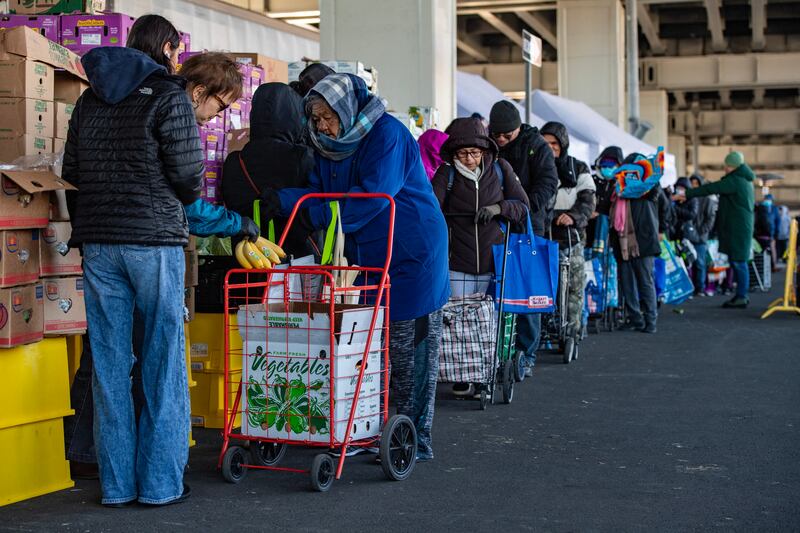
President Donald Trump failed to read the room again as he gave himself a truly baffling score for his performance on the economy even as Americans struggle with rising prices.
He sat down for a wide-ranging interview with Politico’s Dasha Burns on “The Conversation” that was released Tuesday morning. The pair discussed what Trumpworld sees as Europe’s decline, POTUS’ role in Ukraine-Russia peace negotiations and, indeed, the most pressing issue for many Americans.
“I do want to talk about the economy, sir, here at home, and I wonder what grade you would give...” Burns began, though Trump was prepared to give himself glowing marks before she even finished her question. “A-plus-plus-plus-plus-plus,” he declared. As the Daily Beast has previously reported, Americans have given a markedly different assessment.

Burns responded that she had spoken to a Trump supporter who had given the president an “A-plus-plus” overall, but who said groceries, utilities, insurance and the basic cost of running a business are rising “faster than wages,” and lamented that not enough is being done to remedy that.
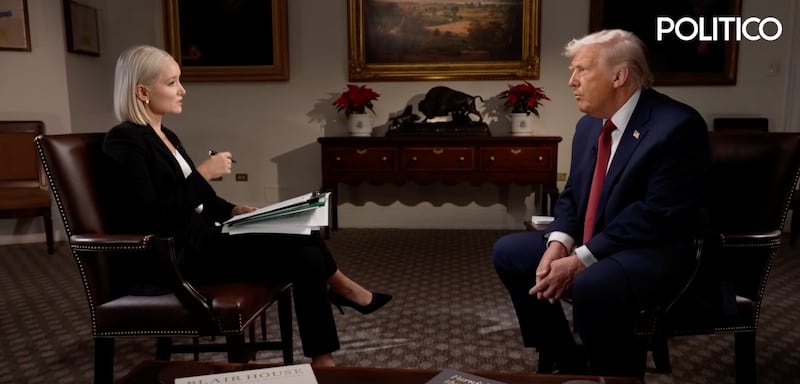
Trump said he “loves” the unnamed Pennsylvania voter for the high grade, before offering a tired refrain about his predecessor, Joe Biden, being to blame for high prices. “I inherited a mess,” he said. “Prices were at an all-time high when I came in. Prices are coming down substantially,” he claimed.
“Look at energy. You and I discussed before the interview. Energy. Energy has come down incredibly. When energy comes down, everything—because it’s so much bigger than any other subject. But energy has come down incredibly. Prices are all coming down,” he said.

While U.S. gasoline prices have remained low or are expected to drop, residential electricity prices have increased faster than the overall inflation rate.
“It’s been 10 months. It’s amazing what we’ve done. If you think of gasoline, a gallon, they had it at $4.50, almost $5. You go to some of the states, you had it at $6. We hit, uh, three states two days ago, $1.99 a gallon. When that happens, everything comes down,” Trump said. “Now, everything is coming down. Uh, with beef, I’ve just opened that up where beef is going to start coming down pretty substantially.”
He then asserted that $18 trillion dollars is “coming in,” without elaborating. The origins of this claim are unclear, though during an Oval Office event last Wednesday, Trump tossed around the same figure, saying, “In 10 months, we have $18 trillion being invested.”
An earlier CBS News review found no indication that total commitments or new investments had come anywhere close to the figures the president has cited.

Although companies and foreign governments have unveiled major projects since Trump took office, the White House has not produced documentation supporting a $21 trillion total (another number he has floated)—a sum equal to roughly two-thirds of annual GDP.
The administration’s own roster of investments it says were “made possible by President Trump’s leadership” stood at $9.6 trillion as of its November update, yet even that tally is inflated. It folds in projects first announced under Biden and counts trade targets for which the United States shares responsibility.
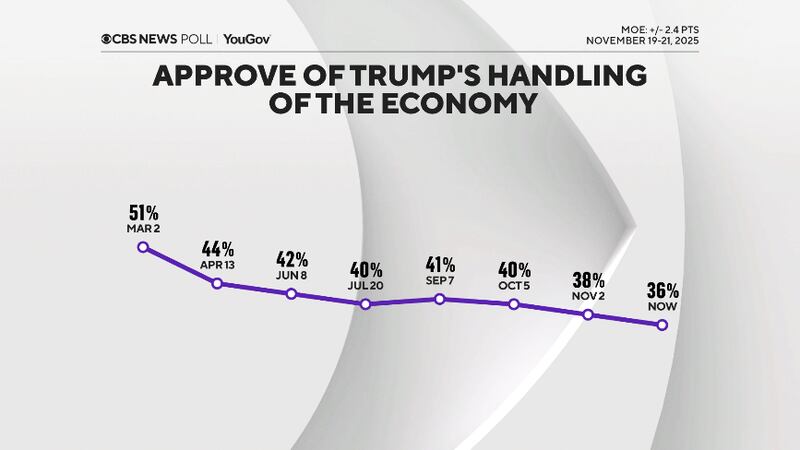
His “A-plus-plus-plus-plus-plus” grade also comes as polls paint a very different picture. In reality, Trump’s standing on the economy has sagged across multiple recent surveys.
A Reuters/Ipsos poll in mid-November put his overall approval at 38 percent, his lowest yet, driven by broad anger over rising prices and cost-of-living pressures.
A separate New York Federal Reserve survey of U.S. households in November found that personal finances and expectations for future economic conditions had worsened, even as inflation expectations stayed stuck.
Consumer sentiment improved only marginally in December, with the University of Michigan index rising to 53.3, a level that still reflects deep public unease over inflation, job security, and everyday expenses.
Other late-year polling echoed that malaise. Surveys released in November showed a large majority of Americans reporting that costs continue to rise, with many describing the economy as “bad” and saying their own financial situation has deteriorated since early 2025, according to Ipsos and YouGov.
The White House has been asked to comment.