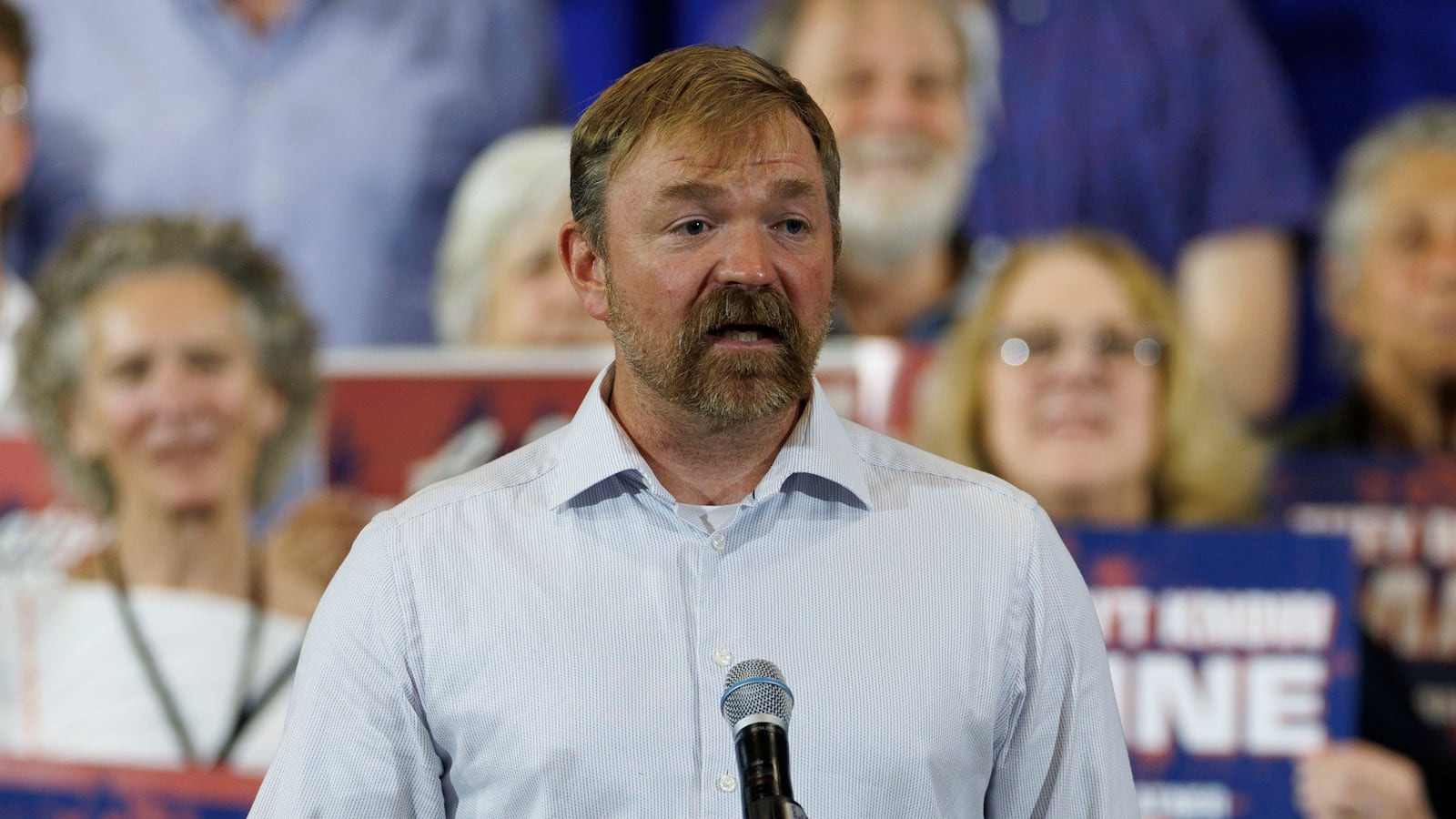
Democratic Senate candidate Graham Platner has been hit with new explosive allegations that he sexually assaulted a woman nearly five years ago.
A woman who spoke with Politico accused the 41-year-old of forcing her to have sex with him despite her repeatedly trying to refuse. Platner has denied the allegation, but he said he was examining the path forward.
Maine resident Jenny Racicot, 41, gave three interviews with Politico over the past two weeks. Politico also spoke with a man who dated Racicot, whom she confided in years after the alleged incident, and reviewed documents, including emails between Racicot and her therapist and messages between Platner’s accuser and a person she warned against getting involved with him.
The Democrat is running to unseat Republican Sen. Susan Collins in one of the most competitive Senate races in the 2026 midterms.
It is the latest in a series of damaging allegations made against the Senate candidate by women who accused him of “unsettling” behavior, but not of sexual assault.

Platner had canceled a series of campaign events just before the Politico report came out on Monday, sparking speculation that he could exit the race amid reports that another damaging report was about to drop.
A campaign sign taped onto the door of a church in Gorham, Maine, where Platner had been scheduled to hold a town hall on Monday night, said the candidate was “sick.”
Ricicot said that she had an on-and-off relationship with Platner for more than two years before he assaulted her in late 2021.
According to her, the Democratic Senate nominee showed up at her home uninvited and deeply intoxicated, where he forced himself on her while she repeatedly told him to stop. She then cut off contact with him after telling him it was not consensual.
“I remember him grabbing my pelvis and being really forceful of me,” she told Politico. “I remember the specific moment where I thought to myself, like ‘This is no longer my choice.’”
Platner responded to the accusations in a video posted on social media, in which he denied the allegations and said he was examining his next steps in the campaign.
“Any accusation of non-consensual behavior is categorically false,” Graham said, speaking directly to the camera. “Regardless of the inaccuracy of the reporting, but mindful of the political reality it will inflict, we are taking the time to reflect on the best path forward for the state that I love, for the people that I love, the movement I belong to, and the goal of defeating Susan Collins.”
Graham said he would not turn his back on Mainers and would use every tool to see Collins defeated, but he did not specify whether that meant he would exit the race.
Racicot told Politico on the night Platner had allegedly assaulted her, she had exchanged texts with him telling him not to come over. Later that evening, he let himself into her house, which was unlocked.
Racicot said he got on top of her on a couch and kept grabbing her despite her repeatedly telling him to stop and that she was not interested. She said she could smell alcohol on his breath and believed he was “almost blackout drunk.” She said when she tried to separate herself from him, Platner followed her into her bedroom, which is where she claimed he had sex with her against her will.

Racicot previously described “unsettling” behavior by Platner to The New York Times, but she said she did not go public with the specific assault claim because she did not want to be known as a rape victim, Politico reported.
She told Politico she later felt compelled to go public because of the reaction to The Times’ story, which sparked controversy over another woman, Lyndsey Fifield, alleging that Platner mistreated her. She faced pushback that her claims were politically motivated.
Despite The Times’ previous report, Platner went on to win the Maine primary early last month. He had no challenger after Governor Janet Mills dropped out.
In a CNN interview with Jake Tapper on Monday, Racicot explained further that “one of the biggest” reasons she came forward was because “there are a lot of men in this world relying on the silence of women to be where they are, and I don‘t want to contribute to that. I also want to just get my life back.”
Racicot added that her claim was not politically motivated.
“I really agree with his politics,” she said. “I think we need somebody with those political stances and who is willing to do the work.”
That made her choice to go public even tougher, she said.
“I understand why people want someone like him in office... and I felt like me coming forward would essentially potentially take that away,” she said. “And I felt really uncomfortable with the responsibility of and the weight of my story and, and what that might do.”
The Democratic nominee now faces a deadline in exactly one week, July 13 at 5 p.m. ET, to drop out of the race so the Democratic Party can replace him.

Political fallout escalated to a new level on Monday in the wake of the Politico report on the alleged assault. Senate Minority Leader and DSCC Chair Sen. Kirsten Gillibrand called for Platner to exit the race.
“The allegations reported today are incredibly disturbing—violence, abuse, and sexual assault are absolutely unacceptable,“ they said. ”Graham Platner needs to immediately withdraw as the Democratic nominee for Senate and allow Maine Democrats the opportunity to choose a new candidate who can defeat Susan Collins. The DSCC will not invest in the Maine Senate race if Platner remains on the ballot.”
The leadership of the Maine Democratic Party also called for him to withdraw as the nominee.

“We are entrusted with deciding who represents our values and who carries our banner. That responsibility requires judgment, leadership, and a willingness to act when circumstances demand it,” Chair Charles Dingman, along with Vice Chair Imke Schessler and Executive Director Devon Murphy-Anderson, wrote in a statement.
Multiple lawmakers, progressive and Democratic influencers, and groups that had previously stuck by Platner called for him to end his campaign. The group End Citizens United withdrew its endorsement and called on him to exit the race. Rep. Ro Khanna and Sen. Ruben Gallego were among the members of Congress who withdrew their endorsements.
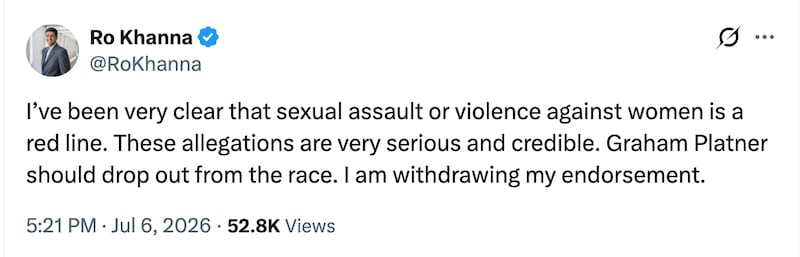
After The Times’ report ahead of last month’s primary, Platner vowed that no further damaging reports could surface against him. But his campaign had already been marred by controversy even before the women came forward.
It was revealed that the Democratic candidate and military veteran, who had the backing of multiple Democratic lawmakers, had a skull-and-crossbones chest tattoo that closely resembled a Nazi symbol.
Platner said he got the tattoo in 2007 while in the Marine Corps, after a night of drinking. He claimed he was unaware that it was a Nazi symbol until more recently. His campaign initially said he would remove it, but he instead decided to cover it up because there were limited removal options in rural Maine.