President Donald Trump’s dramatic reversal on threats to bomb Iran’s energy infrastructure came about via a desperate diplomatic scramble behind the scenes.
Trump, 79, roiled markets and put the world on its toes when he announced on Saturday his intention to strike Iranian power plants “one by one” if the regime in Tehran refused to open the Strait of Hormuz within 48 hours.

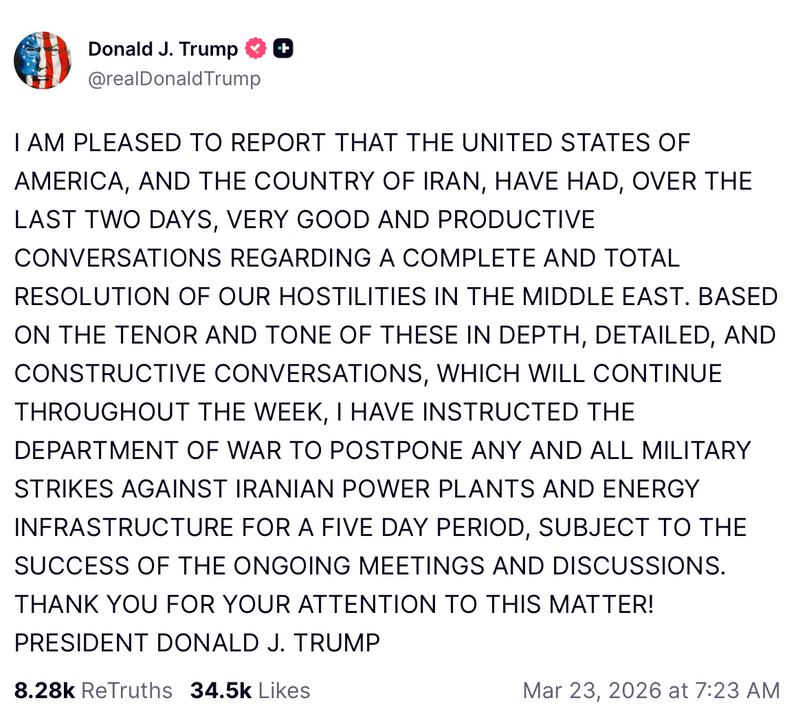
Tehran dug in and threatened revenge attacks, and by Monday morning, Trump had changed his tone, touting “VERY GOOD AND PRODUCTIVE CONVERSATIONS” between the two nations. Iran, however, denied talks had taken place and accused Trump of trying to placate the markets.
This was all played out in public. But what played out behind the scenes was just as dramatic, according to those who watched it all unfold.
Trump, who was reportedly rankled by how the markets reacted to his threats, gleefully accepted an off-ramp cooked up by regional partners in Riyadh on Thursday, days before Trump blew up on social media, the Wall Street Journal reported.
Foreign ministers from Egypt, Turkey, Saudi Arabia, and Pakistan gathered in the Saudi capital to discuss a diplomatic solution to the war.
They initially struggled to find a point man in Tehran, because U.S.-Israeli strikes had taken out Iran’s national security chief, Ali Larijani, who was considered a useful conduit to the regime.
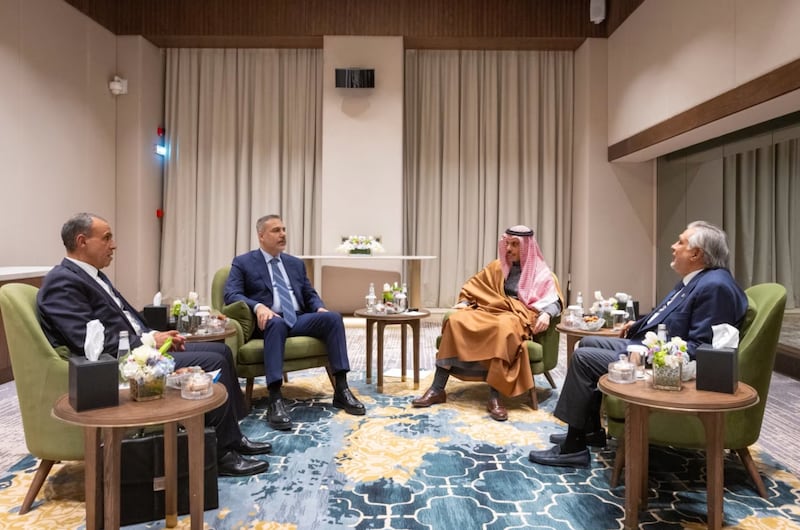
A channel with Iran’s Islamic Revolutionary Guard Corps was opened, and the proposal to end hostilities for five days was born, insiders said. Word reached Mar-a-Lago, where Trump was on his regular weekend retreat. The result of the meeting is what acted as the material for Trump’s next Truth Social post, which, despite being in all caps, had a far more conciliatory tone than his first.
“I HAVE INSTRUCTED THE DEPARTMENT OF WAR TO POSTPONE ANY AND ALL MILITARY STRIKES AGAINST IRANIAN POWER PLANTS AND ENERGY INFRASTRUCTURE FOR A FIVE DAY PERIOD,” he declared.
The Atlantic reported that on Saturday, Trump was “seething” that NATO allies had refused to help secure the Strait of Hormuz, the narrow shipping lane currently on lockdown by Iran. He was also in a bad mood because of the reaction to a social media post where he said he was “glad” Robert Mueller, the ex-FBI chief who had investigated Trump during his first term, had died, advisers said.
Advisers and U.S. allies in the region had also warned Trump that his plan to strike Iranian power plants wasn’t a good one, insiders told the Atlantic. So when the off-ramp came from the Riyadh summit, he gobbled it up.
Between his angry post on Saturday, and his embrace of diplomacy post on Monday, Trump’s administration had been engaged in closed-door talks through Middle Eastern intermediaries that reportedly created hope that the war could end imminently.
People familiar with the matter said that Trump’s decision to cool it on the threats was also born out of the political and economic fallout from the conflict. Indeed, his reversal triggered a stock-market rally.
Wall Street surged with the Dow Jones Industrial Average and S&P 500 recording their biggest single-day gains since early February, while Brent crude—the international benchmark—tumbled 11 percent to just below $100 a barrel, its lowest level since March 11. Brent crude futures climbed above $102 per barrel on Tuesday after Iran’s pushback against Trump’s claims.
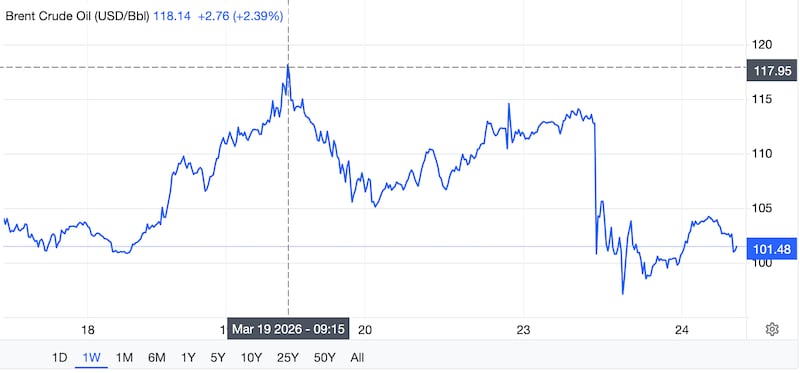
The picture had been much more bleak on Saturday, after his threats to hammer Iran. Brent crude, for one, was trading at over $114 a barrel.
Despite Trump’s jubilant tone in his Monday post, Arab mediators privately expressed skepticism that a deal is close and Iranian officials denied that the discussions were even taking place.
On Monday, Mohammad-Bagher Ghalibaf, Iran’s parliamentary speaker and one of the country’s top remaining officials, said that the optimism whipped up by Trump “is used to manipulate the financial and oil markets and escape the quagmire in which the U.S. and Israel are trapped.”
“These are sensitive diplomatic discussions, and the U.S. will not negotiate through the press,” said White House Press Secretary Karoline Leavitt. “This is a fluid situation, and speculation about meetings should not be deemed as final until they are formally announced by the White House.”