Fisher Wallace Stimulator: Behind the Do-It-Yourself Shock Therapy
Electroshock therapy has a long and notorious reputation, but the new Fisher Wallace Stimulator promises to alleviate a host of disorders—at home. Casey Schwartz takes the device for a test drive.
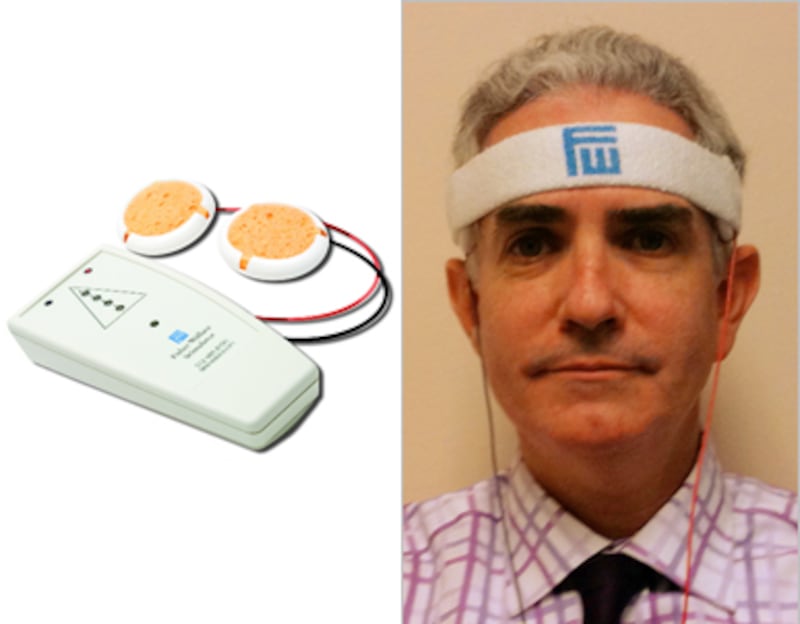
The Fisher Wallace Cranial Stimulator
Get the Beast Digest newsletter delivered straight to your inbox
By clicking “SIGN UP” you agree to our Terms of Use and Privacy Policy.
This Thanksgiving weekend, in the name of science, I sat down on my sofa, strapped two sponge-coated electrodes onto my head, and applied a low-level electrical current to my brain.
I was doing a test run of the Fisher Wallace Stimulator, the newest in a collection of electricity-based contraptions designed for at-home use to treat depression, anxiety, insomnia, and a host of other disorders.
The device, which is about the size of a Game Boy, is available with a prescription, which anyone with a license in electrotherapies, whether a doctor or a masseuse, can provide. Its fans include the singer Carly Simon, who has said it helps her stave off depression and mania.
Treating psychiatric conditions with electrical stimulation belongs, of course, to a long and notorious tradition. At the extreme in this genre is ECT, or shock therapy, which induces seizures—and is typically used as a last resort. ECT has a bad reputation but a relatively good track record, bringing about results in cases of depression and psychosis so entrenched that nothing else succeeds. But it has major side effects—memory loss, for instance—and it tends to sit uncomfortably in the public imagination.
Much more recently, Dr. Helen Mayberg at Emory has pioneered the use of deep brain stimulation, which also uses electrical currents but with much greater precision than ECT, targeting one discrete brain region, known as area 25. The technique has had dramatic effects. Mayberg has reported patients experiencing a palpable alleviation of their symptoms right in the operating room.
The Fisher Wallace device sits on the very near end of this wide spectrum.
An enthusiastic convert to the device, Dr. Richard Brown, a psychiatrist at Columbia University, characterizes the effect on brain waves as being similar to that of meditation.
My mother peeled off the electrodes after 10 minutes, wobbled out of the room, and fell into a deep sleep; the next day, she reported a night of “insane” dreams.
Brown claims to be seeing an 80 percent success rate among the patients to whom he prescribes it, many of whom suffer from major depression that has not responded to any other form of treatment. If Brown’s experience is representative, the Fisher Wallace device has a big future. Selective serotonin reuptake inhibitor drugs, or SSRIs, today’s go-to for treating depression, show a success rate of roughly 50 percent.
Research suggests that the electrical current from the Fisher Wallace device targets the limbic system, which contains brain structures linked to the experiencing of emotions, and that it stimulates the release of the feel-good neurotransmitters dopamine and serotonin.
Chip Fisher bought the patent three years ago and now manufactures the device at his own laboratory. He said he believes that his device might be beneficial for disorders as varied as obsessive-compulsive disorder, drug addictions, attention deficit hyperactivity disorder, post-traumatic stress disorder—and, in fact, anybody with a brain.
Fisher Wallace Laboratories is also reporting great success for use on horses, who are delicate creatures and easily spooked.
The Fisher Wallace Stimulator is a new device, but the technology behind it is more than 20 years old, and FDA cleared.
It was originally developed by two NASA scientists, Drs. Liss and Sheahy. They were brilliant scientists, but bad at marketing, said Fisher.
According to Fisher Wallace Laboratories, the device must be used at least five times, for 20 minutes at a time, before it can begin to produce real results.
In my own highly limited and unscientific time with it, the device left me relaxed, but distinctly blank. For the next several hours, I hadn’t a care in the world—nor a thought.
My mother, who was persuaded to try it after observing my seemingly unscathed experience, didn’t make it through the full 20 minutes. She peeled off the electrodes after 10, wobbled out of the room, and fell immediately into a deep sleep; the next day, she reported a night of “insane” dreams.
On Monday, four curious editors at The Daily Beast tried it out. During the application of the electric current, each person reported that they didn’t feel anything distinct. Three saw a subtle flicker of light in the corner of their vision—a commonly reported response. The aftereffects weren’t obvious. The books editor, however, reported an immediate desire to go to sleep. Later on, he said, he got a slight headache.
Casey Schwartz is a graduate of Brown University and has a master's in psychodynamic neuroscience from University College London. She has written for The New York Sun and ABC News. She's working on a book about the brain world.
See more of our coverage in your search results.

Got a tip? Send it to The Daily Beast here.
Unlock a year of full access to The Daily Beast for $35.
Monthly
$1
First month then $5.99/month
Annual
$35
First year then $59.99/year
Premium
$79
First year then $119.99/year
*Substack access provided by the next business day, using your subscription email. Choosing the Premium plan constitutes your permission to share your subscription email with Substack and your agreement to Substack’s Privacy Policy.
Looks like you already have a subscription!
- Account (completed)
- Payment (completed)
- Confirmation (completed)
You're all set!
Thanks for subscribing.
- 1Account
- 2Payment
- 3Confirmation
Sign in or create an account
Register below to read this article for free or subscribe
to unlock unlimited access to The Daily Beast.
Monthly
$1
First month then $5.99/month
Annual
$35
First year then $59.99/year
Premium
$79
First year then $119.99/year
*Substack access provided by the next business day, using your subscription email. Choosing the Premium plan constitutes your permission to share your subscription email with Substack and your agreement to Substack’s Privacy Policy.
Already have an account? Sign In
Looks like you already have a subscription!
- Account (completed)
- Payment (completed)
- Confirmation (completed)
You're all set!
Thanks for subscribing.
- 1Account
- 2Payment
- 3Confirmation