President Donald Trump has declared war on fraud—despite having been found liable for fraud by a court and granting clemency to his fellow fraudsters who owed $1.3 billion to their victims.
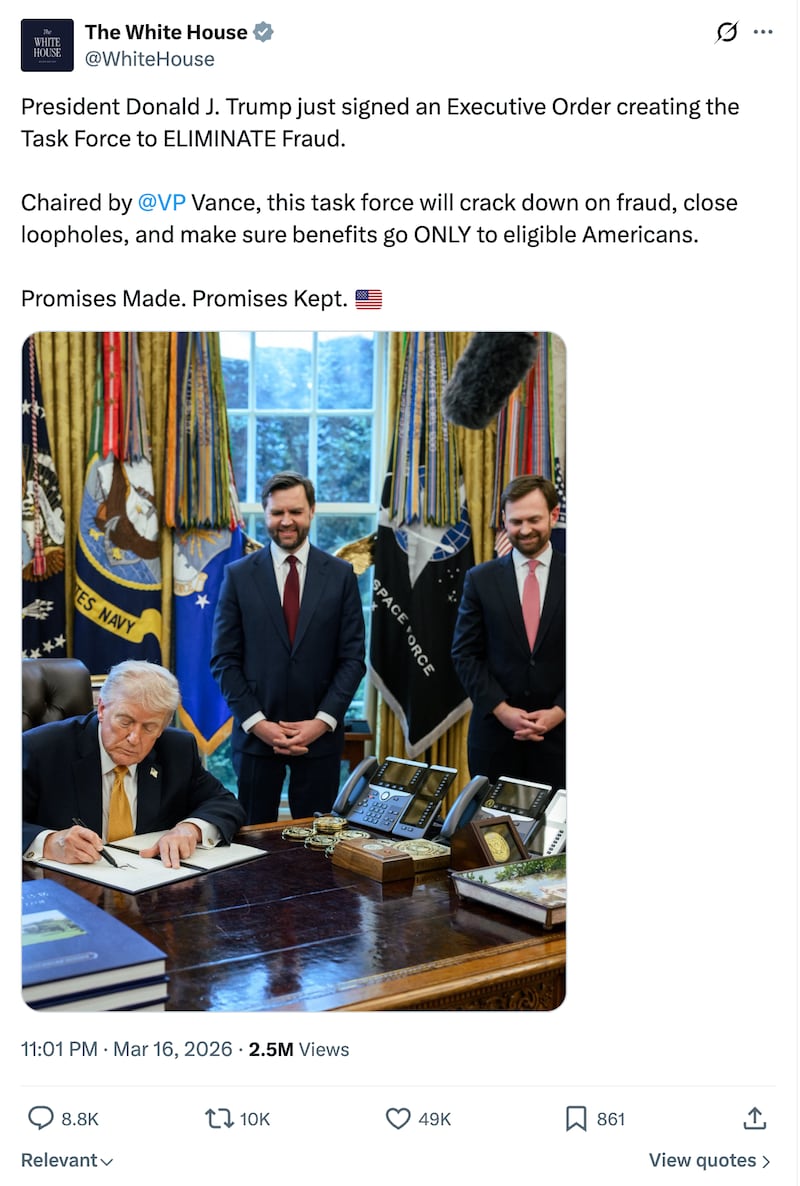
The White House this week announced the Task Force to Eliminate Fraud, putting Vice President JD Vance, 42, in charge of a government-wide crackdown on improper payments across federal benefit programs, including Medicaid, food stamps, and housing assistance.
“Promises Made. Promises Kept,” the White House declared in a social media post on Monday.
Only critics say the slogan doesn’t match reality.
A House Judiciary Committee staff analysis found that Trump’s clemency actions have erased more than $1.3 billion in restitution and fines that courts had ordered paid to victims and taxpayers. California Governor Gavin Newsom’s office, which has been tracking Trump’s pardons, puts the figure closer to $2 billion once forfeitures and first-term pardons are factored in.
Trump, 79, is himself no stranger to fraud findings. New York courts found him and the Trump Organization entities civilly liable for fraud in a case brought by state Attorney General Letitia James.
A mid-level appellate court upheld that fraud finding in August 2025, though it threw out the near-$500 million financial penalty as excessive—a decision both sides have since appealed to New York’s highest court, where the case remains pending.
The Trump Organization was separately convicted by a New York jury of criminal tax fraud and falsifying business records. Trump was also personally convicted of 34 felony counts of falsifying business records in the hush money case—though that conviction, which he has appealed, relates to concealment rather than fraud in the financial sense.
Yet the names he freed from their court-ordered obligations read like a ledger of American fraud.
Trevor Milton, founder of electric truck startup Nikola, was pardoned in March 2025 after prosecutors sought $661 million in restitution from shareholders he defrauded—with his donations to pro-Trump political committees totaling more than $1.8 million.
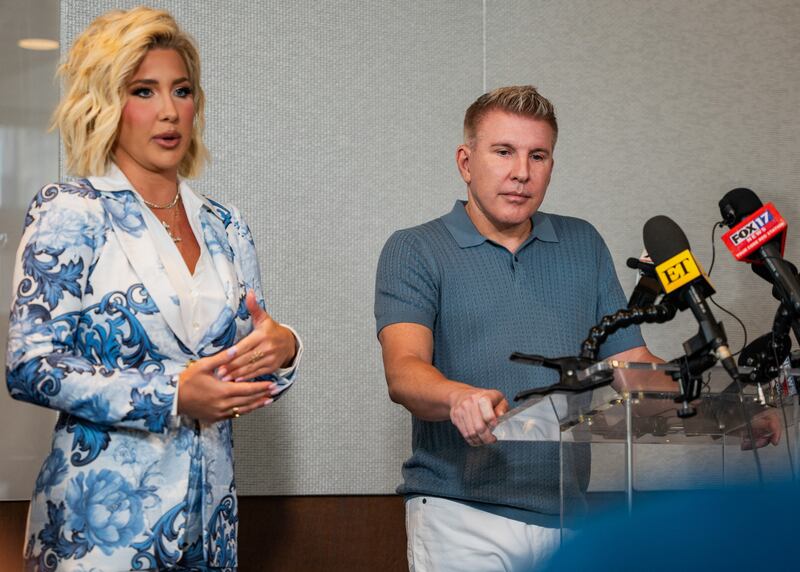
Reality TV stars Todd Chrisley, 56, and Julie Chrisley, 53, who fabricated bank statements to obtain more than $30 million in personal loans before declaring bankruptcy, had their combined $22 million restitution obligation erased.
Jason Galanis, whom his sentencing judge labeled a “serial fraudster” and “con man,” had his sentence commuted, walking away from $84.8 million owed to union pension funds and a Native American tribe.
Paul Walczak, who diverted more than $10 million in employee payroll taxes to bankroll a lavish lifestyle, served not a single day behind bars after Trump’s pardon erased his $4.4 million restitution order entirely.

Perhaps no case lays bare the contradiction more starkly than Philip Esformes, a South Florida nursing home operator, who ran what the FBI described as the largest-ever criminal healthcare fraud case brought against individuals—a $1.3 billion theft from Medicare and Medicaid, the exact programs Trump’s new task force is pledging to protect.
Trump commuted Esformes’s 20-year sentence in 2020, the White House announcing he had devoted his prison time “to prayer and repentance.”
Trump used the signing ceremony to single out Minnesota’s Somali community, claiming immigrants had stolen $19 billion from federal programs—federal prosecutors put the figure at closer to half that.
Left unmentioned was Salomon Melgen, an immigrant sentenced to 17 years during Trump’s first term for a $42 million Medicare fraud scheme, and subsequently granted clemency by the same president.
Elizabeth Oyer, fired as the Justice Department’s pardon attorney last year after she said she opposed restoring the gun rights of Trump supporter Mel Gibson, told The New York Times that the pattern has a clear logic.
Trump, she said, is drawn to “fraud committed by people in whom he sees something of himself. He sees a wealthy and successful businessman and he sees something of himself in him.”
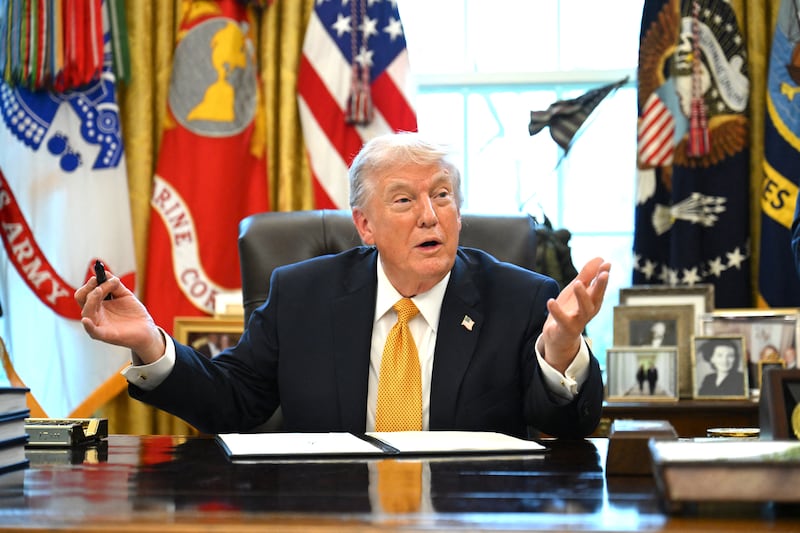
The new task force also includes FTC Chairman Andrew Ferguson as vice chair and White House immigration chief Stephen Miller as senior adviser.
Agencies have 90 days to identify which benefit programs are most vulnerable, with the White House naming California, Illinois, New York, Maine, and Colorado as states with “insufficient” oversight.

Mark Osler, a University of St. Thomas law professor who studies clemency, told the Times there is “certainly a deep contradiction” in the administration’s approach, noting that presidents historically favor clemency for “people they feel sympathy for.”
Given Trump’s own civil fraud liability, Osler said, “it shouldn’t surprise us that he has the most empathy for the people who have faced the charges he faced.”
White House spokeswoman Abigail Jackson told the Daily Beast that Trump had pardoned individuals who had been “victims of political prosecution or over prosecution by a weaponized Biden DOJ,” and the list of convicted fraudsters he had pardoned was “a false equivalence.”