President Donald Trump’s boast that the U.S. is lining up a new era of “Exquisite Class Weaponry” has hit a major double snag.
After a meeting with six top defense contractors in early March, the president crowed that they had “agreed to quadruple Production” at “the highest levels of quantity.”
He bragged that “expansion began three months prior to the meeting” and said weapons production was already well underway. However, The New York Times reports the Trump administration hasn’t gotten the money or congressional support to go ahead with the plan.

And despite Trump’s boast, much of the weapons, if green-lit and funded, would take years to produce. It comes as stockpile issues are so evident right now that the Pentagon is diverting deliveries intended for allies to use in the war in Iran.
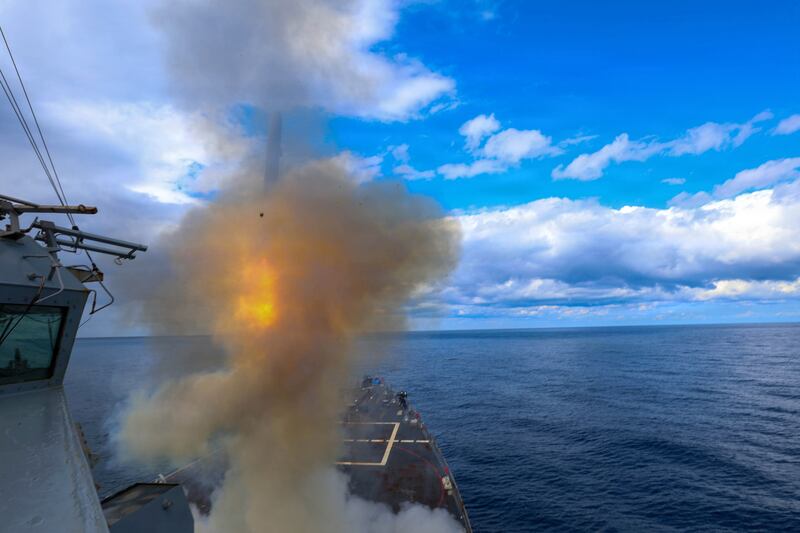
“Operation Epic Fury” has eaten through stockpiles intended for future wars. Since it kicked off on Feb. 28, the U.S. has fired more than 1,000 Tomahawk cruise missiles—roughly 10 times its annual purchase rate—along with over 1,200 Patriot interceptor missiles at more than $4 million each, and more than 1,000 Precision Strike and ATACMS ground-based missiles, according to a previous New York Times analysis.
The strikes have burned through close to the entire remaining U.S. stockpile of long-range stealth cruise missiles built for a potential war with China, leaving inventories at worryingly low levels, according to internal Defense Department estimates and congressional officials.
Stocks were already depleted because of the Ukraine-Russia conflict. The U.S. supported the former by sending reams of weapons. Operation Midnight Hammer, joint strikes with Israel on Iranian nuclear sites last June, also used up a lot of existing weaponry. This “does create risk in future conflict scenarios,” Jerry McGinn, a defense industry expert at the Center for Strategic and International Studies, told the Times.

After the White House meeting in March, agreements included a multiyear deal with Lockheed to significantly scale up production of two of the military’s primary missile defense systems—one designed to intercept short-range ballistic missiles, the other capable of shooting down threats at much higher altitudes—alongside separate deals with RTX to accelerate output of several long-range strike and air defense missiles.
Some production lines, it was reported at the time, are set to double or quadruple in volume. Announced as “framework agreements,” none have yet translated into finalized contracts.
A budget request, delivered to Congress earlier this month, calls for $1.5 trillion in defense spending for FY27—$1.15 trillion in the base budget and an additional $350 billion from a forthcoming reconciliation bill. A separate supplemental funding request to cover operations in the Middle East may also be on the way. The department got $825 billion from Congress last year, plus $150 billion in supplemental funding.
Analysts expect the Pentagon to spread the latest funding over several years. “I think the Pentagon is viewing this as a generational budget, as something to try and overcome some of the longstanding challenges that existed and to essentially reposition the United States so that it does have the stockpiles it needs in the future,” Becca Wasser, the defense lead for Bloomberg Economics, told the Times.
In appearances before the House and Senate Armed Services Committees on Wednesday and Thursday, Defense Secretary Pete Hegseth suggested the funding package was essential for justifying Trump’s boast. He urged lawmakers to greenlight the spending so the Pentagon could buy the munitions from the weapon manufacturers.

Hegseth’s abrasive appearances, meanwhile, might have scorned the very people able to rubber-stamp the package. “It takes 218 votes to get something across the floor of the House of Representatives,” Rep. Austin Scott warned during Hegseth’s angry display.
“We’re going to lose some Republican votes, and we’re going to have to have some Dem votes to do the things that we have to do to fund the Department of Defense. And I just would encourage everybody to keep that in mind,” the Georgia Republican added.
The Pentagon did not immediately reply to a request for comment from the Daily Beast.