Israel And Germany's Not-So-Special Relationship
Kate Connolly argues, ahead of Netanyahu's talks with Merkel, that relations between Israel and Germany have reached a historic low.
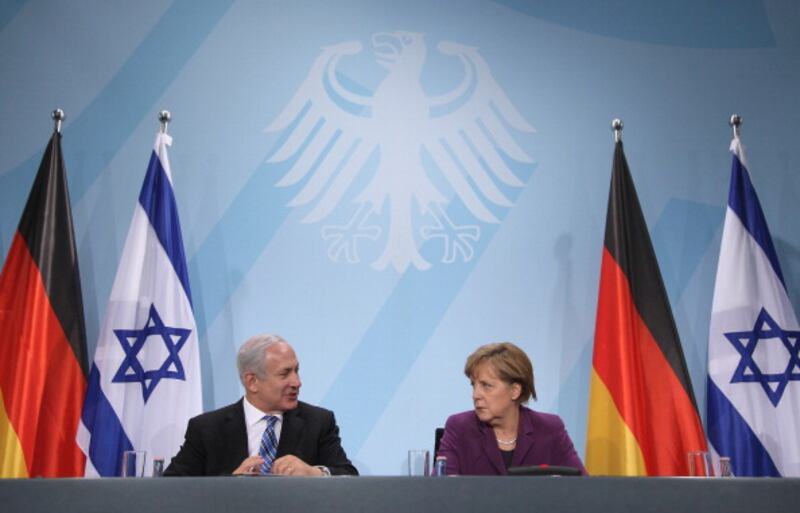
Sean Gallup / Getty Images
Get the Beast Digest newsletter delivered straight to your inbox
By clicking “SIGN UP” you agree to our Terms of Use and Privacy Policy.
The diplomatic speak being used to describe the nature of the gathering that will take place this evening, when Benjamin Netanyahu arrives in Berlin for talks with German chancellor Angela Merkel, is “open talks between friends.” But in reality, the discussions—which are expected to start with dinner tonight and lead to more detailed talks tomorrow—are likely to be harsh rather than hearty.The German foreign ministry has talked of wanting to “create a positive atmosphere appropriate to the close partnership of our countries.” But after Germany's decision earlier this week to abstain from voting on enhancing the Palestinians' status in the U.N. General Assembly, followed by the Israeli decision to build 3000 new settler homes in East Jerusalem and the West Bank, relations between the two countries have reached a historic low.
Israel's ambassador to Germany, Yakov Hadas-Handelsmann, expressed his surprise about Germany's U.N. abstention. By all accounts, the Israeli government had believed Germany would join Israel, the U.S. and Canada, along with six other countries, in voting against the decision.In Berlin, it is widely believed that Daniel Barenboim, the esteemed pianist and conductor and the only person in the world to hold both Israeli and Palestinian passports, was instrumental in steering German officials to abstain. Although there is no official confirmation of the rumors, it is believed Barenboim's intervention helped Merkel reach the decision she would not pander to Netanyahu's wishes.
That decision has been described by Netanyahu as “a lack of consistency” in Germany's behavior towards the Middle East peace process. It also marked something of a break in the tradition that Germany would always offer Israel its undying support, in recognition of its ongoing historical responsibility towards Israel as an act of expiation for the Holocaust.
But from Berlin's perspective, Netanyahu's right-wing government has squandered any chance of unconditional support he might expect to receive from Germany's center-right coalition because of what Berlin perceives as his utter lack of willingness to move the peace process forward.
And, say commentators in Berlin, it is not as if Merkel did not warn Netanyahu that she would only vote 'no' if Israel declared its willingness to freeze its settlement policy.
Both the chancellery and the foreign ministry were suspicious that Israel would do precisely the opposite and its suspicion proved right. While Germany did not withdraw its ambassador from Jerusalem, unusually sharp words were nevertheless issued from the chancellery.
“Israel (by doing this) has undermined the trust in its willingness to negotiate,” government spokesman Steffen Seibert said of the settlement plans, adding that they led to the “further shrinking of the geographical space for a future Palestinian state which has to be the basic requirement for a two state solution.”
For her part, Merkel faces a dilemma. While she will want to make clear to Netanyahu that she thinks his settlement policies are fundamentally flawed, she will not want there to be any doubt about Germany's awareness of its special responsibility towards Israel, which she has been even keener to stress than her predecessors. Just a week ago, at the presentation of the Heinz Galinski prize, she repeated her belief that “the security of Israel is part of the 'reason of state' of the Federal Republic of Germany. We are not neutral,” she said. She repeated the sentiment in her weekly video message to the nation, saying, “Germany will always stand at Israel's side.”
But she has also made clear that she will not allow Germany to be emotionally blackmailed into supporting Israel at any cost.
For its part, Israel knows precisely what German support means, translating in real terms into the delivery of valuable armaments to Israel, such as dolphin-class torpedo and cruise missile-armed submarines that have been developed by Germany especially for the Israeli Navy. A total of six of them are due to be delivered to Israel by 2017. But part of the German dilemma is that these very weapons and other weapons systems that were reported this week to be in the planning, might be deployed in a conflict between Palestinians and Israeli security forces. While Germany's elite remains determined to continue to give Israel its support, public resentment towards such unquestioning solidarity is on the rise.
See more of our coverage in your search results.

Got a tip? Send it to The Daily Beast here.
Unlock a year of full access to The Daily Beast for $35.
Monthly
$1
First month then $5.99/month
Annual
$35
First year then $59.99/year
Premium
$79
First year then $119.99/year
*Substack access provided by the next business day, using your subscription email. Choosing the Premium plan constitutes your permission to share your subscription email with Substack and your agreement to Substack’s Privacy Policy.
Looks like you already have a subscription!
- Account (completed)
- Payment (completed)
- Confirmation (completed)
You're all set!
Thanks for subscribing.
- 1Account
- 2Payment
- 3Confirmation
Sign in or create an account
Register below to read this article for free or subscribe
to unlock unlimited access to The Daily Beast.
Monthly
$1
First month then $5.99/month
Annual
$35
First year then $59.99/year
Premium
$79
First year then $119.99/year
*Substack access provided by the next business day, using your subscription email. Choosing the Premium plan constitutes your permission to share your subscription email with Substack and your agreement to Substack’s Privacy Policy.
Already have an account? Sign In
Looks like you already have a subscription!
- Account (completed)
- Payment (completed)
- Confirmation (completed)
You're all set!
Thanks for subscribing.
- 1Account
- 2Payment
- 3Confirmation