A growing number of Americans are rolling up their sleeves and selling their blood to stay afloat as President Trump’s economy tightens purse strings.
Across the country, plasma centers are reporting steady traffic from middle-class workers who say rising costs and weakened job prospects have pushed them to trade their plasma for cash. An estimated 200,000 people a day sell their plasma across the country as part of a multibillion-dollar industry that buys the blood component so it can be used in medical treatments.

NBC News reported that Ian Pleasant, 43, from Holmes, Pennsylvania, arrived at a plasma center looking for extra money for toilet paper and pet food. He left with $65 on a prepaid debit card.
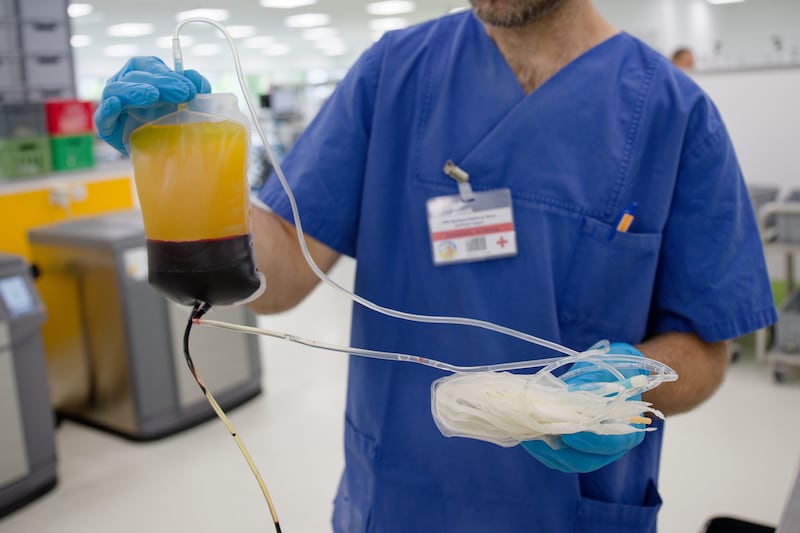
“I’m making enough money now doing DoorDash to keep up with the bills, but for anything else in the house, this is going to help out,” he said while waiting for an employee to insert a thick needle into his arm.
Last year, Americans made an estimated $4.7 billion selling about 62.5 million liters of plasma, a more than 30 percent increase since 2022, according to Peter Jaworski, a professor at Georgetown University who studies the ethics and economics of the plasma business.
The transactions take place in more than 1,200 plasma centers—now more numerous than Costco stores—with new locations opening in suburban strip malls and college towns.
Despite data showing a relatively stable economy, many donors say the past year has forced new calculations.
“I’m angry that I’m working this much, that I’m educated, that I’m articulate, that I have marketable skills, and that I’m reduced to selling my plasma,” said Jill Chamberlain from Phoenix, Arizona. After being laid off from a job overseeing the finances of a local business in 2024, she went from making $87,000 a year to $16.11 an hour.
“I was ashamed at first, but now I’m angry. This is not how things are supposed to be,” she said.
“We always heard the middle class was disappearing,” she said. “But really, really quickly, the rich are getting richer and the rest of us are sinking.”
In Fresno, California, Erin Ragnetti began selling plasma to cover debt and bills. “Because the economy is what it is right now, everything’s just so much more expensive,” she said. “I realized, if we’re going to make ends meet, I’ve got to find a way to make more money.”

In suburban Minneapolis, Michelle Eagan drives 35 minutes twice a week to sell plasma to cover her son’s $700-a-month preschool tuition. After leaving a $75,000-a-year paralegal job to care for him full time, her husband’s $90,000 salary has not been enough, and their credit card balances have risen.
Lax regulations allow people to donate twice weekly. The U.S. now supplies 70 percent of the world’s plasma, shipping $6.2 billion worth overseas in 2024. Many centers are run by just a handful of biopharmaceutical companies.
“It’s like a drug dealer—once they have you in there, they have to keep you coming back,” Eagan said.
There is little research on the long-term health effects, though some studies show regular donors experience decreases in certain proteins and antibodies. The health consequences remain unclear.