Muammar Gaddafi Short on Money and Fuel in Libya Civil War
Daniel Stone writes that sources say the embattled Gaddafi is showing new signs of strain and desperation.

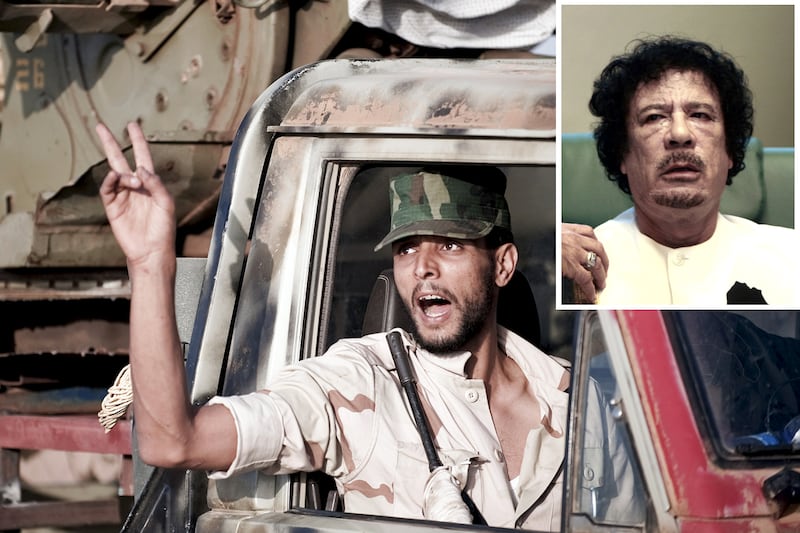
Gianluigi Guercia / AFP-Getty Images (inset); Amr Nabil / AP Photos
Get the Beast Digest newsletter delivered straight to your inbox
By clicking “SIGN UP” you agree to our Terms of Use and Privacy Policy.
Muammar Gaddafi and his forces have lost several recent battles in the Libyan civil war. Now it appears his grip is loosening even faster.
As a NATO coalition continues to provide military and humanitarian aid to Libyan rebels, top commanders are seeing new signs that the embattled leader is quickly running out of fuel and money, according to three U.S. intelligence officials.
Gaddafi’s hold on power since the war began has been in limbo, with fighting resulting in an extended stalemate. But stockpiles of oil that Gaddafi has used to fund and power his army of loyalists have dropped dramatically over the past month, leaving NATO leaders to believe his hand is increasingly weakening.
In late June, Libyan rebels cut off one of Gaddafi’s largest and most lucrative oil pipelines that runs from the Awbari oilfield to the Azzawiya refinery. Since then, Gaddafi’s oil reserves have fallen between a third and a half, say officials. The regime’s remaining reserves in the smaller oil town of Brega, which rebels have repeatedly tried to take, have not been able to compensate the loss.
“He’s not going to run out of fuel tomorrow, but over the next month or two he’ll have to make tough decisions about how to continue,” says one U.S. official familiar with the intelligence in the region who, like others in this story, spoke on the condition of anonymity.
NATO leaders have begun to discuss contingency plans for when Gaddafi’s oil runs out and what impact it might have on Tripoli, which has remained relatively untouched by the war because of Gaddafi’s stronghold on the capital city. U.S. intelligence has gathered reporting of unrest in Tripoli over reduced access to fuel. A continued loss of supply could cause further instability that could aid rebel forces, who have tried several times to approach Tripoli.
Opposition fighters, who have had communication and transportation problems over months of fighting, received a considerable boost on Friday when U.S. Secretary of State Hillary Clinton recognized the rebel leadership as the country’s official government, opening up access to some of Gaddafi’s frozen assets.
"The United States views the Gaddafi regime as no longer having any legitimate authority in Libya," Clinton said at a conference in Istanbul, where more than 30 other countries supported a plan for the rebel leaders in the Transitional National Council to lead the transition to a new democratic government. "Until an interim authority is in place, the United States will recognize the TNC as the legitimate governing authority for Libya, and we will deal with it on that basis.”
While trying to protect areas around Tripoli from Gaddafi’s forces, leaders are preparing for an unwelcome reception if they advance into Gaddafi’s city. A Russian newspaper quoted Kremlin envoy Mikhail Margelov saying that “The Libyan premier told me if the rebels seize the city, [Gaddafi’s forces] will cover it with missiles and blow it up.”
Rebel and NATO forces have also been encouraged by Gaddafi’s increasing economic isolation, as international sanctions continue to squeeze his regime’s finances. The latest, the freezing of Gaddafi’s assets by a prominent Turkish bank that had underwritten $2 billion in letters of credit and guarantees in 2010, appeared to rattle the dictator, according to U.S. surveying in the region.
Gaddafi and his inner circle have shown signs of desperation. French diplomatic officials said earlier this month that the Libyan leader had sent emissaries to discuss a plan for his departure, suggesting the regime prefers to negotiate a favorable settlement than continue a protracted civil war.
One reason appears to be his fighting force, which U.S. officials say is showing new signs of strain and some resentment. “His commanders aren’t happy, there’s really very little organization and strategy that they have to work with,” says the official.
Gaddafi’s resilience has made NATO and U.S. military analysts reticent to project when he may finally step down or be driven from power. But one who spoke said it’s clear the pendulum is continuing to swing away from Gaddafi at a faster pace. “His options are very limited, and becoming increasingly more so.”
See more of our coverage in your search results.

Got a tip? Send it to The Daily Beast here.
Unlock a year of full access to The Daily Beast for $35.
Monthly
$1
First month then $5.99/month
Annual
$35
First year then $59.99/year
Premium
$79
First year then $119.99/year
*Substack access provided by the next business day, using your subscription email. Choosing the Premium plan constitutes your permission to share your subscription email with Substack and your agreement to Substack’s Privacy Policy.
Looks like you already have a subscription!
- Account (completed)
- Payment (completed)
- Confirmation (completed)
You're all set!
Thanks for subscribing.
- 1Account
- 2Payment
- 3Confirmation
Sign in or create an account
Register below to read this article for free or subscribe
to unlock unlimited access to The Daily Beast.
Monthly
$1
First month then $5.99/month
Annual
$35
First year then $59.99/year
Premium
$79
First year then $119.99/year
*Substack access provided by the next business day, using your subscription email. Choosing the Premium plan constitutes your permission to share your subscription email with Substack and your agreement to Substack’s Privacy Policy.
Already have an account? Sign In
Looks like you already have a subscription!
- Account (completed)
- Payment (completed)
- Confirmation (completed)
You're all set!
Thanks for subscribing.
- 1Account
- 2Payment
- 3Confirmation