Werner Herzog’s cinematic life has been one of audacious exploration. Famed for both his fiction features (Aguirre the Wrath of God, Cobra Verde, Rescue Dawn) and documentaries (Grizzly Man, Lessons of Darkness, Little Dieter Needs to Fly), the German auteur has for more than sixty years sought knowledge, epiphanies, mysteries, and an elusive “ecstatic truth” that’s somehow realer than real.
He’s a mad philosopher-adventurer who marches to the beat of his own offbeat drum, eager to discover the secrets of the world and those who inhabit it, and yet as enraptured by the journey as he is the destination.
And with Bucking Fastard, he crafts perhaps the most beguiling—and downright bizarre—film of his career.

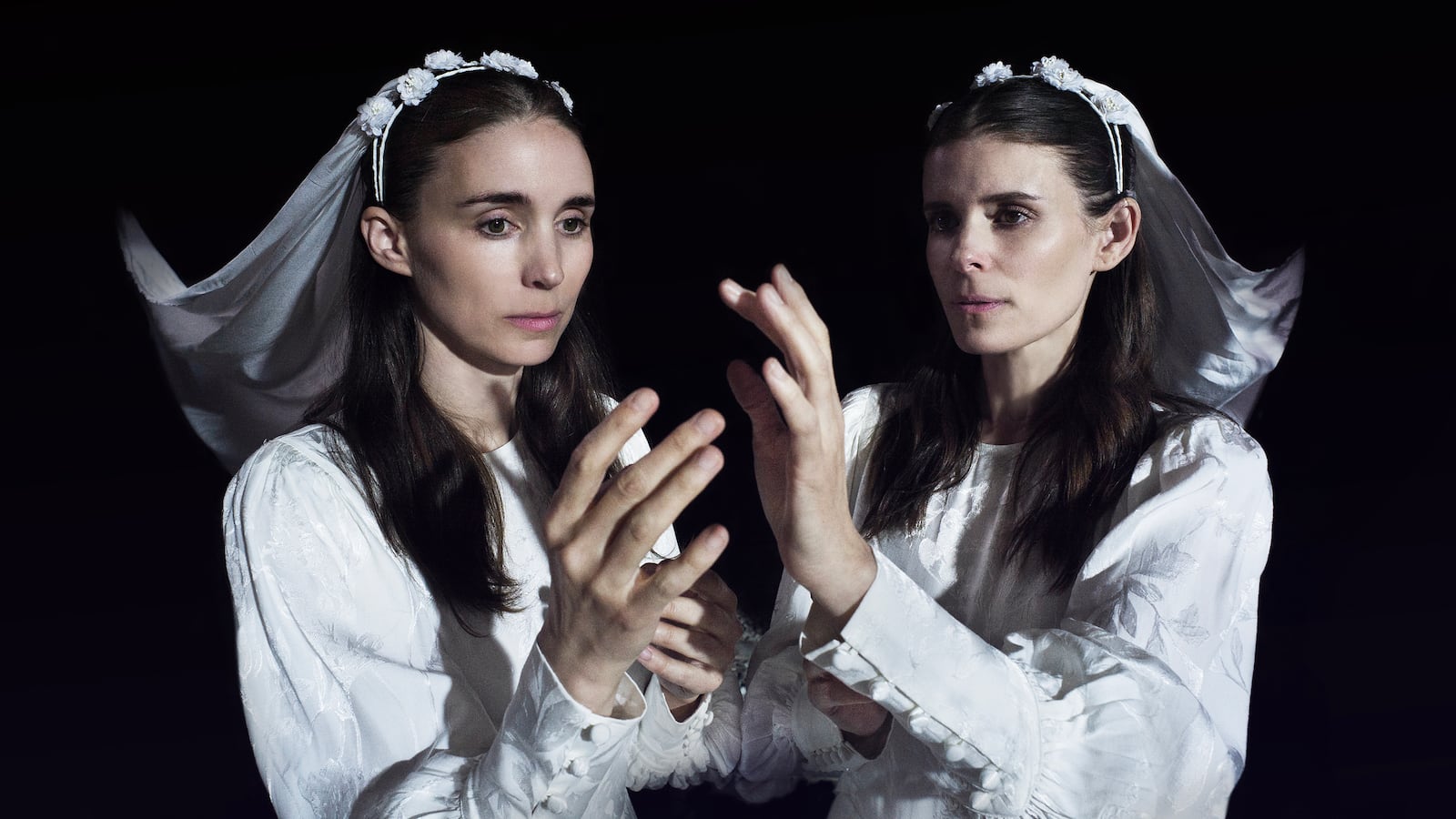
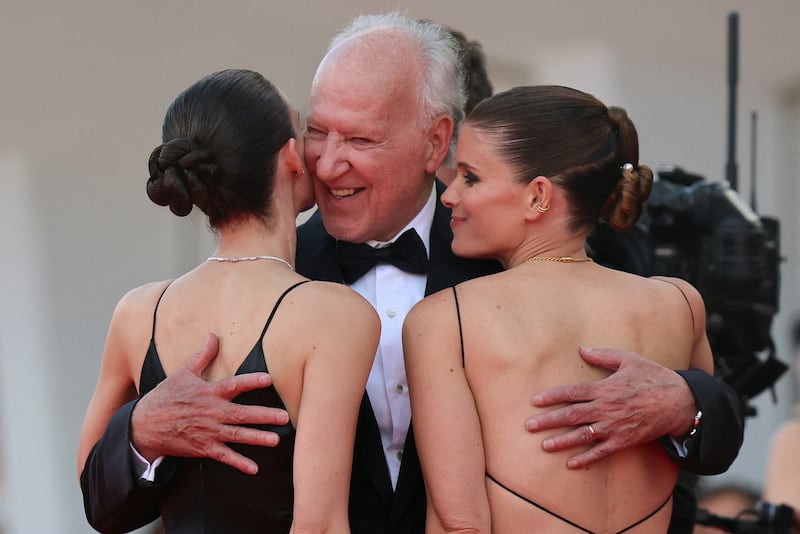
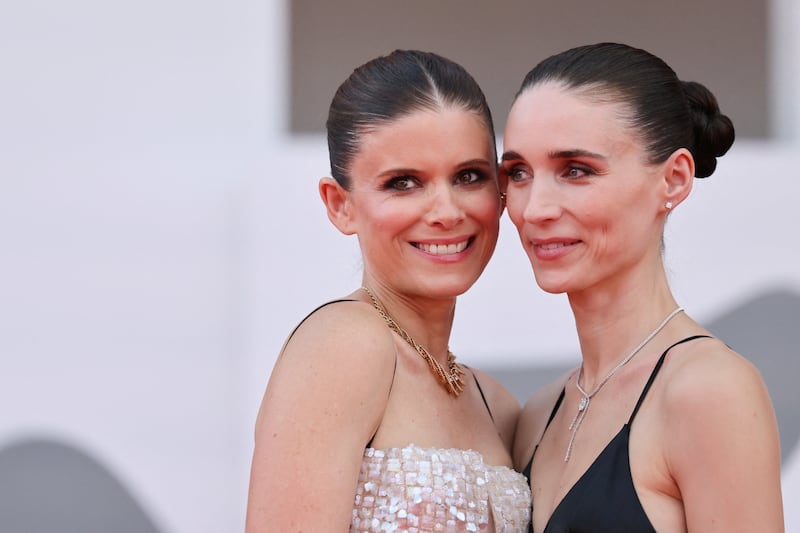
Screening at the Toronto International Film Festival on September 14, the 84-year-old Herzog’s bonkers drama is the story of two sisters, Jean and Joan Holbrooke—played by real-life sisters Kate and Rooney Mara—who dress, gesture, emote, and speak in perfect harmony. They’re mirror images of each other and, in some strange and unfathomable way, also two halves of a whole, and as befitting a venture indebted to the modern master of surrealism, the late David Lynch, no explanation is given for their condition. Curiously and uncannily, they simply are.
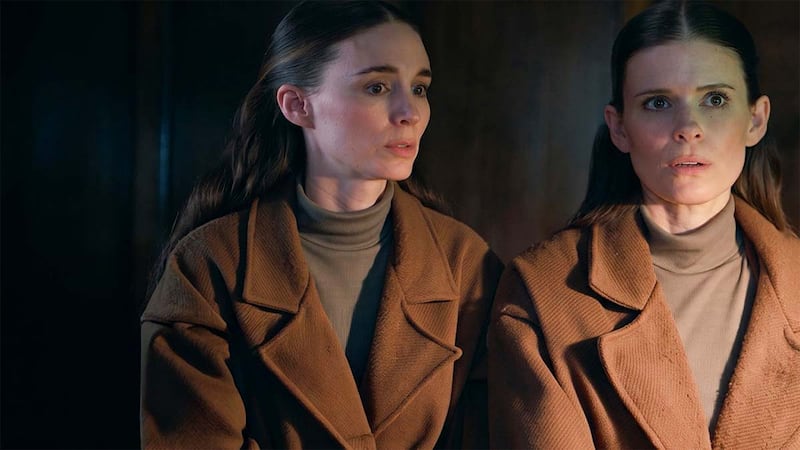
Wearing a series of modest outfits (long-sleeved sweaters and frilly dresses, ankle-length skirts, headscarves, trench coats) that seem to be from a different era—and amplify the sense that they’re out of time—Jean and Joan appear in court at the outset of Bucking Fastard.
The reason for their judicial hearing is Gareth Mulroney (Orlando Bloom), a boozy hunk who enchanted the sisters and enjoyed torrid afternoons with them in the shed adjoining their properties. Their tryst is laid out through testimony and flashbacks, and though it began woozily for Jean and Joan, it took a nosedive when Gareth announced he was engaged to another woman and earned their wrath, prompting him to petition for a restraining order.

The initial sight and sound of Jean and Joan talking as one is at once odd and disarming, especially when they verbally hesitate or repeat themselves. Their attempts to take revenge on their beloved Gareth help plant the action in distinctly humorous territory.
Nonetheless, Bucking Fastard is also intensely, confoundingly weird. An opening sequence that likens Jean and Joan to caged birds gives a hint of Herzog’s interest in (and design for) his peculiar premise. However, the ensuing film is doggedly evasive, carving out a narrative path as if in a trance, with no overt rhyme or reason for why anything is happening or why anyone is doing what they’re doing.
From the way the camera gazes at their echoing faces and bodies, there’s a distinct early impression that Herzog is just entranced by Kate and Rooney Mara operating in unison. He has cause to be fascinated, since the actresses’ performances (or is it a single performance?) are exceptionally eerie; it’s as if their physical forms are conduits for some unseen unearthly force. Eerier still, they have the disposition of adolescent girls, as evidenced by their over-the-top lovestruck fixation on Gareth and, later, their tee-heeing at jokes, playful frolicking, and—in one particularly funny instance—juvenile striptease pantomime.
In the aftermath of their legal trouble, Jean and Joan relocate to an apartment provided by a kind widower where they’re stalked by a predatory creep who’s snapping nude photos of them and posting them online; menaced by a dim-witted forklift driver who covets their lovely brown hair; and coached by a state representative and recovering addict named Timothy (Domhnall Gleeson) to be more independent.

This leads to a host of amusing bits (the finest involving the women trying to open a can of sardines), and is followed by their move to their aunt’s countryside home. There, they protect a fox from government officials determined to quell a rabies outbreak. And in the surrounding mountain range, they become transfixed by ancient caves and, upon hearing a local legend, decide to complete an unfinished tunnel they think will bring them to the Orkneys—which they envision as “like Atlantis. Somewhere that only exists in our dreams.”
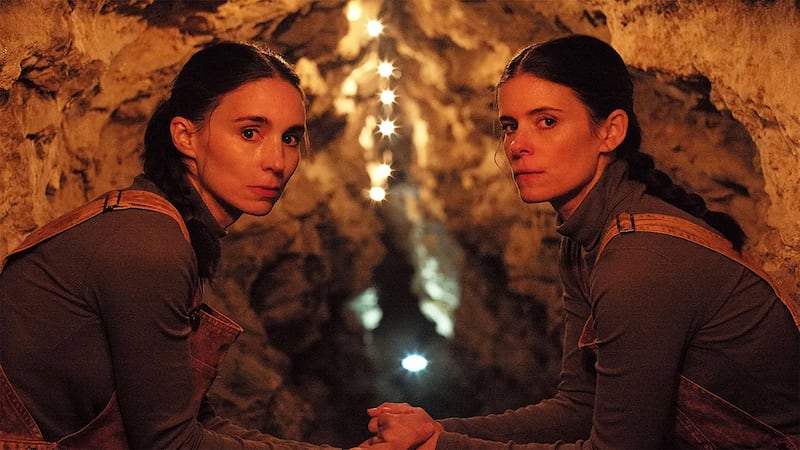
“Everybody should dig a tunnel through a mountain,” state Jean and Joan, and given that Herzog famously hauled a steamship over a mountain in his 1982 masterpiece Fitzcarraldo, the proclamation is more than a tad tongue-in-cheek.
Regardless of its flights of wacko fantasy, though, there’s something deeply sincere about Bucking Fastard. The writer/director doesn’t treat his protagonists or their story as a joke; instead, he considers them with a mixture of affection and awe and casts their saga as a reverie that, on more than one occasion, vaguely resembles a Goldilocks and the Three Bears-style fairy tale.

Bucking Fastard encourages several potential readings, but Herzog avoids sticking with any long enough to pin down his intentions. There’s a mischievous evasiveness to his latest, which proves a mesmerizing trip down the rabbit hole—or, to be more precise, an ancient cavern that recalls Herzog’s Cave of Forgotten Dreams and which even Jean and Joan at first think is a figment of their imagination.
Where their journey takes them is as unpredictable as the rest of the proceedings, and to the end, Jean and Joan remain spectral puzzle boxes who, whether they’re speaking at the same time or alternating words in shared sentences, are never solved.
Bucking Fastard is deliberately slippery and weightless, such that it would be easy to dismiss it as purely a Lynchian lark driven by the kookiness of its lead turns. Yet as Jean and Joan strive to reach some mystical Shangri-La where they might fit in and—despite being habitually tethered to each other—feel less alone, the film increasingly resonates as an oblique expression of its maker’s belief in the primacy, and majesty, of The Search.
What Herzog is seeking is ultimately open to interpretation; concrete answers are of no concern to this arcane whatsit. Of far greater importance, however, is the act of exploration itself, and the quest upon which he embarks in Bucking Fastard is in perfect accord with the many prior cinematic expeditions that have defined his incomparable canon.