There are a million and one ways for a horror movie to terrify—and after more than a century, the genre continues to thrive precisely because creative artists keep devising new methods of staging murder and mayhem.
Add River to that esteemed list, as Joshua Giuliano’s feature debut distinguishes its psycho-killer premise with an inventive form that exploits what’s seen and heard (and what’s not) to frightening effect. Like this summer’s nightmarish breakouts (Obsession, Backrooms, Hokum) and also 2024’s kindred spirit In a Violent Nature, it elevates a tried-and-true formula through clever artistry—as well as a memorable fiend, a handful of gruesome slayings, and penetrating performances from Don’t Breathe’s Jane Levy and Happy Death Day’s Jessica Rothe, two formidable and riveting screen queens.

Premiering in the Midnight Madness section of this year’s Toronto International Film Festival, River establishes its fascination with image and sound from the outset. As Giuliano’s camera glides in and around an abandoned Ford Mustang in the middle of the woods, the voices of the young man and woman who drove it to this remote spot are heard talking on the soundtrack, their chitchat, beer-drinking, and fooling around juxtaposed with what resembles a fresh crime scene.
The disconnect between video and audio is paralleled by the divide between the past and the present, and it’s not until the very end of this bravura sequence that the dissonance is (temporarily) resolved with jarring impact.
There’s a maniac on the loose in River, although he’s not on the radar of Lucy (Levy), who’s at her childhood home with her layabout younger brother Drew (Max Mattern), waiting for the arrival of older sister Carla (Rothe), who skipped town years earlier. From the moment they lock eyes, tensions run high between Lucy and Carla, and repeated references to their recently departed father—whose empty beer cans still litter his motorboat—indicate that he’s the source of their rupture.
Their first testy evening together only heightens their estrangement, and their sniping persists the following day when all three take the boat to the river they used to frequent with their dad to say goodbye to him and spread his ashes.
The makeshift ceremony Lucy leads does not, predictably, go as planned, reopening old wounds about their dad and mom, about whom Lucy and Carla have differing and contentious opinions. A more pressing concern, however, becomes their boat’s lack of gas—the byproduct of Carla driving over something that dislodged their fuel line. A deep-focus shot of the craft suggests a torso may have been the struck object, but as is frequently the case, River tantalizes through quick, obscured glimpses of horrors and the monsters perpetrating them.
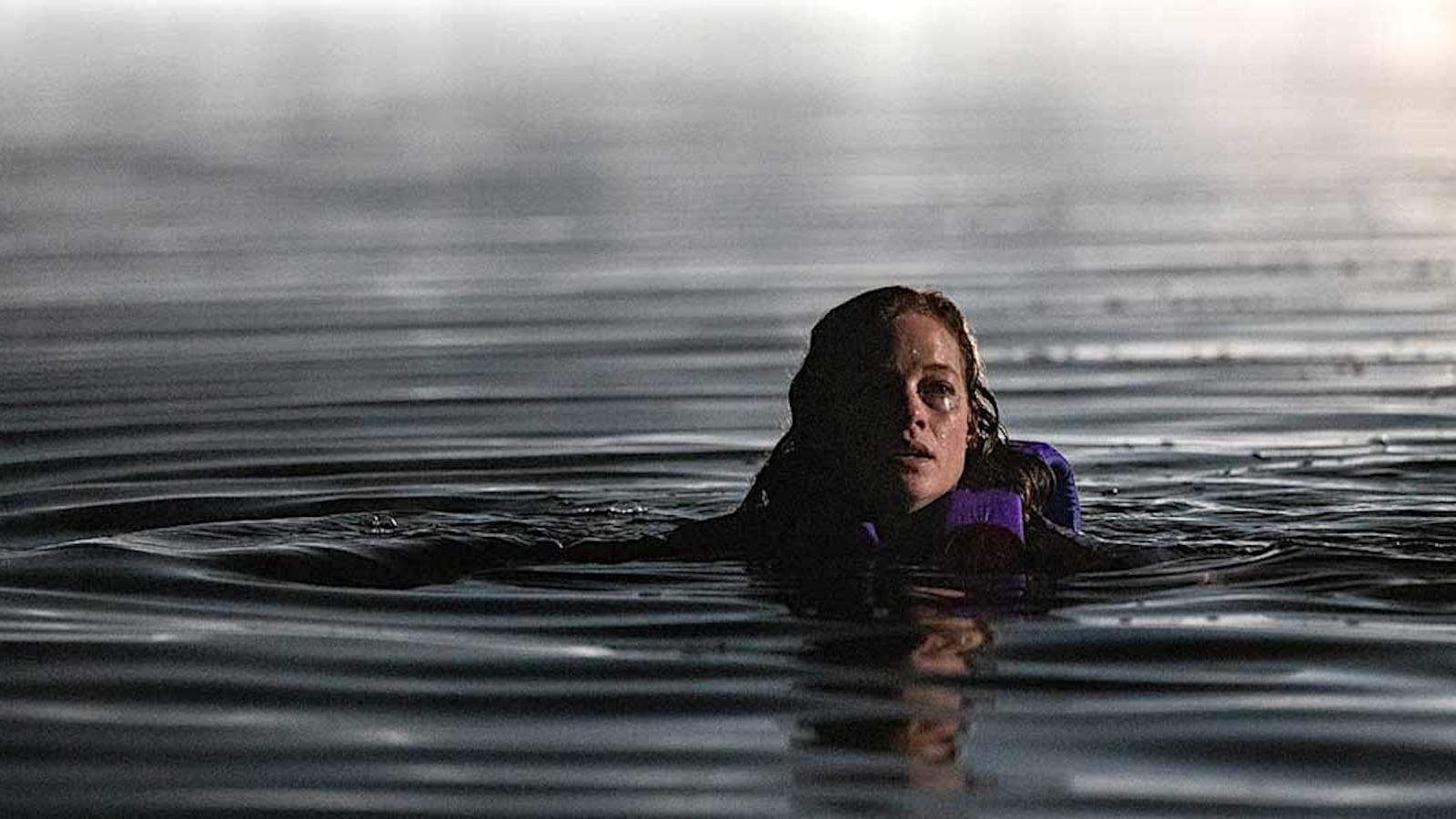
That’s not to say, however, that the thriller is a tease. Stranded in the middle of the water, Carla decides to swim to land to get help. Her journey is abruptly halted by a startling sight, and in what becomes the film’s trademark, Giuliano and cinematographer Nick Matthews prioritize Rothe’s stunned, alarmed reaction over its off-screen cause.
Coupled with sound design that spotlights her harried breathing, this focus creates both intense engagement with Carla’s emotional state and anxious anticipation to learn what’s produced her petrified expression—which, it turns out, is a kneeling man on the shore, his torso covered in blood and his visage hidden behind a lifeless and creepy human-face mask.
When this stranger suddenly leaps into the water to pursue Carla, any doubt about his intentions is dashed. Mercifully for Carla, this initial encounter doesn’t end in carnage. Yet River doesn’t waste time cranking up the craziness, starting with a pale, blood-soaked woman emerging from the tree line, where her anguished screams are brutally cut short. Worse, the killer then celebrates by raising his crimson-stained hands toward the sky in unison with a similarly masked woman on the opposite shore—confirmation for Lucy, Carla, and Drew that they’re now in a world of hellish trouble.

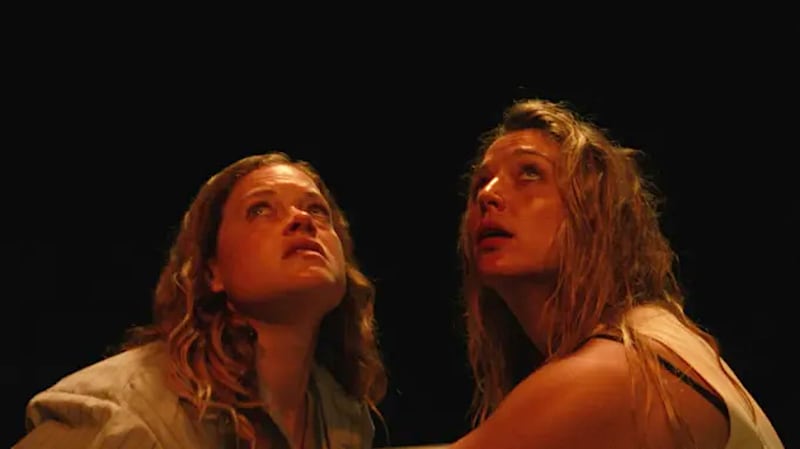
While River’s set-up is conventional, its execution is anything but, with Giuliano repeatedly disengaging his visuals and his dialogue—highlighted by a subsequent Lucy scream that doesn’t make a sound—and fixating on his protagonists’ countenances as they gawk and gasp at the unthinkable (and inescapable) insanity unfolding before them. Fortunately for the writer/director, Levy and Rothe are two excellent actresses who can convey a depth of fear and panic that burrows beneath the skin.
Lucy and Carla’s prickly dynamic provides a sturdy foundation for the butchery to come and helps underscore the tale’s portrait of paternal malevolence and its lingering, corrosive impact. It’s the leads’ powerfully communicative faces, though, that resonate most strongly, even once their pursuer’s mug begins receiving its own close-ups.
Giuliano’s compositions are as imaginative as his set pieces, such as a long pan down a rope tied to a bridge that ends with a charred corpse that perfectly frames an oncoming boat. Still, the director never allows himself to be the center of attention. Economical scripting and nerve-wracking momentum combine to make River a fleet and ferocious creature, and its revelations about its baddies—they appear to be homicidal cultists with their own code and rituals—are intriguing precisely because they’re left vague. Recognizing that telling too much is a surefire way to lessen suspense, the director merely hints at his villains’ backstory, thereby rendering them infinitely more compelling.
Bad dads are a cancer in River, and yet the film shrewdly avoids getting bogged down in hackneyed trauma terrain; its themes take a back seat to its go-for-broke innocents-versus-lunatics action.
In its surprising final act, the proceedings take a turn for the ruthlessly grim, amplifying the sense that all bets are off and everyone’s neck is on the (literal) chopping block. Thanks to the nimble, magnetic Levy and Rothe, Lucy and Carla are characters worth rooting for, and one’s empathy for them is key to selling the material’s stakes.
It’s no shock that pairing two seasoned horror vets with another of 2026’s talented neophyte genre directors is a recipe for success. Nonetheless, River is ultimately even more than the sum of its parts—including the multiple appendages that, during the course of its saga, wind up severed from their owners.