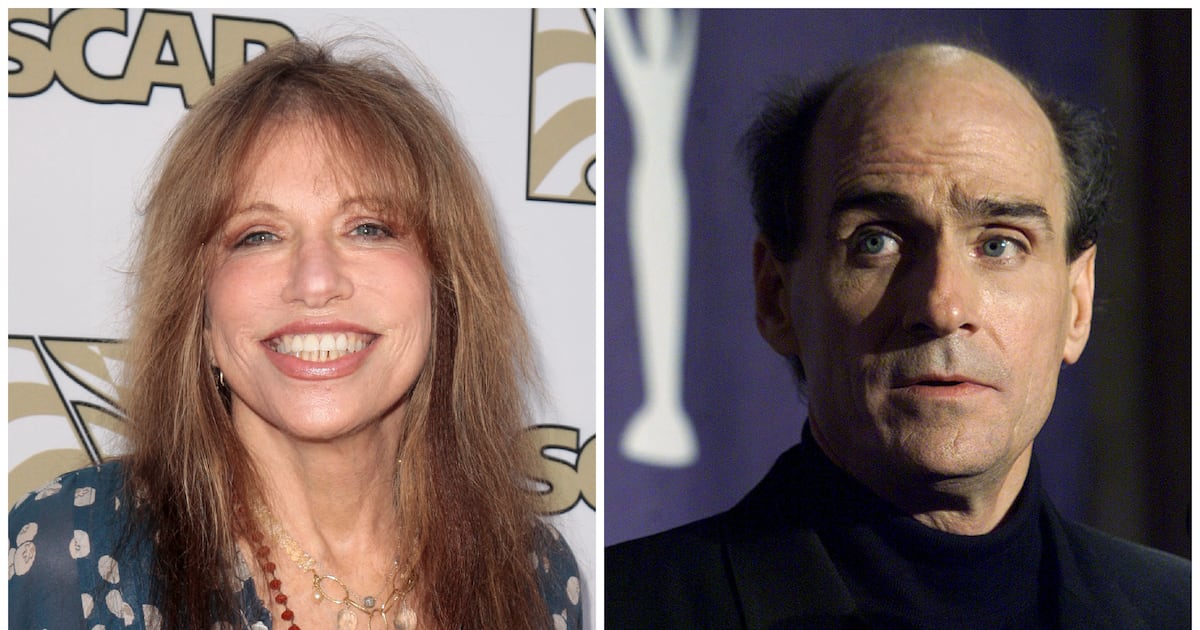

‘70s legend Carly Simon, 83, got real about her marriage to James Taylor, 78, in a brutally honest new song, “Maybe I Never Loved You.”
The track is second on her first original album in 18 years, Comes in Waves, which drops August 14. Though she never mentions Taylor—to whom she was married from 1972-83—by name, sources suspect he’s the mystery man Simon’s lyrics tear into.
“Maybe I never loved you / But anyway, I thought I did,” Simon sings. “I married you, we had a kid / That counts for something.”
She continues, describing the relationship’s complex emotional dynamics, “Maybe I never loved you / Yes, and maybe I did. / And maybe you never loved me / Although God knows, you said you did.”

But the song isn’t only negative. Simon also expresses gratitude for their mutual support and regret for the relationship’s downward spiral.
“You came for me those times I hid / I’m so glad you did that,” she sings. “And maybe it’s wrong to wonder how everything kind became forbidden.”
Simon and Taylor were the folk-rock power couple of the 1970s. Despite an increasingly turbulent relationship, the superstars collaborated on an array of projects, including the song “Mockingbird,” which reached No. 5 on the Billboard Hot 100 in March 1974.
After having two kids, Ben and Sally, the pair split. Both parties had affairs—Simon had a six-month dalliance with John Travolta—and Taylor’s heroin addiction strained things further. They haven’t spoken in over a decade, Simon told People in 2015.

“Our relationship is far from the idyllic one that the general public reads about,” she wrote in her diary in 1977, six years before their divorce.
Simon will release her new album just two weeks after opening up about her concurrent skin cancer diagnosis and Parkinson’s diagnosis, which she called “frustrating, and sometimes frightening” on Instagram. She wrote that music has helped her cope with her health issues.
“Working on the music gave shape to days that did not always have much shape,” she wrote in July. “It gave me somewhere to go without having to leave the room. It reminded me that illness can change your life without becoming the whole of your life.”