
The Epstein Files have shown the world that rich and powerful men will often use their privileged positions to abuse children. Yet as demonstrated by Dateline NBC’s To Catch a Predator series—the subject of last year’s documentary Predators and this September’s Robert Pattinson-headlined drama Primetime—the scourge of pedophilia also exists in everyday society.
It’s in that nondescript domestic arena that Gentle Monster locates the shock, horror, and trauma wrought by this heinous crime. A harrowing portrait of the human toll of such depravity, it’s as timely as it is heart-wrenching.
Screening at the Toronto International Film Festival on Sept. 15 following its Cannes Film Festival premiere (and ahead of its Oct. 30 debut in theaters and Nov. 18 bow on Netflix), Austrian writer/director Marie Kreutzer’s film approaches its hot-button topic from a ground-level female perspective.
Lucy (Léa Seydoux) is a concert pianist who covers songs written by men; “I take their words and question them,” she explains. While her introductory rendition of Charles & Eddie’s “Would I Lie to You?” is piercingly relevant, it’s not her chosen artists who need investigating but, rather, her husband Philip (Laurence Rupp).

A documentary filmmaker, Philip has relocated with Lucy and their young son Johnny (Malo Blanchet) from Munich to the countryside. And as suggested by a fragmentary glimpse of Lucy soothing Philip during a severe breakdown, the reason for this move is a fresh start.
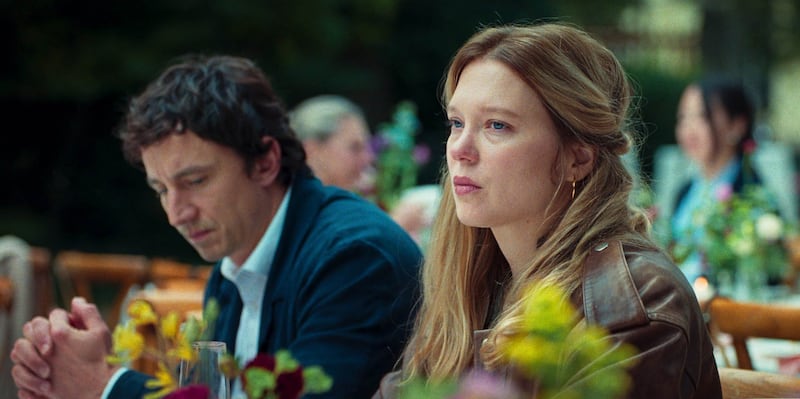
Early snippets around their rustic home, with Philip and Lucy building a trampoline for Johnny and making love on a floor mattress, reveal them as a happy, close-knit clan. Blissful tranquility, alas, is short-lived, as they’re unexpectedly visited by Elsa Kühn (Jella Haase), a police officer who confiscates all of Philip’s digital devices and hard drives.
This upsets Philip and baffles Lucy, whose immediate reaction is to ask her husband if he “hacked the banks.” If only. Visiting Philip at the police station, Lucy is directed to the second floor, and in the elevator, she learns that the unit located there handles sex crimes against children.
Seydoux’s face, upon making this discovery, shows a mix of gut-punch surprise and dread, and the actress’ performance remains a case study in silently projecting interior thoughts as Lucy tries to get answers.
Unfortunately, Kühn is prevented from disclosing information about the case, and Philip’s lawyer friend Lukas (Nils Strunk) isn’t much more forthcoming. Thus, in the absence of details, Lucy retreats to the home of her classical pianist mother Eloise (Catherine Deneuve), although that provides scant solace, as Eloise is a cold fish who—without knowing what’s going on—subtly critiques her daughter by saying that the sole thing worse for a female artist than having a child is moving to the countryside.

Equally comfortable in projects in her native France (Blue is the Warmest Color, The Beast) and in Hollywood (Spectre, The Grand Budapest Hotel, Dune: Part II), Seydoux is marvelous in Gentle Monster, her mesmerizing turn at once roiled and coiled. Doing as much with her eyes as with her words, the headliner beautifully captures Lucy’s revulsion and confusion, the latter begat by her enduring love for her spouse.
Looming over all of it, meanwhile, is the instinctive and unshakeable fear that Johnny was victimized by his father. Despite hearing from Kühn and a child psychologist that there are no indications that Philip physically assaulted anyone or that Johnny was raped, the possibility that either (or both) occurred functions as a veritable Sword of Damocles hanging over her head.
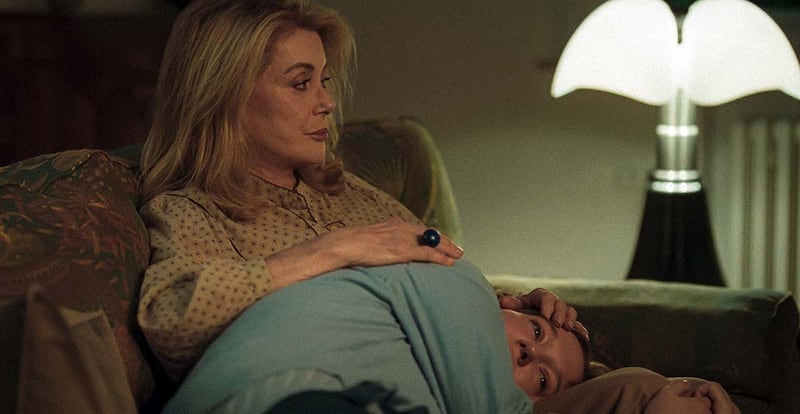
Stripping away the sensationalistic aspects of pedophilia, Gentle Monster assumes Lucy’s down-to-Earth POV, and in telling snapshots—such as Lucy stripping the sheets off the bed she shared with Philip—the film attunes itself to its protagonist’s tortured frame of mind. Complicating matters is Philip’s initial claim that he acquired this illegal material for a documentary project, and Lucy, desperate for a way out of this nightmare, ferociously clings to that glimmer of hope.

Nonetheless, such optimism is fleeting. Through Lucy’s ordeal, Kreutzer’s tale repeatedly illustrates how men obfuscate their misdeeds and blame the women in their lives who are left to suffer the consequences of their partners’ actions.
In a subplot about Kühn’s struggles with a faltering elderly father who repeatedly sexually mistreats his live-in caregiver, Gentle Monster offers a second, intertwined example of crimes perpetrated by men against both women and children. The police officer’s predicament, which renders her a kindred spirit to Lucy, is a tad on the nose for a film that’s otherwise restrained and realistic. Even so, Haase’s visage is almost as expressive as Seydoux’s, and their scenes together are infused with a complicated mix of desperation, compassion, agony, and denial.

Lucy’s crisis slowly morphs into a quest for the truth, since there’s no hope of moving on without understanding the precise nature of Philip’s conduct. Her husband, however, offers little help in this undertaking, nor do his well-off parents, whose response to the news about their son is as understandable as it is dismaying.
A brief flashback to a vacation two years earlier highlights an incident that, in hindsight, takes on a sickening new dimension, and as in multiple similar instances, Kreutzer lets the implication hang in the air. Its title a reference to Philip’s online chat room handle, Gentle Monster doesn’t hammer one over the head; it disturbs by affixing itself so closely to Lucy that every subsequent revelation—for her, and us—lands with seismic force.
There are no pat conclusions or “closure” in Kreutzer’s film, only the sad reality that some things can never be fully known—perhaps for the better, as Lucy comprehends at story’s end.
The Epstein Files may have exposed ruling class members’ wicked impulses and atrocities, but the writer/director’s latest serves as a stark reminder that there are monsters everywhere—and that their offenses are a byproduct of a callous, brutal chauvinism that all too frequently wounds women.